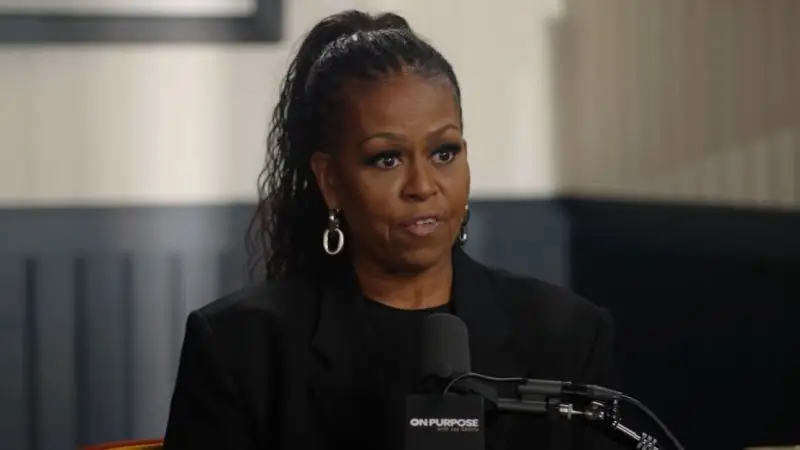
Michelle Obama has again ruled out any prospect of running for president, telling an audience in New York that Americans are “not ready for a woman” in the White House and accusing those who urge her to stand of “lying” about their readiness for female leadership. The former first lady made the remarks during a live conversation at the Brooklyn Academy of Music, where she was promoting her new book and reflecting on the aftermath of the 2024 US election.
Speaking on stage in early November alongside actor Tracee Ellis Ross, Obama was asked about recurring calls for her to launch a presidential campaign, particularly for the 2028 race. Supporters have repeatedly held up placards and posted online messages urging “Michelle 2028” at political rallies and protests across the United States and in Europe. Obama acknowledged the enthusiasm but rejected the idea that it reflects a genuine willingness to elect a woman as president.
“Well, as we saw in this past election, sadly, we ain’t ready,” she said, referring to Donald Trump’s victory over then-Vice President Kamala Harris in the 2024 presidential contest. She went on to tell the audience: “That’s why I’m like, don’t even look at me about running, because you all are lying. You’re not ready for a woman. You are not, so don’t waste my time.”
Obama linked her refusal to run to what she described as a deeper cultural problem in the United States. “We got a lot of growing up to do,” she said, arguing that “there are still, sadly, a lot of men who do not feel like they can be led by a woman.” Her comments drew sustained applause from the New York audience and were widely shared on social media, where supporters and critics debated whether her assessment of the country’s political maturity was accurate.
The appearance marked the latest in a long series of occasions on which Obama has publicly dismissed speculation that she might seek elected office. Since her husband left the White House in 2017, she has consistently insisted that she has no interest in running, even as opinion polls have often suggested that she would be a formidable candidate in a national race. In interviews, speeches and podcasts, she has repeatedly said that politics is not where she believes she can make the greatest impact.
Earlier this year, in a conversation on Kylie Kelce’s podcast, she described the idea of a presidential campaign as “unthinkable” and said that those who ask her to run “have absolutely no idea the sacrifice that your kids make when your parents are in that role.” Recalling her daughters’ childhood years in the White House, she said the experience left her determined not to subject them to a similar environment again. “So when people ask me would I ever run? The answer is no,” she told the podcast. “They’ve already served their time. It would be unthinkable. Nope.”
Obama has often framed her decision in terms of both family considerations and personal temperament. She has described politics as “tough” and “hard on a family,” saying that national campaigns expose relatives to intense scrutiny and hostility that few outside the political world truly understand. At a conference in Florida several years after leaving the White House, she said she “wouldn’t ask my children to do this again” and noted that “when you run for higher office, it’s not just you, it’s your whole family.”
Her husband, former president Barack Obama, has frequently reinforced that message. In radio and television interviews he has said that his wife “will never run for office,” describing her as a gifted and brilliant person who simply “does not have the patience or the inclination to actually be a candidate herself.” He has told audiences that there are “three things that are certain in life: death, taxes and Michelle is not running for president,” adding that this is “one thing you can take to the bank.”
Despite those statements, speculation about Michelle Obama’s political future has persisted, fuelled by her sustained popularity among Democratic voters and her high-profile presence on the campaign trail. During her husband’s presidency and in subsequent election cycles, she delivered prominent speeches supporting Democratic nominees, including a widely praised address at the 2016 party convention and appearances backing Kamala Harris in 2024. Her ability to connect with voters has led some party strategists to view her as an ideal standard-bearer in a difficult political climate.
Obama has pushed back on that narrative, arguing that admiration for her public speaking should not translate into expectations that she shoulder the burden of a presidential run. In previous remarks, she has said that people who urge her to run often do so because they “like” her, but that such affection is not a sufficient basis for entering politics. She has also stressed that there are “millions of women who are inclined and do have the passion for politics,” suggesting that the search for candidates should focus on those who actually want the job.
Her latest comments in New York added a sharper edge to that long-standing position by explicitly questioning the sincerity of those who claim to want a woman in the Oval Office. By pointing to Harris’s defeat by Trump as evidence that the country “ain’t ready,” Obama appeared to argue that voters’ behaviour at the ballot box undercuts public expressions of support for female leadership. Her remark that people were “lying” about wanting her as president underscored her frustration with recurring petitions and campaign fantasies that disregard her stated wishes.
The former first lady’s assessment comes against a backdrop of continuing debate over gender and power in American politics. Although women have made substantial gains in Congress, governorships and cabinet posts, the United States has never elected a woman president. Hillary Clinton’s 2016 defeat and Harris’s more recent loss have become touchstones in discussions about sexism, party strategy and the expectations placed on female candidates. Obama’s remarks suggest she views those electoral outcomes as part of a broader pattern rather than isolated contests.
At the Brooklyn event, Obama also spoke more broadly about the state of American democracy and the pressures facing women’s rights. Without entering into detailed partisan commentary, she suggested that recent political developments had reversed progress on issues affecting women, and that this was another reason she was pessimistic about the prospects for a female president in the near term. Commentators noted that her comments were delivered in a conversational setting focused on her new book and creative work rather than as part of a formal political speech.

Since leaving Washington, Obama has devoted much of her time to writing, media projects and philanthropic initiatives. She has published bestselling memoirs, launched a production company, hosted podcasts and worked on programmes aimed at supporting girls’ education and voter participation. In interviews she has described her post-White House life as more “freeing,” saying she relishes the ability to choose projects on her own terms and to spend time with her family without the constant surveillance that comes with living in the executive mansion.
In the same period, Michelle and Barack Obama have occasionally spoken about how their years in office affected their daughters, Malia and Sasha. The former first lady has said she was already planning for their eventual transition to private life from the moment they entered the White House, focusing on making sure they would be “normal and ready” when the family left and the young women had to “live in an apartment and be sane and live in the world.” She has described their time in the spotlight as a form of service that the daughters should not be asked to repeat.
Her latest remarks reiterate that protecting her daughters remains central to her thinking about politics. On the podcast earlier this year she said that “the thought of putting my girls back into that spotlight when they are just now establishing themselves” was a decisive factor in her refusal to run. She characterised the idea of a campaign as not only undesirable but, in her words, “unthinkable,” stressing that her family had already endured enough public scrutiny.
The comments at the Brooklyn Academy of Music also highlight how Obama views expectations placed specifically on high-profile women. While acknowledging that some supporters genuinely want change, she argued that too many people treat women they admire as ready-made solutions to complex political problems, without considering their consent or the personal cost involved. By saying “don’t waste my time,” she signalled a desire to close the door firmly on the speculation and redirect attention to the work she has chosen to do.
For many Democrats, her stance may be disappointing, particularly at a time when the party is searching for figures who can galvanise voters in a polarised and volatile landscape. Yet Obama’s insistence that she will not change her mind has been consistent over more than a decade, from early remarks while still first lady through to her most recent statements on stage and in podcasts. In that sense, her New York appearance was not a departure but an emphatic restatement of a position she has held since at least 2012.
The former first lady’s remarks are likely to do little to stop speculation entirely. Signs bearing her name have become a fixture at certain protests and rallies, and online campaigns continue to float scenarios in which she emerges as a unifying candidate in a future Democratic primary. But Obama’s message to those supporters remains direct: she is not running, she does not believe the country is ready to elect a woman president, and she intends to spend her post-White House years outside electoral politics, pursuing other ways of influencing public life.