Saturday Night Live has turned the growing political fallout over newly released Jeffrey Epstein emails into the focus of its latest cold open, lampooning President Donald Trump’s attempts to dismiss the material while joking about selling the files to the public. The sketch, which opened the 15 November episode of the NBC show, came just days after the House Oversight Committee released thousands of emails from the late financier’s estate, more than 1,000 of which are reported to mention Trump and have revived scrutiny of his long-documented association with Epstein.
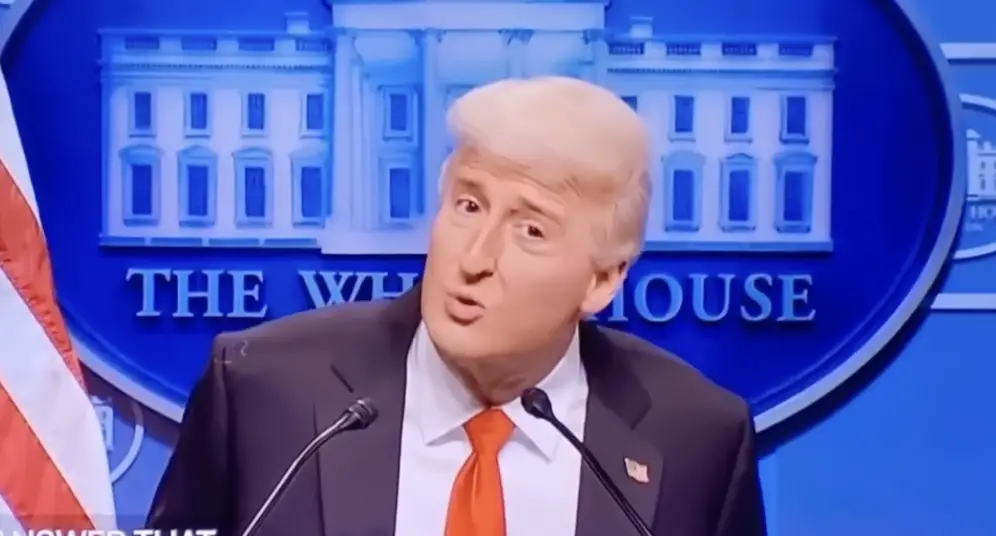
In the sketch, actor James Austin Johnson once again portrayed Trump, interrupting a televised White House press briefing to address questions about the email cache. The scene began with Ashley Padilla playing White House press secretary Karoline Leavitt, fielding inquiries from reporters about the content of the messages and what they might reveal about the president’s relationship with Epstein, who died in jail in 2019 while awaiting trial on sex-trafficking charges.
As Kenan Thompson’s reporter character asked what the president “has to hide,” Johnson walked into the briefing room in full Trump persona and declared, “I can answer that.” He then delivered a line that set the tone for the sketch, telling the press corps, “I am hiding almost nothing, just enough to make it extremely suspicious,” before circling around questions about why his name appears repeatedly in the newly disclosed emails.
The writers used the format of a routine presidential press conference to riff on a series of specific emails that have circulated in Washington since the House committee made the documents public. One reporter, played by Mikey Day, asked about a message in which Epstein allegedly described Trump as “the dog that hasn’t barked,” a line that has attracted attention among commentators trying to interpret whether the financier believed the then-businessman knew more than he had publicly said about Epstein’s activities. Johnson’s Trump dodged the issue, echoing the real president’s recent efforts to label the story a political distraction.
Another question came from Jeremy Culhane’s character, who pressed Trump on the nature of his past relationship with Epstein and suggestions online that the financier had visited the White House. The sketch did not attempt to reconstruct any specific visit but instead used the query to launch one of its more surreal lines, with Johnson replying that “Trump exists across many timelines, it’s the Trump multiverse theory, and we just happen to be living in the worst possible one.” The remark played into the show’s long-running portrayal of Trump as both self-aggrandising and detached from conventional political accountability.
At the centre of the cold open was a running joke in which Trump treats the controversy not as a legal or ethical problem but as a merchandising opportunity. Toward the end of the scene, Johnson’s character announced that he would “release all the Epstein files,” before adding the punchline that each would be “on sale for the low, low price of $800.” Holding up a framed printout of one heavily redacted email, he described it as “a beautiful, one-of-a-kind, printed out screenshot in very low resolution” and suggested that such items would make “a great stocking stuffer.”
The sketch also referenced one of the most widely discussed emails in the tranche, in which Epstein’s brother Mark appears to speculate about whether Russian President Vladimir Putin possessed compromising photographs of Trump, using a crude phrase that has circulated widely online. Johnson’s Trump told the briefing room he had “just ordered the one that says, ‘Does Putin have the photo of Trump blowing Bubba,’” adding, “We love that one, whatever the hell that means.” The line nodded to the political sensitivity of any suggestion that foreign powers could hold damaging material on the president, while also highlighting the way sensational snippets from the email cache have been shared and debated on social media.
The episode, hosted by actor Glen Powell with singer Olivia Dean as musical guest, continued the Epstein theme later in the night through a series of MacGruber sketches featuring returning cast member Will Forte. In those segments, Forte’s character initially sets out to expose the Epstein files but panics when he realises his own name appears in the documents, ultimately deciding to destroy the evidence instead. The additional sketches extended the show’s criticism of public figures who have been linked to Epstein while suggesting that many in positions of power may have reasons to fear complete transparency about their interactions with him.
Saturday Night Live’s decision to centre its cold open on the Epstein emails came as the political row over the documents intensified in Washington. The House Oversight Committee recently released thousands of emails as part of a wider push to make long-awaited “Epstein files” public, following years of speculation about who may have been connected to the financier’s alleged sex-trafficking network. More than 1,000 of the newly disclosed emails are reported to mention Trump, now 79, whose longstanding social and business ties with Epstein have been documented in photographs and reporting dating back to the 1990s in New York and Florida. Epstein died by suicide in a Manhattan jail in August 2019 while awaiting trial on federal charges of sex trafficking minors and conspiracy.
The renewed focus on Trump’s name in the emails has prompted fresh scrutiny of how closely he was linked to Epstein’s activities and what he may have known. The president has responded by characterising the entire issue as politically motivated. In a lengthy statement on his Truth Social platform on 14 November, he described the email revelations as a “hoax” and claimed that Democrats were using his inclusion in the correspondence to divert attention from the political fallout of the recent government shutdown and subsequent reopening of federal agencies. According to reporting cited by People and Yahoo, Trump argued that his opponents were seizing on the emails because they had been “utterly defeated” in the shutdown dispute.
The White House has echoed that framing in official comments. Spokesperson Abigail Jackson said in a statement reported by People that “these emails prove literally nothing” and accused “liberal outlets” of trying to focus on the scandal instead of the administration’s policy agenda. Jackson added that the administration would not be “distracted” and would continue working on its promise to “Make America Affordable Again,” a slogan Trump has used in speeches on the cost of living and inflation.
Despite those efforts to downplay the disclosures, the emails have kept alive questions that have followed Trump since Epstein’s arrest in 2019. Records and photographs have shown that the men moved in overlapping social circles for years, particularly in Florida, where Trump’s Mar-a-Lago resort and Epstein’s Palm Beach home stood a short drive apart. In a 2002 magazine interview, Trump described Epstein as a “terrific guy” and said he liked beautiful women “on the younger side,” although Trump has since said the two fell out and that he banned Epstein from his properties. Those comments, together with numerous images of the pair socialising at events, have continued to fuel public interest in the extent of their relationship.

The House is expected to vote soon on whether to release a broader set of Epstein-related records, including additional emails and other documents, a move that could shed further light on which public figures were in regular contact with the financier before his arrest and death. Trump, who previously campaigned on a promise to make all Epstein files public, has more recently rowed back on that rhetoric, arguing that the current disclosures are part of a partisan attempt to damage his presidency as he seeks another term in the White House.
Saturday Night Live has frequently used its opening sketches to respond to political news cycles, and Johnson’s impression of Trump has become a central feature of those segments in recent seasons. The latest cold open followed that pattern, using humour and exaggeration to mirror aspects of Trump’s public messaging around the Epstein emails. The fictional press briefing allowed writers to compress several real-world elements: the release of the correspondence by a congressional committee, Trump’s insistence that the story is a hoax, the lingering questions about his past statements on Epstein and his more recent reluctance to follow through on promises of transparency.
Social media clips of the sketch circulated widely after broadcast, with viewers commenting on Johnson’s performance and on the decision to confront the Epstein controversy directly in a mainstream comedy show. Some users praised the cold open for addressing what they see as the unresolved questions about elite networks that surrounded Epstein, while others argued in posts that turning such material into satire risks trivialising the underlying allegations of exploitation and abuse. Those reactions formed part of a broader online debate about how entertainment programmes should handle subject matter that touches on allegations of sexual exploitation, political corruption and questions of accountability.
For NBC and the long-running sketch show, the episode underlined how SNL continues to position itself at the intersection of politics, pop culture and public controversy. By depicting Trump openly marketing the Epstein files as novelty items, the cold open suggested a president willing to treat a sensitive trove of documents as another commodity, even as legal and political institutions wrestle with the implications of what those records might show. Whether the House ultimately releases further files, and how they might affect Trump’s political standing, remains uncertain. For now, SNL has added its own pointed interpretation of the unfolding story, translating the emerging details of the email scandal into a satirical portrait of a presidency under renewed scrutiny over its links to one of the most notorious figures of recent American history.