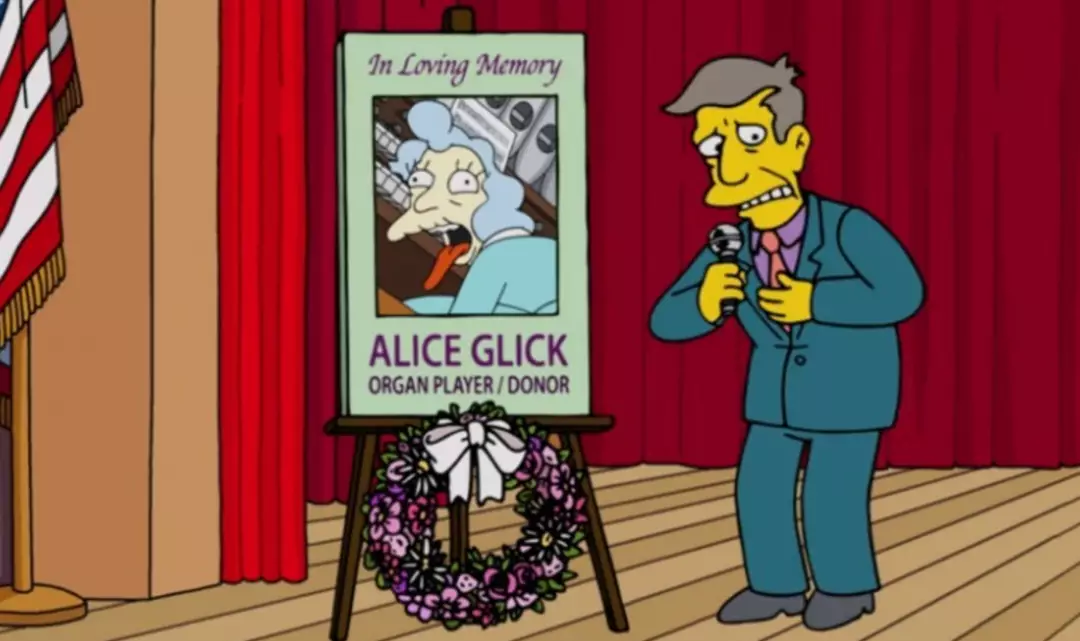
The Simpsons has permanently written out one of its longest-serving background characters, with producers confirming that church organist Alice Glick will not return after her death in a new episode from the show’s 37th season. The character, who first appeared in 1991 and has been part of Springfield’s supporting cast for more than three decades, dies suddenly in the episode “Sashes to Sashes”, which aired in the United States on 16 November 2025.
In the episode, set largely around a student council race at Springfield Elementary and a parallel look back at the Quimby political dynasty, Alice is seen at the First Church of Springfield playing the organ during one of Reverend Lovejoy’s sermons. As the congregation listens, she slumps forward onto the keys and the music crashes into a discordant chord, signalling that the elderly musician has died mid-service. The moment is brief and not heavily foreshadowed, but it is treated within the story as a genuine death rather than one of the show’s frequent throwaway gags.
Later in the episode, the impact of Alice’s death becomes clear when Springfield Elementary learns that she has left her estate to the school. The money is earmarked for a new music programme, becoming a central plot point as Lisa Simpson and Joe Quimby III clash over how the unexpected windfall should be spent and which students should benefit from it. That storyline ties Alice’s passing to one of the series’ recurring themes, the precarious state of arts education in public schools, while also underlining how a background character can influence the town’s future.
Outside the fictional world of Springfield, producers have moved to make clear that this death is different from the many fake-outs and reversals that have become part of the programme’s loose approach to continuity. Co-executive producer Tim Long has stated that Alice is “dead as a doornail” and described her as “dead as a doornail” while adding that the character will “live forever” through her music. These remarks were made in interviews discussing the episode and were intended to draw a line under any suggestion that she might reappear in future seasons as if nothing had happened, a device the show has used with other characters over the years.
Alice Glick, often referred to as Mrs Glick, has been a familiar if largely silent presence across hundreds of episodes. According to official character guides, she is an elderly Springfield resident introduced in the second season episode “Three Men and a Comic Book”, where Bart Simpson does yard work for her and discovers that she is both frugal and tough, paying him just fifty cents for a full day’s labour. Over time she came to be known primarily for two things: her role as the church organist and her distinctive design, with a hunched posture, blue dress and white hair swept up in a bun.
The character has been voiced by several notable performers. Academy Award-winning actor Cloris Leachman originated the role, providing Alice’s voice in her earliest appearances. After Leachman’s long association with the series, other actors, including Tress MacNeille, later took over the part as Alice continued to appear in crowd scenes, church services and occasional comedic cutaways. Leachman died in 2021 at the age of 94, and the decision to retire Alice permanently in 2025 comes after a period in which the series has gradually adjusted its cast in response to real-world changes and the advancing age of some of its original performers.
This is not the first time The Simpsons has depicted Alice Glick’s demise. In a season 23 storyline she was apparently killed after a robotic pet animal, the “Robopet”, turned on the town’s residents and attacked her. That death was played for shock value when it first aired, with Alice being dramatically flung into the air, but subsequent episodes continued to show her alive in the background or in group scenes, effectively treating the earlier incident as non-canonical. The producers’ new insistence that she is now gone for good reflects the show’s longstanding, sometimes contradictory relationship with continuity, where major events can either be reset or allowed to stand depending on how the writers want to use them.

In interviews surrounding “Sashes to Sashes”, producers have acknowledged that fans often debate which events in the series “count” and which are dream sequences, alternate timelines or simple gags. One producer recently summed up that attitude with the remark that there is “no canon” in the conventional sense, reinforcing the idea that the show prioritises jokes and character moments over strict internal consistency. In that context, a firm declaration that a character is permanently dead carries more weight than it might in other series, because it signals that the creative team intends to treat this particular story beat as part of the show’s ongoing reality, even as other elements may continue to shift.
Viewers responded quickly to Alice’s death once the episode aired. Social media users posted clips of the church scene and screenshots from the memorial sequence, expressing surprise that the show had chosen to quietly end the character’s run in a mid-season episode rather than building to a larger event or heavily publicising the change in advance. Fans noted that Alice had been part of The Simpsons for 35 years and that her removal marked another step away from the early seasons’ recurring background cast. Some compared the moment to earlier losses, including the death of barfly Larry Dalrymple, a long-time patron of Moe’s Tavern who was written out in 2024.
Reactions ranged from nostalgia to frustration. Some viewers argued that the show had become too willing to kill off or radically alter long-running characters in later seasons, while others felt that the understated handling of Alice’s death fit her status as a peripheral but beloved figure rather than a central member of the Simpson family. Messages on X and other platforms highlighted favourite past scenes, such as Alice’s miserly treatment of Bart in her debut and her recurring presence in church pews and town gatherings.
The episode itself gives Alice a measure of posthumous recognition. The memorial at Springfield Elementary functions both as a storyline device and as an in-universe tribute, showing staff and students acknowledging her gift and debating how to honour it properly. The bequest allows the school to invest in its music facilities, a rare piece of good fortune in a series that often portrays the institution as underfunded and neglected. Producers have said that this inheritance is likely to have consequences in future episodes, as improved musical resources at the school create new story possibilities for Lisa and other students.
While Alice Glick has never been as central to The Simpsons as figures like Ned Flanders or Moe Szyslak, her longevity made her part of the show’s visual fabric. Animation historians often point to the importance of background characters in long-running series, arguing that they help create a sense of a living town that exists beyond the adventures of the main cast. In Springfield, characters such as Alice, the Crazy Cat Lady and the recurring church congregation have filled that role, appearing in group scenes, cutaways and crowd shots that give the series its distinctive populated feel. Alice’s departure therefore represents more than just the loss of a minor character; it subtly alters the backdrop against which the Simpson family’s stories unfold.
The decision comes at a time when The Simpsons, which premiered in 1989 and is already the longest-running scripted primetime series in American television history, continues to adjust to an evolving media landscape and shifting audience expectations. The programme recently secured renewals that will keep it on air for several more seasons and has increasingly experimented with flash-forward episodes, alternate timelines and anthology formats. In 2025 earlier episodes hinted at or depicted the deaths of other major characters, including a storyline in which Marge Simpson was shown as deceased in a speculative future scenario. Producers later stressed that such episodes do not necessarily reflect the current continuity of the show, clarifying that characters like Marge and music teacher Dewey Largo remain alive in the main timeline despite their fates in those stories.
Against that background, Alice’s confirmed death stands out as a rare instance in which The Simpsons appears to be committing to a permanent change in its ensemble. Previous permanent deaths have been relatively infrequent, often linked to the real-world passing of voice actors. One early example was the jazz musician Bleeding Gums Murphy, who died in the 1995 episode “‘Round Springfield”, a story that dealt directly with grief and loss. The show later retired characters such as Maude Flanders after the death of her voice actor. In Alice’s case, the change follows the passing of Cloris Leachman but comes several years later, after other performers had already continued the role.
There is also a broader creative context. Co-executive producer Tim Long has suggested that making certain story choices irrevocable can help sustain emotional stakes in a series that has run for nearly 800 episodes. By confirming that Alice will not simply reappear in a future episode with no explanation, the production team signals that some developments in Springfield are meant to carry lasting weight, even when they involve characters who rarely speak. His comment that Alice is “dead as a doornail” but will “live forever” through her music encapsulates that approach, acknowledging both the permanence of the decision and the character’s enduring place in the show’s history.
For long-time viewers, the moment also serves as a reminder of how much The Simpsons has changed since Alice first entered the series more than three decades ago. When she debuted in “Three Men and a Comic Book” in 1991, the show was still defining the borders of Springfield and introducing the recurring faces who would populate its world. Over the years, those characters have aged only slightly on screen, but the real-world time that has passed is substantial. Alice’s death, presented quietly in the middle of a sermon, underlines the fact that even in a cartoon where most figures seem ageless, some are eventually allowed to reach the end of their stories.
The series continues to air on Sunday nights, with “Sashes to Sashes” forming part of a season that blends political satire, family narratives and experiments with the show’s long continuity. In that mix, the loss of Alice Glick is a small but notable development, connecting a fleeting moment of drama in a church organ loft to the wider question of how a decades-old animated series refreshes itself while still feeling like the same Springfield that first appeared on television in the late 1980s. For fans who grew accustomed to spotting the elderly organist at the edge of scenes, her absence may be felt most in the quiet background shots where she once sat, a reminder that even in the endlessly reset world of The Simpsons, some characters really do leave for good.