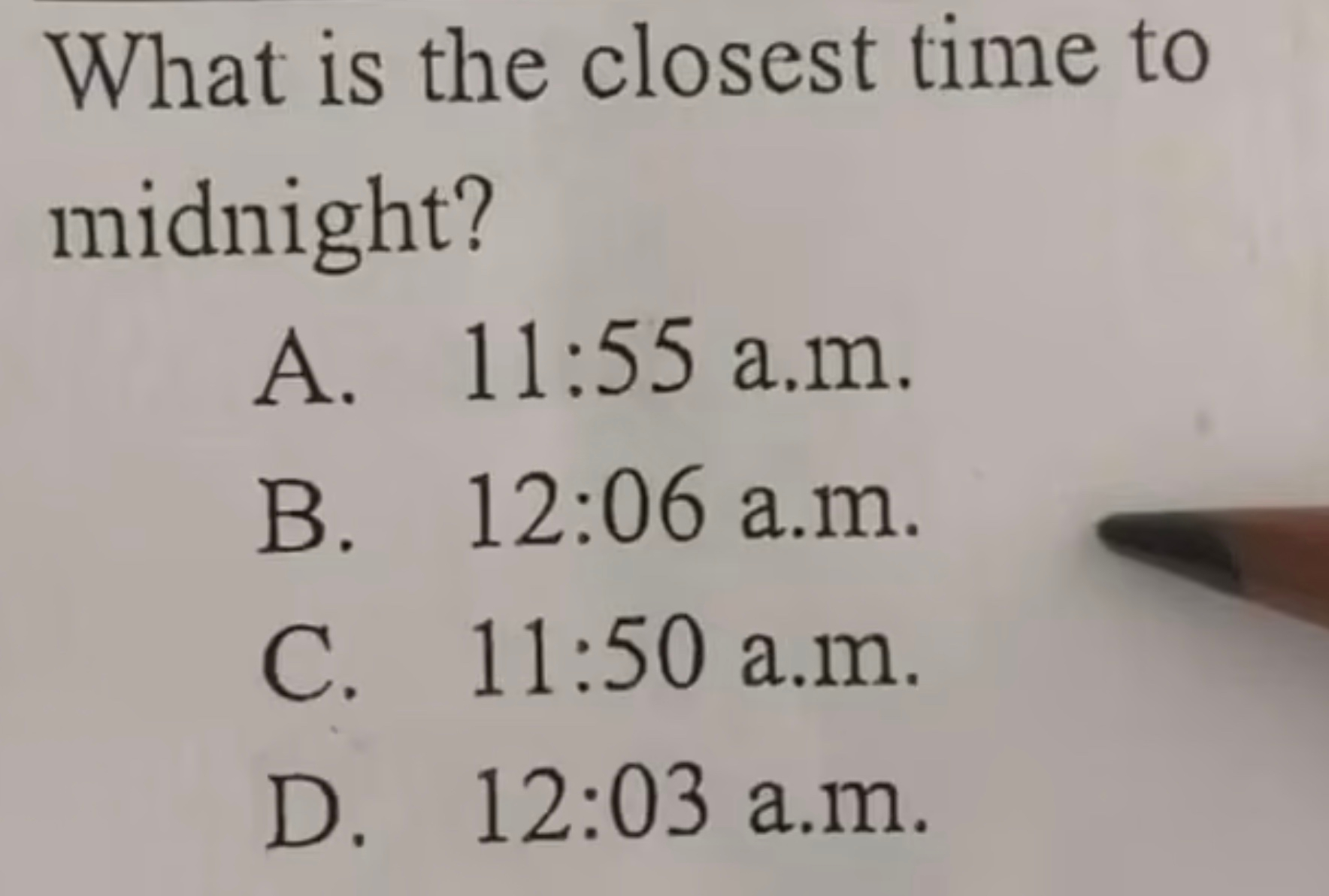
A simple children’s maths question asking “What is the closest time to midnight?” has sparked widespread confusion and debate on social media. The multiple-choice options given were A) 11:55 a.m., B) 12:06 a.m., C) 11:50 a.m., and D) 12:03 a.m.
The image of the question circulated online after being posted by Twitter user yawdmontweet and subsequently tracked by outlets such as The Straits Times, which reported that the tweet “hurt his head.”
At first glance the correct answer might appear to be D, since 12:03 a.m. is three minutes past midnight and therefore closest in raw minutes to the “midnight” point. For example, one commenter wrote: “12:03 a.m. is the closest TO midnight.”
However, others pointed out that because time proceeds forwards and one must consider how far each time is from the next midnight, option A (11:55 a.m.) becomes plausible under that interpretation. The times in question convert to: A) 11 hours 5 minutes before the next midnight; B) 23 hours 54 minutes after the previous midnight; C) 11 hours 10 minutes before; D) 23 hours 57 minutes after.
As the Straits Times reported, many users argued that because the question uses “to midnight” rather than “until midnight,” and because once the clock passes 12:00 a.m. that new day’s midnight is far away again, option A made sense.

At the same time, others insisted the simpler reading — which option D provides — must prevail: the “time closest to midnight,” measured on a clock face without regard to direction, is 12:03 a.m.
No definitive official source has been identified by which the original test-creator endorsed one answer over another. As the article in Parade noted: “the correct answer depends on the interpretation of the question and its wording.”
This viral problem reveals underlying assumptions about how time is framed in questions. On one hand it invites literal proximity to midnight (pre- or post-12:00 a.m.). On another it implicitly assumes the journey to the next midnight, which changes the calculus entirely. Social media users reflected this divide. In one Reddit thread a user wrote: “12:03 a.m. is the closest TO midnight. 11:55 a.m. closest TILL midnight.”
Another explained the ambiguity:
“The question is the closest time to midnight, not the closest time until midnight.”
Teachers and logic puzzle authors have noted that ambiguity of phrasing often leads to confusion in such problems, especially when including “a.m.” and “p.m.” formats.
The puzzle also reignited discussion about 12-hour clock conventions. As one analysis pointed out, “Once it clocks 12 a.m., it’s past midnight … so the question was ‘which is the closest to midnight?’”
Beyond the online debate, the maths question has become a teaching point about clarity in testing and the importance of specifying whether a question refers to the next midnight, previous midnight, or simply the closest on a clock face. Some educational commentators pointed out that if instead the question used the 24-hour clock (for example asking “What is the closest time to 00:00?”) such ambiguity would largely disappear.
In summary, the viral “closest time to midnight” question presents four given times in a multiple-choice format and challenges common assumptions about how to interpret proximity to midnight. Depending on whether one interprets “closest” as immediate proximity (favoring 12:03 a.m.) or as shortest forward journey to the next midnight (favoring 11:55 a.m.), either answer could be argued. At present there is no universally accepted “correct” answer publicised by the question’s originator, meaning the puzzle continues to amuse and frustrate internet users who debate whether it is about chronology or purely numerical closeness.
While the underlying mathematical content is relatively trivial, the popularity of the riddle underscores how easily ambiguous phrasing can provoke widespread confusion—and how viral it can become when such confusion is shared socially.