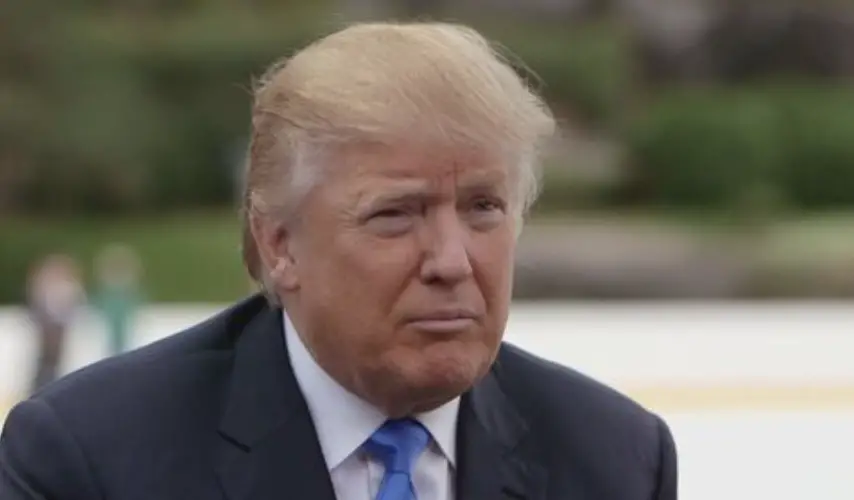
Former US President Donald Trump drew widespread attention after stepping out at the White House wearing a new burgundy scarf beneath a black over-coat, marking a departure from his customary winter attire. The image, appearing on November 22, 2025, immediately went viral as social-media users compared the look not only to the villainous imagery of the “Star Wars” character Emperor Palpatine but also to the style of New York’s incoming mayor, Zohran Mamdani.
Trump’s change of wardrobe coincided with the previous day’s meeting at the White House with Mayor-elect Mamdani, who is 34 years old and part of a younger generation of Democrats in New York. The meeting, held on November 21, had been widely anticipated given the ideological differences between Trump and Mamdani, but instead the two emerged appearing cordial. What followed, however, was that Trump’s accessory choice rapidly generated speculation about whether the former president was signalling a softer image, borrowing youth-oriented style cues, or simply experimenting. Social-media commentary included remarks such as: “He meets with Mamdani one time and immediately tries to step his swag up,” shared on the platform X.
At the White House South Lawn, as Trump prepared to depart aboard Marine One, the burgundy scarf caught immediate visual attention. A clip of the moment, posted by journalist Aaron Rupar with the caption “Quite a look for Trump today,” amassed millions of views. On X, one commentator wrote: “Yikes! Today, Donald Trump looks like a cross between Emperor Palpatine and Don Corleone!”
From a historical standpoint, Trump has rarely changed his winter styling significantly from the classic dark over-coat and traditional neckwear. The notable shift to a bold colour for the scarf in question therefore drew attention not just as a fashion moment but potentially as a symbolic gesture. Some online users pointed out that in earlier photos of Zohran Mamdani, the younger politician has been seen wearing a burgundy turtleneck or dark blazer combined with deep red neck-wear—leading many to suggest Trump’s scarf might be a visual echo.
Others were less charitable in their interpretation, mocking the look via edited images and messaging, with memes linking Trump’s scarf to quasi-villain imagery. As one note on Yahoo News UK put it: “With winter coming in fast, President Trump has got himself a plush new burgundy scarf to keep the cold at bay—which unfortunately has received a rather frosty reception online.”
While the scarf may seem trivial, in the realm of public-figure image management even minor changes can signal shifts in persona or messaging. Trump’s meeting with Mamdani had been framed in some media outlets as unexpectedly positive, with noted productivity on topics such as crime, housing and cost of living in New York. That context has added to speculation that the scarf may be part of a broader attempt to soften or modernise his image ahead of future public appearances.
That said, there is no official statement from the Trump team indicating that the accessory choice was deliberate or symbolic. The scarf may simply represent a personal preference for a warmer tone, or may have been selected for purely weather-related reasons; the sugar-coating it with political meaning remains speculative. Meanwhile, the viral nature of the image speaks to the power of visual cues in high-profile public life.
Zohran Mamdani, for his part, is entering office as Mayor of New York City on a wave of progressive support, having been elected earlier in 2025 at the age of 34. His style, distinct from traditional US political dress codes, is noted for its younger-skewing palette and less formal cuts. The comparative resemblance between his publicly shared outfit palette and Trump’s new scarf look triggered much of the commentary.
In announcing the November 21 meeting, the White House described the exchange as “substantive,” touching on mutual interests in New York’s economic recovery and national crime policy. Trump reportedly told Mamdani that he could imagine living in New York under the incoming mayor’s leadership. Such remarks were considered surprising given Trump’s earlier criticism of Mamdani during the election cycle. The wardrobe change, arriving the next day, thus became a subject of heightened interest.
Public-reaction data shows the clip of Trump in the scarf amassed over 16 million views on X, forming part of wider social-media chatter. Conversations ranged from lampooning the look to more serious speculation about objective signalling. One recurring line: “He’s copying the look,” though some defended Trump’s independent style, stating: “No way he’s copying the look — the guy does his own thing.” The irony of critics suggesting similarity with Mamdani, and using that to mock Trump’s style, reinforced the meme-culture element of the story.
In any case, the visual narrative marks a rare moment where fashion, politics and optics converged for Donald Trump. When considered alongside the broader context of his meeting with a political opponent-turned-met collaborator like Mamdani, the scarf episode becomes more than a passing accessory change. It offers yet another data point in the evolution of Trump’s public presentation in a post-presidency era in which he remains a dominant figure in American politics.
For analysts watching Trump’s communication strategy, the scarf may represent an incremental shift. Rather than maintaining the familiar red tie and dark suit alone, the introduction of the burgundy neck-wear could be seen as an attempt at diversification of his look, possibly designed to appeal visually to younger or more style-conscious audiences. However, absent confirmation from the camp, this remains speculative.
As winter advances in Washington D.C., the scarf will likely be remembered not just for its tone and texture but for when it appeared: following a meeting that was expected to underscore divisions but instead highlighted camaraderie between Trump and a rising urban progressive. That convergence of style and substance helps explain why a simple scarf became a story.
In the coming weeks, observers will watch whether Trump continues to wear the burgundy scarf, thereby signalling a consistent shift, or reverts to his earlier visual brand. Either outcome may carry its own signal. For now, the scarf stands as a visual footnote on a day of unexpected diplomatic warmth and style commentary, and a reminder that in modern political optics even small details can spark major conversations.