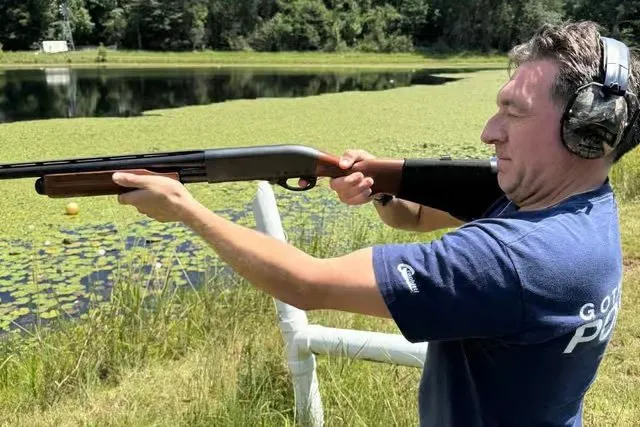
A British man has spoken of his shock after being arrested and questioned for weeks over a photograph he posted on Instagram while on holiday in the United States, sparking a police investigation that he says left his career in ruins despite all charges being dropped. Jon Richelieu-Booth, a 50-year-old IT consultant from West Yorkshire, had travelled to Florida earlier this year, where he visited a private property and posed for a photo holding a legally owned firearm. He later uploaded the image to Instagram, describing it as a harmless holiday snapshot taken in a country where gun ownership and recreational shooting are widespread. When he returned to the UK, however, the post drew the attention of West Yorkshire Police, who said the image had raised concern because of the way it was presented online and the potential alarm it could cause to members of the public.
Officers initially visited his home and advised him about the implications of sharing images involving weapons. Richelieu-Booth said he explained that the gun was legally handled in the United States, where he had been invited to shoot on private land. Despite this, he was arrested on 24 August on suspicion of firearms possession with intent to cause fear, a charge that stemmed not from the American incident itself but from the interpretation of how the image appeared publicly in the UK. The arrest formed part of a wider inquiry that also included claims of stalking, which he strongly denied. The allegations were later dismissed, but his case continued to widen as investigators examined a separate social-media post, leading to an additional accusation of a public order offence.
Richelieu-Booth said that what followed was a series of police visits and interviews that stretched across nearly three months, during which time officers seized his computer equipment as part of their inquiries. Because he worked as a freelance IT contractor, the loss of his equipment severely disrupted his ability to earn a living. He described being unable to access clients’ systems, losing ongoing work and suffering reputational damage. He said he repeatedly told police that the firearm in the photograph had been handled legally under American law and that he had no criminal intent in sharing the post, but the investigation continued while digital forensic checks were carried out.
The prospect of a court appearance loomed for weeks. Although the firearms and stalking allegations were eventually dropped in their entirety, the separate public order offence was pursued for several more weeks. Richelieu-Booth maintained that the claim had been based on a misinterpretation of a post that he said carried no threatening meaning. Shortly before he was due to appear in Bradford Magistrates’ Court on 25 November, the Crown Prosecution Service withdrew the remaining charge, ending the legal case against him. By that point, however, he said he had spent 13 weeks under investigation, leaving him anxious, unemployed and unsure of how to explain the circumstances to colleagues and clients.
Speaking after the collapse of the case, Richelieu-Booth said he believed he had been unfairly targeted for what he viewed as a lawful and unremarkable photograph taken in a country with very different cultural and legal norms around firearms. He said he felt “deeply bewildered” that an image taken abroad could result in an arrest at home, and claimed that the process had inflicted long-lasting damage despite his name being cleared. He urged police to consider more carefully how they assess social-media material that originates from foreign jurisdictions, arguing that context matters and that an action legal in one country should not automatically be treated as suspicious when shared online.
West Yorkshire Police said the case began after concerns were raised by viewers of the post, prompting officers to assess whether any offences relating to fear, intimidation or harassment had been committed. The force said that decisions to arrest or seek charges are based on perceived risk, not on the legality of the activity in the country where an image was taken. In the UK, strict laws prohibit the possession, display or imitation of firearms in ways that could cause alarm, even when no physical weapon is present. Investigators examined whether Richelieu-Booth’s social-media presence could be interpreted as threatening or targeted towards specific individuals. After several weeks of inquiries, the CPS concluded that the remaining charge did not meet the threshold for prosecution.
The case has reignited debate over how police handle social-media content involving weapons, particularly when posts are shared by British nationals travelling in the United States, where recreational firearm use is common and often featured on holiday accounts. Critics of the investigation questioned whether the UK’s approach risks criminalising people for sharing legal activities carried out abroad. Others argued that officers must investigate any online content that could cause fear or distress in the UK, especially against a backdrop of rising concern about intimidation and threats made through digital platforms.
Legal experts say that similar cases are likely to increase as social-media platforms blur the distinction between jurisdictions. A photograph taken in one country can be instantly viewed in another, where the laws and cultural expectations differ sharply. They note that although the UK does not criminalise the mere sharing of images involving foreign firearms, prosecutions can be brought if a post is judged to be threatening, harassing or intended to cause alarm. Police are therefore required to weigh subjective factors that can shift depending on context, audience and interpretation.
For Richelieu-Booth, the dropping of all charges has not ended the consequences. He said he intends to seek legal advice with a view to pursuing damages for the loss of earnings and distress experienced during the investigation. He maintains that the incident has left him wary of using social media at all and concerned about how ordinary holiday photographs can be misunderstood. He said the process had been “exhausting and humiliating,” adding that he hopes no one else will experience similar repercussions for posting material they believe to be lawful.
The case has highlighted the broader tensions between digital expression, national security considerations and the differing legal landscapes in which British travellers operate. While the investigation is now closed, the questions it raises about the limits of online behaviour, police powers and public perception remain at the centre of a growing debate about social-media policing and how far authorities should intervene when images cross borders but remain accessible to millions at home.