The US National Park Service is facing a growing backlash after confirming that, from 2026, Americans will be able to visit national parks for free on Donald Trump’s birthday, but will no longer enjoy fee-free access on Martin Luther King Jr Day or Juneteenth. The change, publicised this week through federal notices and park service communications, has been framed by the administration as part of a new calendar of “resident-only patriotic fee-free days” designed to prioritise American taxpayers. Civil rights advocates and many park users, however, see it as a politically charged reshaping of how the country commemorates its history.
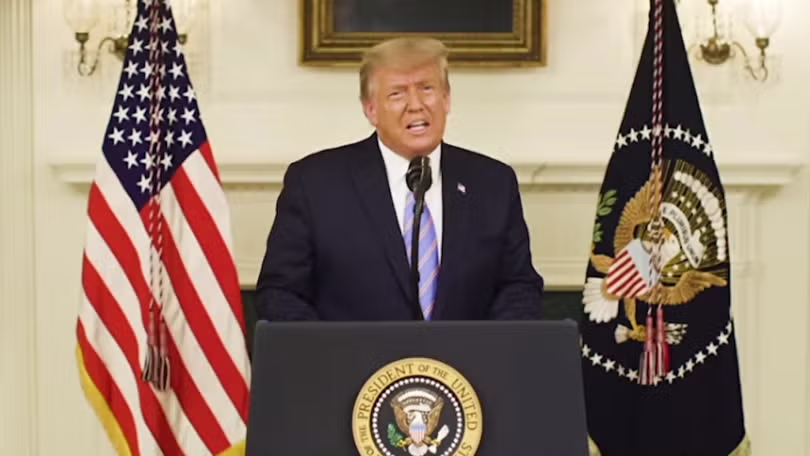
Under the revised schedule, 14 June will be added to the list of days when entrance fees are waived for US citizens and permanent residents. The date already appears on federal calendars as Flag Day and is also the birthday of Trump, who returned to the White House as the 47th president earlier this year. On those days, Americans will be able to enter more than 100 sites that normally charge an entrance fee, including some of the country’s most famous landscapes such as Yellowstone, Yosemite and the Grand Canyon. The same benefit will no longer apply on the January federal holiday honouring Martin Luther King Jr or on 19 June, the federal holiday marking the end of slavery in the United States.
Fee-free days are a longstanding feature of the National Park Service’s efforts to widen access. For years, the agency has picked a small number of significant dates when entrance charges are lifted to encourage more people to visit. In 2024, the list included Martin Luther King Jr Day, the first day of National Park Week in April, Juneteenth in June, the Great American Outdoors Act anniversary in August, National Public Lands Day in September and Veterans Day in November. By contrast, the 2026 list centres heavily on patriotic and presidential observances: Presidents Day, Memorial Day, the Independence Day weekend, the National Park Service’s own 110th anniversary, Constitution Day, Theodore Roosevelt’s birthday, Veterans Day and now Flag Day, paired on the calendar with “President Trump’s birthday.”
The decision to drop the two civil rights-linked holidays while elevating the president’s own birthday has drawn particular criticism from campaigners and historians. Martin Luther King Jr Day, first observed as a US federal holiday in 1986 and widely promoted as a day of service, has for many years been used by community groups to organise volunteer clean-ups and educational events in national parks. Juneteenth, which became a federal holiday in 2021, commemorates the 1865 order in Texas that finally enforced the Emancipation Proclamation for the last enslaved people in the Confederacy. Both days were seen as symbolically powerful moments for the park system to acknowledge Black American history.
Civil rights organisations and environmental groups argue that removing those dates while adding one associated personally with the president sends a clear political message. Leaders of advocacy groups have warned that it appears to downplay the struggles of Black Americans and replace them with celebratory imagery centred on Trump himself. They also say the move fits into a wider pattern from the administration, which has moved to curtail diversity, equity and inclusion programmes across federal agencies earlier this year. Those programmes had previously underpinned outreach work designed to bring more people of colour into national parks, both as visitors and as staff.
At the same time as altering the calendar, the administration is restructuring how much people pay to access some of the most popular parks. Beginning in 2026, a new pricing system will sharply raise costs for international visitors while offering preferential treatment to US citizens and permanent residents. On fee-free days, a new $100 “patriotic fee” will be charged to some non-resident tourists entering 11 of the most visited parks, while a new “non-resident” annual pass is due to cost $250. By contrast, Americans will qualify for a $80 yearly pass covering entrance to participating sites. Standard entrance fees for selected parks are also set to rise to around $250 for certain categories of international visitors.
Officials at the Department of the Interior, which oversees the park service, insist the package of changes is about fairness and fiscal responsibility. Interior Secretary Doug Burgum has argued that American taxpayers already subsidise the park system through their taxes and that it is reasonable to offer them additional benefits and to require foreign tourists to “pay their fair share.” The department has branded the new free-entry dates as “resident-only patriotic fee-free days,” language that signals a deliberate shift in emphasis from broad public access to a model that explicitly prioritises US residents.
Supporters of the decision inside the administration also point out that all visitors, regardless of nationality, will still be able to visit the parks throughout the year by paying the standard entrance fees, and that many National Park Service sites, including major monuments and historic locations, do not charge admission at all. They say the new system reflects the financial realities of maintaining a vast network of protected areas at a time of rising visitor numbers and mounting climate pressures, arguing that overseas tourism can help cover those costs. Nonetheless, the sharp distinction drawn between residents and non-residents on days officially billed as “patriotic” has added to concerns about the message the policy sends both at home and abroad.
The controversy has landed in an already polarised political climate. Trump, now in his late seventies, has made opposition to what he calls “woke” policies a prominent theme of his second term. Removing fee-free access on two holidays that explicitly mark civil rights milestones while emphasising his own birthday fits closely with his administration’s moves to roll back diversity initiatives in schools, federal agencies and the military. Critics argue that tying the National Park Service more closely to the president’s personal brand risks politicising institutions that have historically tried to sit above partisan conflict.
Another element provoking debate is the redesign of the long-running “America the Beautiful” pass, which gives holders unlimited entry to participating parks for a year. From 2026, one version of the pass will feature new patriotic artwork, including an image of Trump alongside George Washington. Legal experts and watchdog groups have suggested this could test federal rules that govern how the pass is branded, which have traditionally barred the use of imagery that could be construed as political promotion of a sitting president. The administration has not publicly addressed those concerns, and the park service has said only that the redesign is part of a wider effort to modernise its digital and physical passes.
The fee-free calendar itself does not affect every visitor in the same way. Many Americans who live near national parks or can travel easily may be able to take advantage of the remaining free days or buy an annual pass, while lower-income families or those living far from major sites often rely on the specific days that waive entrance charges to make a trip affordable. Community groups that have used Martin Luther King Jr Day as a chance to organise service projects in parks say dropping that date will make their work harder and could reduce the number of people experiencing national parks for the first time. They also warn that shifting the focus to a presidential birthday could discourage some volunteers who do not wish to be seen as supporting a particular political figure.
For Juneteenth, the symbolism is similarly contested. When Congress created the federal holiday in 2021, one of the arguments in favour was that it would provide opportunities for education and reflection about slavery and its legacies. In 2024, its inclusion as a fee-free day was welcomed by many as aligning the parks with that national conversation. Removing it just a year after it was first added has been interpreted by opponents as an attempt to narrow the official recognition of Black history, particularly in the context of wider disputes over how race and inequality are taught in schools and represented in public spaces.
The administration, for its part, has not signalled any intention to reconsider the changes. Officials emphasise that the new calendar and pricing structure were announced weeks ago and that park managers are already preparing for the 2026 season on that basis. They argue that the inclusion of Trump’s birthday is justified because it coincides with Flag Day, a date that has appeared intermittently in earlier discussions about patriotic commemorations, and they reject suggestions that the move diminishes the importance of civil rights milestones. With the president himself yet to comment directly on the row, his allies have framed the policy as a straightforward application of his “America-first” approach to tourism and public lands.
As the debate continues, much of the focus is likely to remain on how ordinary people respond when the new rules actually come into force. Park staff are already bracing for potential confusion at entrances, where they will have to explain that 14 June is free for Americans but not for international visitors, and that the removal of MLK Day and Juneteenth from the fee-free list does not mean the parks are closed on those dates, only that standard charges apply. Advocacy groups say they intend to monitor how the new pricing system affects visitor numbers, particularly among communities of colour and overseas tourists, and to press for future administrations to restore the civil rights holidays to the calendar. For now, though, the National Park Service finds itself at the centre of a political argument it did not initiate but must now administer, as the country’s public lands become another arena in the battle over how the United States chooses to remember its past and celebrate its leaders.