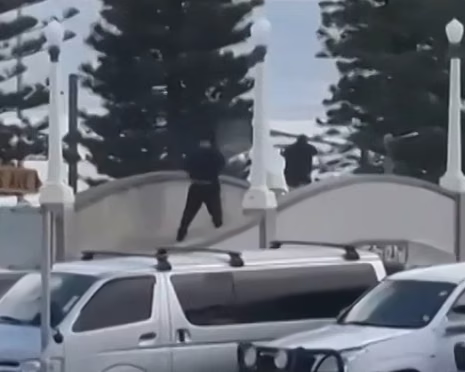
Sirens and panicked screams tore across Sydney’s Bondi Beach as gunfire erupted at a packed waterfront gathering, sending families, tourists and festivalgoers sprinting for cover along the sand and through nearby streets.
By Sunday evening, New South Wales Police said 16 people had been confirmed dead and dozens more were being treated in hospitals across the city, after what authorities described as a mass shooting and terrorist incident linked to an attack on a Jewish beach festival.
Police said the suspected attackers were a father and son, and that officers confronted them at the scene. The older gunman was shot dead by police, while the second suspect was taken to hospital in a critical but stable condition, according to officials.
New South Wales Police Commissioner Mal Lanyon told reporters that investigators were satisfied there were two offenders and that no third suspect was being sought. “I can say that we are not looking for a further offender,” he said. “We are satisfied there were two offenders involved in yesterday’s incident. One is deceased. The second is in critical but stable condition in hospital at the moment.”
Authorities said the older gunman was a licensed firearms holder and that weapons were recovered at the scene. Lanyon said the man was licensed for six firearms and that six had been recovered from Bondi Beach.
Police also disclosed the discovery of two devices at the beach, which were made safe. Lanyon described them as “two active devices” of “fairly basic” construction, and said specialist teams removed and rendered them safe. He said: “I’m very glad that those devices were not activated.”
The scale of the casualties placed emergency services under immediate strain. Police said 14 people died at the scene and two later died in hospital, including a 10-year-old girl and a 40-year-old man. Dozens of others were taken to hospitals across Sydney, including children, with several patients remaining in critical condition.
Two police officers were also shot during the response and were being treated in hospital. Lanyon said the injured officers were in a critical but stable condition and added: “The thoughts of the New South Wales police are with those officers and their families.”
Officials said the violence unfolded at one of Australia’s best-known public spaces, during a period of heightened community tensions and increased scrutiny of threats against faith groups. As police continued to comb through the crime scene and review witness footage, the state government announced an expanded security posture in areas with large Jewish populations.
Lanyon said there would be a visibly increased police presence at “places of worship” and locations “known to be frequented by the Jewish community,” describing the deployment as part of “Operation Shelter.” He said: “I want make it very clear the New South Wales police will not tolerate the types of violence or the types of antisemitic behaviour we have seen.”
Prime Minister Anthony Albanese described the attack as an “act of pure evil” and said national security agencies were working alongside state authorities. “We will do whatever is necessary to stamp out anti-Semitism. It is a scourge and we’ll eradicate it together,” Albanese said.
In a statement posted publicly, Albanese sought to frame the national response as both protective and defiant, praising police, first responders and civilians who intervened. He wrote: “Australia is stronger than the cowards who attacked innocent people today. Australia is braver than those. Who seek to make us afraid. Australia will never submit to division, violence or hatred. We will see justice done and we will come through this together.”
NSW Premier Chris Minns said the state would respond with both enforcement and a broader pushback against hatred. He described antisemitism as “cancerous” and said: “We need to send a strong and clear repudiation of antisemitism in all of its forms.” He added: “There’s no tolerance for racism or Jewish hatred in New South Wales or Australia and we need to be clear and unambiguous that we’ll fight it everywhere we see it.”
As investigators worked to establish a motive and reconstruct a minute-by-minute timeline, attention also turned to the victims and their families, with communities in Australia and overseas beginning to name the dead.
Among those identified was British-born rabbi Eli Schlanger, described as an assistant rabbi at Chabad of Bondi. Schlanger, 41, grew up in north London and was a father of five, according to reports cited in Australia. His family described him as a “joyful rabbi.”
His cousin, Brighton-based Rabbi Zalman Lewis, was quoted describing the loss in stark terms: “How can a joyful rabbi who went to a beach to spread happiness and light, to make the world a better place, have his life ended in this way?” The family said Schlanger and his wife, Chayala, had celebrated the birth of their youngest child, a boy, two months earlier.
The attack’s impact reverberated beyond Australia, with messages of condolence and condemnation arriving from abroad, including from the United Kingdom. The British government’s travel advice was updated to urge vigilance, and public figures issued statements describing the incident as antisemitic terrorism.
The Australian government signalled that federal resources would be made available to support the investigation and assist affected communities. Albanese said the Australian Federal Police and the domestic security agency were working closely with New South Wales authorities and that the government would “dedicate every single resource” required.
Police said their immediate priorities were confirming identifications, notifying families, and stabilising those injured, while specialist officers continued forensic work at the scene and examined devices recovered from the beachfront.
The incident also prompted renewed focus on the intersection of public safety and the accessibility of firearms, after police revealed one suspect was licensed and multiple weapons were recovered. Investigators said they were examining the suspects’ backgrounds, movements and communications, and whether the two devices found at the scene were intended to cause additional casualties or panic after the shooting began.
In the hours following the attack, bystander accounts described people diving behind cars, barricading themselves in shops and beach facilities, and using their phones to warn friends and relatives. Police praised those who rushed towards danger to help others, including civilians who tried to shield strangers, apply first aid, or direct people away from exposed areas.
Authorities cautioned that many early reports circulating online could not be verified and urged the public to avoid sharing graphic footage. Even so, police acknowledged that social media videos and witness recordings would form a key part of their evidential picture as they worked to map the incident across multiple locations around the beachfront.
With an alleged father-and-son pair at the centre of the case, investigators were also expected to examine how the two men planned the attack and whether anyone assisted them, knowingly or unknowingly, with weapons, transport, reconnaissance or materials related to the devices.
Commissioner Lanyon said police were focused on prevention as well as response in the days ahead, noting the large deployment under Operation Shelter. Officials said that presence would be concentrated around Jewish communal sites and areas where people might feel particularly vulnerable in the wake of the assault.
For many Australians, the fact the violence unfolded at Bondi, a place closely tied to public life and national identity, sharpened the shock. Politicians repeatedly referenced the symbolism of an “iconic” public location and stressed that the attack was aimed not only at individuals but at a sense of shared safety.
Albanese’s public statement leaned into that framing, urging national solidarity while promising an uncompromising law-enforcement response. “As Prime Minister, I say on behalf of all Australians, to the Jewish community, we stand with you, we embrace you,” he wrote.
By late Sunday, the focus remained on hospitals, where doctors were treating the wounded, and on grieving families beginning to learn the fates of relatives and friends. Police said several patients remained in critical condition and that the full toll could still shift as emergency teams continued care.
The investigation was expected to continue for weeks, with detectives examining firearms licensing records, the construction and intended function of the two devices recovered at the scene, and any indications of extremist motivation or prior planning. For now, authorities said, the priority was ensuring no further threat remained and that communities most directly affected felt protected as Sydney, and the country, absorbed the scale of what had happened.