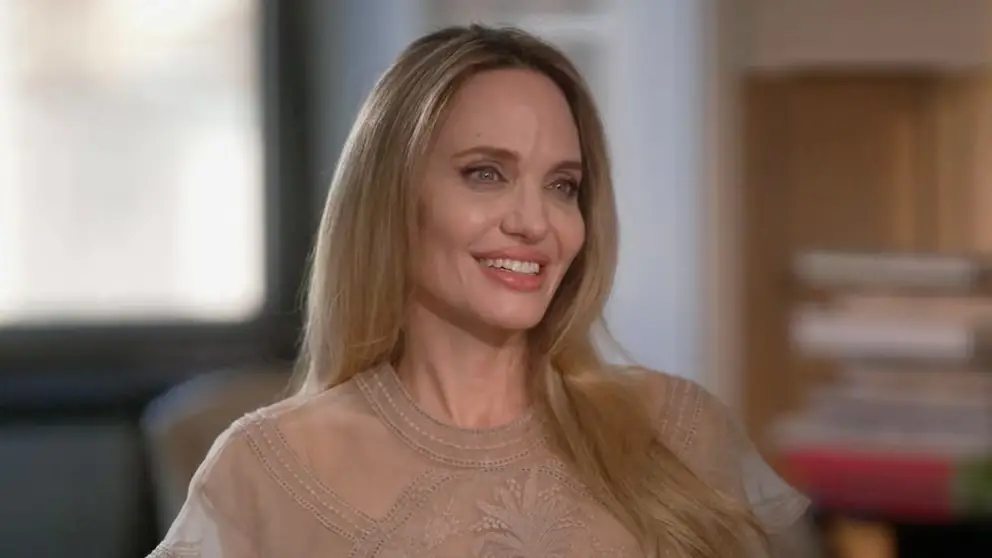
Angelina Jolie has spoken about her decision to publicly reveal the scars from her preventive double mastectomy for the first time, saying she wanted to stand with other women who have shared similar experiences and to use the moment to draw attention to breast health and cancer prevention.
The 50-year-old actor and filmmaker made the comments in an interview with TIME France, after appearing on the cover of the magazine’s inaugural issue. The portrait shows Jolie in a low-cut black top, with small scars visible on her breast from surgery she underwent in 2013.

In the interview, Jolie said: “I share these scars with many women I love. And I’m always moved when I see other women share theirs.” She added: “I wanted to join them, knowing that TIME France would share information on breast health, prevention and knowledge about breast cancer.”
TIME France published the cover alongside an abbreviated version of the interview, while indicating a full version would be available when the issue reached newsstands on 18 December.
Jolie’s mastectomy was preventive rather than a response to a cancer diagnosis. She previously disclosed that she carries a BRCA1 gene mutation, which can significantly increase the risk of breast and ovarian cancer. In a New York Times opinion piece in 2013, Jolie wrote that doctors estimated she had “an 87 percent risk of breast cancer and a 50 percent risk of ovarian cancer,” while noting that risk varies from person to person.
She said at the time that her decision was driven by family history. Jolie’s mother, actor Marcheline Bertrand, died in 2007 at the age of 56 after years of illness linked to cancer, and Jolie has also spoken of her grandmother dying young.
In the 2013 piece, Jolie wrote that the choice to undergo the procedure was difficult, but that she was relieved by the reduction in risk, saying: “My chances of developing breast cancer have dropped from 87 percent to under 5 percent.” She added: “I can tell my children that they don’t need to fear they will lose me to breast cancer.”
Jolie, who has six children, also wrote about how her family reacted to the outcome of the surgery. “It is reassuring that they see nothing that makes them uncomfortable,” she said. “They can see my small scars and that’s it. Everything else is just Mommy, the same as she always was.”
Two years after the mastectomy, Jolie underwent surgery to remove her ovaries and fallopian tubes, again describing it as a preventive decision linked to her genetic risk and family history. Reports at the time said she had chosen the procedure after doctors found markers that could indicate early cancer, though she emphasised the operation was intended to reduce risk and protect her long-term health.
The renewed focus on Jolie’s surgeries has also highlighted the broader public health impact of her original disclosure. After she published her 2013 essay, researchers and clinicians reported increased public awareness and higher demand for genetic testing and counselling related to BRCA mutations, a phenomenon that has been widely referred to as “the Angelina effect”.
In her TIME France interview, Jolie linked her decision to share the scars now with the importance of women having access to information and care. According to coverage of the interview, she stressed that women should be able to make their own healthcare decisions, saying: “Every woman should always be able to determine her own healthcare journey and have the information she needs to make informed choices.”
The magazine feature coincides with Jolie’s continued work in film, including roles that touch on themes of illness, identity and resilience. Coverage of the TIME France interview notes that Jolie discussed her role in a film titled Coutures, directed by French filmmaker Alice Winocour, which premiered at the Toronto Film Festival in September. In the film, she plays an American director who is diagnosed with breast cancer, a storyline that has drawn attention because of Jolie’s own medical history.
Jolie has previously spoken about the personal weight she carried into the project. In the interview, as reported, she described her mother’s illness and the emotional strain of being defined by cancer, saying: “My mother was ill for years.” She recalled a moment during her mother’s treatment: “One evening, when she was being asked about her chemotherapy, she became very emotional and told me she would have preferred to talk about something else; she felt as though the illness was becoming her entire identity.”
The same reporting said Jolie wore jewellery belonging to her late mother during filming, noting that the pieces contain her mother’s ashes.
Jolie has long been one of Hollywood’s most recognisable stars, winning an Academy Award for Girl, Interrupted and receiving nominations for roles including Changeling. She has also worked as a director and producer, and in recent years has maintained a high profile through humanitarian work, including advocacy related to refugees and conflict zones. While the TIME France cover focused on health and personal history, it also marked a rare moment of deliberate exposure in a public career that has often mixed intense attention with periods of privacy.
Her comments about wanting to “join” other women in showing scars have been echoed and amplified on social media, where survivors and people with BRCA mutations have publicly described their own experiences of preventive surgery, reconstruction, screening and family loss. In the Facebook comments beneath the LADbible post sharing the cover, users wrote about living with BRCA1 or BRCA2 mutations, undergoing mastectomies and reconstructions, and attending regular mammograms and MRI screenings because of family history.
At the centre of Jolie’s decision, both in 2013 and now, is the same core message: that knowledge of risk, access to screening, and the ability to choose a course of treatment can alter outcomes. As she wrote in 2013, the aim was not to prescribe a single answer, but to reduce fear and widen options for others by making an intensely private decision public. More than a decade later, by putting her scars on a magazine cover, Jolie has again attached her name and image to a conversation about prevention, genetics and women’s health, framing it as solidarity with those who have lived through similar choices.