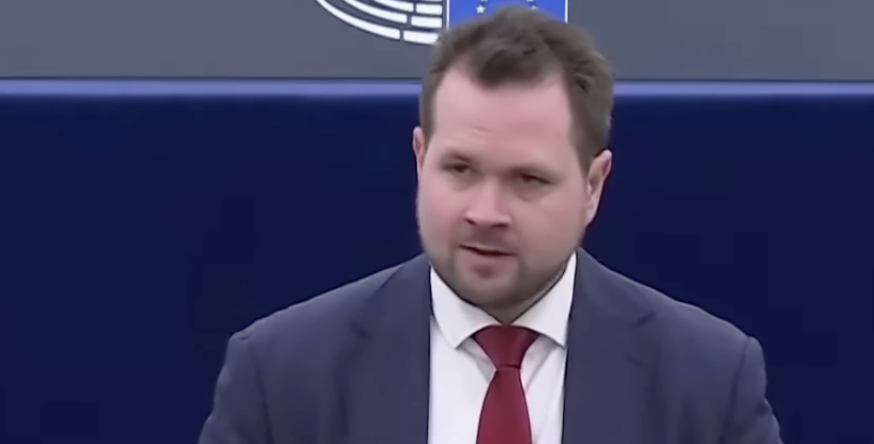
A Danish member of the European Parliament was cut off mid-speech after telling US President Donald Trump to “f**k off” during a debate that touched on renewed US rhetoric about Greenland, a self-governing territory in the Kingdom of Denmark.
Anders Vistisen, a Danish MEP from the Danish People’s Party, made the remark while addressing colleagues in Strasbourg, in comments that were later widely shared on social media and reported by multiple outlets.
In the footage, Vistisen is heard speaking in English as he criticises Trump’s recent statements and framing about Greenland, before ending his intervention with the profane message directed at the US president.
The chair of the sitting intervened immediately, telling him his words were not acceptable and cutting the microphone as the chamber reacted.
The incident landed amid heightened international attention on Greenland following a new round of public comments from Trump about the strategically located Arctic territory, which has long been of interest to the United States for defence and security reasons.
Greenland, the world’s largest island, is an autonomous territory within the Kingdom of Denmark. It has its own government and parliament and controls many domestic matters, while Copenhagen retains responsibility for areas including foreign affairs and defence.
The United States has maintained a military presence in Greenland for decades, reflecting the island’s strategic position between North America and Europe and its role in monitoring the Arctic. The territory has also drawn increasing focus as warming temperatures open new shipping routes and spur interest in natural resources.
Trump’s interest in Greenland first drew widespread attention during his first term, when he floated the idea of the United States purchasing the island, prompting sharp pushback from Danish leaders, who publicly rejected the proposal.
In recent remarks, Trump has returned to the subject, linking Greenland’s future to US national security. In a statement cited in UK parliamentary research, he said: “For purposes of National Security and Freedom throughout the World, the United States of America feels that the ownership and control of Greenland is an absolute necessity.”
He has also posted on social media about Greenland’s strategic importance, using language that has fuelled fresh political debate in Denmark and across Europe about sovereignty and security in the Arctic.
Vistisen’s outburst came as European politicians discussed the implications of US rhetoric and the wider geopolitical context, including Denmark’s relationship with Greenland and the United States, and the increasing strategic competition in the region.
On the European Parliament’s website, Vistisen is listed as a member of the Patriots for Europe Group and as Denmark’s representative for the Danish People’s Party. His curriculum vitae states he was born in Viborg on 12 November 1987 and previously served as an MEP from 2014 to 2019, returning to the Parliament in 2022.
The parliamentary listing also notes his educational background in law at Aarhus University and his earlier work in and around European institutions.
While profanity and disorder are not uncommon flashpoints in legislatures, the explicit personal insult directed at a sitting US president, delivered from the floor of the European Parliament, was treated as a breach of standards by the chair, who halted the remarks.
The clip’s spread online triggered a wave of reaction, with some users praising the bluntness and others criticising the tone as undiplomatic. The episode also prompted renewed attention to the underlying dispute over Greenland’s status and the role of major powers in the Arctic.
Greenland’s government has repeatedly emphasised that the territory’s future is for Greenlanders to decide, while Danish leaders have historically rejected any suggestion the island could be bought or ceded. The issue is politically sensitive within the Danish realm, where questions of autonomy and independence remain part of domestic debate.
For Denmark, the Arctic has become an increasingly prominent national security concern, with Copenhagen balancing its responsibilities for defence and foreign policy with Greenland’s autonomy and the United States’ longstanding military interests.
The European Parliament exchange also came at a time when transatlantic relations have been tested by disagreements on trade, defence spending and foreign policy, alongside ongoing conflicts and instability affecting European security.
Although Greenland is not a member of the European Union, Denmark is, and developments involving Greenland can carry implications for European politics, security planning and relations with Washington.
The episode is likely to add to political pressure on Danish and European officials as they seek to manage diplomatic ties with the United States while responding to domestic and regional concerns about sovereignty and security in the Arctic.
It also underlines how quickly political flashpoints can be amplified by social media, turning a short parliamentary exchange into an international news moment, and forcing governments and institutions to address both the substance of geopolitical disputes and the conduct of elected representatives.
In the immediate aftermath, the European Parliament’s intervention focused on the language used rather than the broader political argument, but the underlying issue, Trump’s renewed focus on Greenland and what it signals about US policy, remains a live topic for Danish politicians and Greenlandic leaders as scrutiny of the Arctic intensifies.