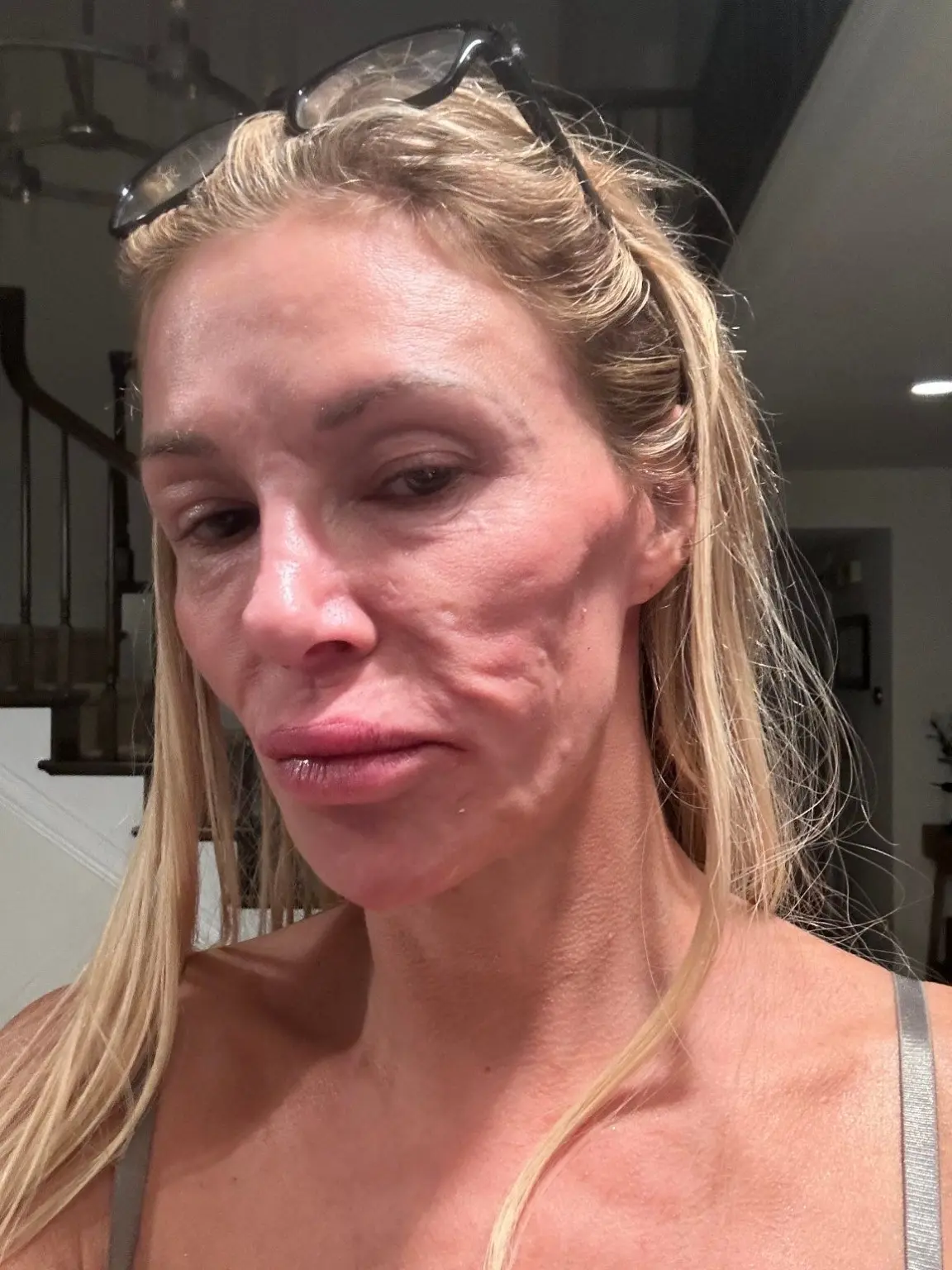
Brandi Glanville has said ruptured breast implants were the underlying cause of the facial infection and disfigurement she has described as ageing her “20 years overnight”, after a prolonged health ordeal that she says involved repeated medical consultations and an initial belief that she was dealing with a parasite.
Speaking in an interview published this week, the former “Real Housewives of Beverly Hills” cast member said she had breast implants placed roughly two decades ago and only learned recently, after further testing, that the implants had leaked and ruptured. She told TMZ that silicone had leaked into her lymph nodes, which she said led to lymphatic blockage and ultimately contributed to the infection affecting her face.
Glanville said standard checks had not initially raised concerns. “They looked fine, they felt fine, the mammogram said they were fine, it wasn’t until I had a sonogram,” she told TMZ, describing her decision to pursue additional imaging after continuing to feel unwell. “I was just feeling like you should check that too, why not? I’ve checked everything else,” she added.
In the same interview, she said she had sought extensive medical help while trying to identify the source of her symptoms. “I definitely had a parasite, I was shocked because I’ve had [my implants] for 20 years, almost,” she told the outlet, adding that she had seen “21 doctors” and “spent so much money” during the process of trying to establish what was happening.
The account links her facial symptoms to complications associated with implant rupture and leakage, a known risk that medical authorities and professional bodies say can occur even when implants appear normal on routine examination. In guidance on silicone gel-filled implants, the US Food and Drug Administration recommends imaging surveillance with ultrasound or MRI beginning five to six years after implantation and then every two to three years, including for patients without symptoms, in order to detect “silent” rupture.
Glanville framed her experience as a cautionary lesson about long-term implant maintenance. “There is such a thing as breast implant illness and you really should change your implants every 10 years, I just didn’t do it. If it’s not broke, don’t fix it. I learned a really, really hard lesson,” she said.
The term “breast implant illness” is used by patients and clinicians to describe a broad group of symptoms reported by some people with implants, though clinicians note it is not a single formal diagnosis and is typically approached by excluding other conditions. The Cleveland Clinic describes breast implant illness as a collection of symptoms reported by people with implants, and says treatment commonly involves implant removal, with many patients reporting symptom improvement afterwards.
Glanville said her facial symptoms were severe and had a major effect on her day-to-day life and confidence. “It sucks to age like 20 years overnight,” she told TMZ, saying she had been undergoing laser treatments for her face and had recently had her breast implants changed.
While she said she did not want to discourage women from having breast implants, she urged consistent follow-up imaging, specifically mentioning sonograms, and described her case as one where mammography alone did not reveal the problem she believes drove the infection.

The timeline she described places the start of her facial swelling in mid-2024, with the disfigurement persisting into 2025 as she sought answers. Earlier public comments from Glanville had reflected uncertainty about the cause. In a social media post in 2024, she wrote: “Some Dr.’s (sic) say I have a parasite that jumps around my face. Some say it’s stress induced edema. I personally say it’s Bravo.”
In later remarks reported in December 2025, she indicated she had finally received a diagnosis but did not disclose details at the time. “I have a long road ahead of me to get fully better, but I finally have an answer, so I’m just thrilled,” she said then, adding: “It’s been hell. I’ve turned into an introvert. Leaving my house, I get the worst anxiety because I’ve been in my house for two years.”
This week’s disclosure places her account in a broader context of ongoing public discussion about implant surveillance and complications. The FDA’s rupture-screening guidance has been widely cited by professional organisations, which emphasise that imaging can identify leakage or rupture that is not obvious through symptoms or physical examination alone.
Glanville said she has now undergone surgery relating to her implants, and she described early signs of improvement following treatment. People magazine reported that one implant was “completely ruptured” and the other was leaking, and that she had linked a range of symptoms to the condition, including lumps and fatigue, alongside the facial issues that became most visible publicly.
She has also shared images of her swelling and redness during her illness on social media in the past, prompting wide public speculation online about what could have caused the changes. In her more recent statements, she has maintained that she “definitely had a parasite” but now believes the implant rupture created the conditions for the infection to take hold and persist, describing a chain of events that she says clogged her lymph nodes and affected drainage.
Medical guidance does not describe facial infection as a typical presentation of implant rupture in most patients, and experts generally caution against drawing broad conclusions from individual cases. However, clinicians acknowledge that implant rupture can lead to silicone migration and local inflammatory responses, and that reported systemic symptoms vary widely among patients. Reviews in peer-reviewed medical literature describe breast implant illness as a poorly defined set of complaints, with some patients reporting improvement after implant removal, while research continues into causes and mechanisms.
For Glanville, the personal impact appears to have been the defining feature of the experience, described in terms of isolation, anxiety and the financial strain of extended medical consultations. She has portrayed the eventual identification of implant rupture as an answer after years of uncertainty, while continuing cosmetic and medical treatments aimed at restoring her appearance.
Her comments have also renewed attention to the practical question she raised repeatedly in interviews: whether patients with older implants are receiving consistent advice about follow-up imaging beyond routine breast screening. The FDA’s recommendations specify ultrasound or MRI surveillance on a set timeline even without symptoms, reflecting the agency’s position that rupture can be silent and missed without targeted imaging.
Glanville’s account, delivered in her own blunt terms, ends with a message she says she learned too late: implant care, in her view, should be treated as ongoing maintenance rather than a one-time procedure. “If it’s not broke, don’t fix it,” she said, before adding: “I learned a really, really hard lesson.”