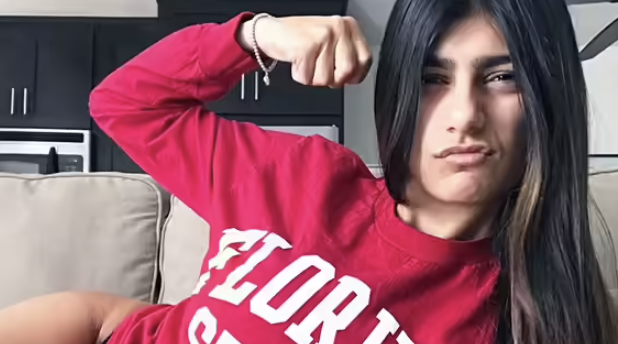
Mia Khalifa has returned to one of the defining battles of her public life, the question of who controls her image, by sharing a series of X-ray photographs that turn nudity into something colder, stranger and more deliberate than the internet persona that first made her famous. The images, created for SHOWstudio’s 25th Anniversary Box Set, were presented by the fashion platform as “never-before-seen” nudes and described as a way of “reclaiming her own image with X-Rays,” while also featuring jewellery from her brand Sheytan. In practical terms, the shoot placed Khalifa’s body back in public view. Symbolically, it did so on very different terms from the ones that shaped her notoriety a decade ago.
The project has attracted attention not because Khalifa is new to provocation, but because it draws directly on the tension that has followed her since 2014, when a brief stint in the adult film industry made her one of the most recognisable women on the internet. Khalifa has repeatedly said that the public identity attached to her was never something she consciously built. In an interview for The New York Times’ “The Interview”, she said she “became infamous by accident” after entering the adult industry in October 2014 and being pressured into a video in which she appeared as “an Arab veiled woman”. She said the intent was to exploit the fact that she was Arabic and spoke Arabic, and that once the video was released, “every news outlet picked it up” and she lost control of her “image” and “reputation”.
That origin story matters to the new X-ray images because the entire premise of the shoot appears to rest on reversal. Instead of conventional nude photography, the body is rendered as bone, shadow and outline. Instead of being presented through the commercial grammar of the adult industry, the images are framed as art, fashion and personal authorship. SHOWstudio explicitly cast the work that way, describing Khalifa as an “icon and activist” whose contribution offered a “witty and personal take on the concept of nudity”. Even the use of Sheytan jewellery inside the project suggests that the photographs are not simply about exposure but about ownership, branding and authorship, with Khalifa folding her own business into the visual statement.
Khalifa’s life since leaving pornography has largely been shaped by that attempt to regain authorship. In the same New York Times interview, she described trying to return to ordinary work after the controversy, but said she felt like “a distraction” in a law office, with whispers around her that made clear normal anonymity was not coming back. She said that realization pushed her towards social media and public life rather than away from it, because if she could not escape public recognition, she would have to learn how to live inside it. That shift eventually turned her into a major online personality with large followings across platforms and a career no longer tied only to the notoriety of her past, even if that past has never stopped trailing behind her.
Her current relationship with sexualised content is far more tightly bounded than the one that first brought her fame. Khalifa told The New York Times that on OnlyFans, where she later built a paying audience, she does not go beyond the level of nudity seen in fashion work, saying, “I don’t do nudity past what I’ve done in a fashion magazine,” adding that she feels secure because her audience understands those limits. She also said she joined OnlyFans in 2020 after the Beirut port explosion with the aim of raising and donating $100,000, and stayed after discovering the community felt different from what she had expected. The distinction she draws is not between sexuality and modesty, but between exploitation and agency. The internet may still trade on the image created in 2014, but Khalifa has spent years insisting that control over context, platform and ownership changes everything.
That same logic runs through Sheytan, the jewellery and bodywear label she launched with Sara Burn. In an interview with Hypebae in 2023, Khalifa described the brand as a celebration of freedom and self-expression, saying it was for “the girl who wears lingerie just for her” and for the woman who wants to feel “more powerful”. She also said the business was self-funded and personal, not a corporate exercise but “our little LLC” created by “just 2 immigrants”. The name itself, derived from the Arabic word for “devil”, was presented not as a scandal tactic but as something intimate, playful and rooted in language she knew from childhood. That background helps explain why the X-ray images matter to her wider career arc. They are not a random stunt. They sit squarely in the aesthetic world she has been building, where the body is still central but is now linked to fashion, commerce and self-definition rather than to the machinery that first consumed it.
Khalifa’s biography also helps explain why image control has become such a durable theme in her public statements. In the New York Times interview, she was described as born in Lebanon and raised Catholic in the Washington area before becoming globally famous at 21. That trajectory, from immigrant upbringing to internet celebrity by way of one deeply controversial viral moment, has long made her a lightning rod for debates over religion, sex, ethnicity and online shame. The hijab scene that accelerated her fame also triggered threats, including violent imagery circulated online, and Khalifa has said the fallout made it impossible to separate herself from a persona the world had already fixed in place. The X-ray shoot does not erase that history. Instead, it seems to acknowledge it directly, by making the body visible again while changing the terms on which it is seen.
There is also a deliberate irony in the method. X-rays are clinical. They flatten glamour, strip away skin tone, expression and seduction, and reduce the body to structure. For someone whose fame has been inseparable from overexposure, that is a pointed choice. The images still trade on curiosity, but they also deny the viewer the old access. They offer form without conventional flesh, intimacy without ordinary revelation. That is why the language used around the project has stressed “reinterpreting” nudity rather than simply displaying it. The work does not ask the public to forget who Mia Khalifa was. It asks them to confront how much of that identity was built by industries, audiences and assumptions that she has spent years trying to outgrow.

What emerges from the episode is less a clean reinvention than a continuation of the argument Khalifa has been making for years: that notoriety can be repurposed, but only if the person at the centre of it holds the pen. She said in the New York Times interview that she wants her brand to represent “being a contradiction” and “evolution”. The X-ray images fit that description. They are provocative but guarded, naked but concealed, commercial but self-aware. They draw energy from the same public fascination that once trapped her, yet they are embedded in a fashion project, linked to a business she owns, and framed through language of reclamation rather than surrender. Whether audiences accept that shift is another question, but the message of the images is hard to miss. Mia Khalifa is still using her body as public text. She is simply insisting, more forcefully than before, that she now gets to write the caption.