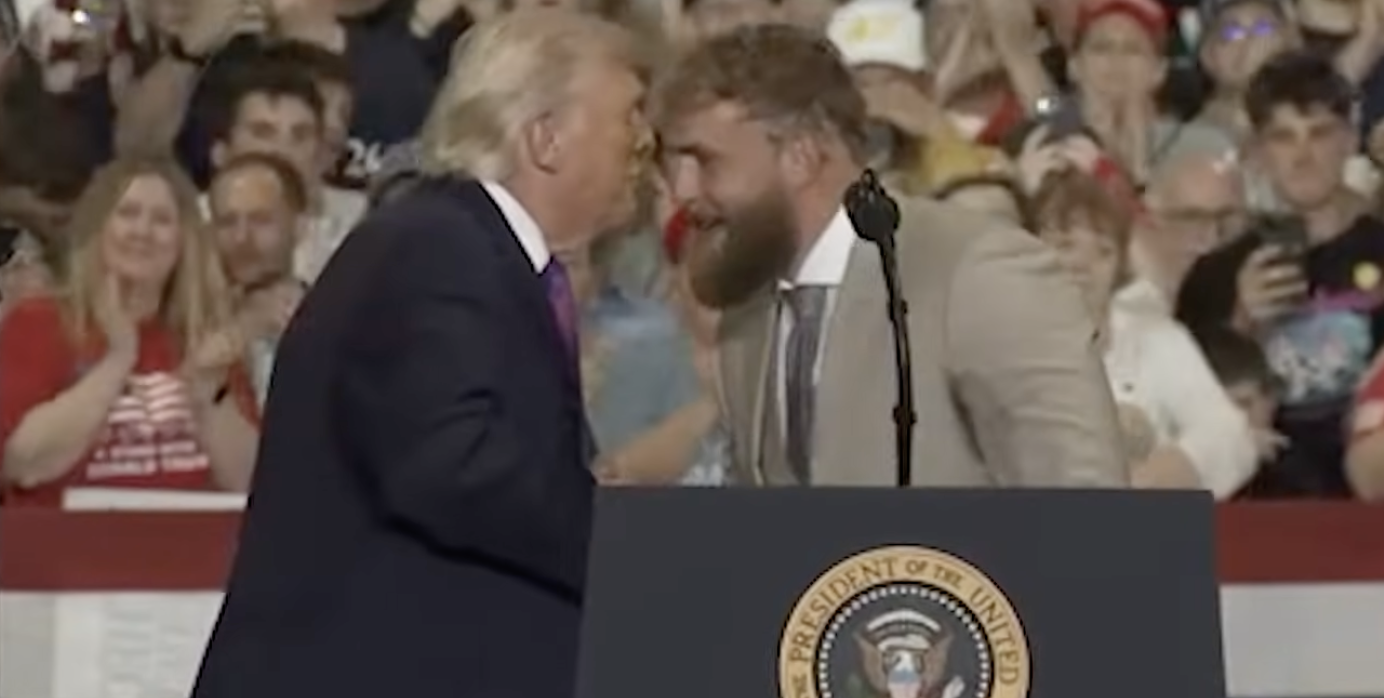
President Donald Trump used a campaign-style rally in northern Kentucky to elevate Jake Paul from celebrity supporter to potential future office-holder, telling supporters that the boxer and internet personality had his “complete and total endorsement” if he ever chose to enter politics. The remarks came on 11 March at Verst Logistics in Hebron, where Trump invited Paul on stage and predicted that the 29-year-old would, “in the not-too-distant future,” run for political office. Paul then addressed the crowd himself, deepening an alliance that has become increasingly visible since the 2024 election cycle.
The moment was striking not only because of Trump’s language, which echoed the formula he often uses for formal political endorsements, but because it placed Paul, a figure who built his fame on YouTube controversy and prizefighting spectacle, into a more overtly political frame. According to accounts of the rally, Trump praised Paul’s toughness and public persona before calling him up, saying he believed the Ohio-born influencer had the temperament and visibility to seek office one day. Paul responded with a speech built around themes of courage, truth-telling and American industry, presenting himself less as an entertainer passing through politics and more as a public figure trying on the language of a campaign surrogate.
Paul’s appearance did not come out of nowhere. In October 2024, shortly before the presidential election, he publicly endorsed Trump in a long video titled “who I’m supporting for president… and why you should too,” telling followers he wanted to lay out the reasons that had led him to his decision. That endorsement marked a notable step in Paul’s transition from online provocateur to culture-war commentator, and it signalled a willingness to use the vast audience he built through YouTube, boxing and social media in explicitly political ways. By March 2026, Trump was no longer merely receiving Paul’s support. He was publicly imagining a future in which Paul himself could become a candidate.
That political flirtation comes at a complicated moment in Paul’s wider career. He remains one of the most commercially powerful figures in combat sports, but he is also coming off the most punishing defeat of his boxing life. In December 2025, Anthony Joshua stopped Paul in the sixth round of their heavily publicised fight in Miami, breaking Paul’s jaw in two places. Reuters reported before and after the bout that Paul had become a singular figure in boxing, leveraging internet fame into headline events with mainstream reach, while also attracting criticism from purists who saw his rise as evidence of spectacle overtaking sporting merit. The Joshua loss did little to erase Paul’s market value, but it did underline the limits of his in-ring experiment at heavyweight level.
Even so, Paul’s influence in the fight business extends well beyond his own record. His company, Most Valuable Promotions, which he co-founded with Nakisa Bidarian in 2021, describes itself as a fighter-first sports promotion business focused on building athletes and events through digital storytelling and major live shows. That model has helped Paul shift from being merely the subject of spectacle to one of its organisers. It also helps explain why Trump may view him as useful in political terms. Paul brings not just name recognition, but a direct pipeline to younger, overwhelmingly online audiences who do not consume politics through traditional party structures or broadcast news.
Trump and Paul have also been increasingly visible together in person. In January, they were photographed at the College Football Playoff National Championship game at Hard Rock Stadium in Miami Gardens, one of several public settings in which their relationship has moved from loose mutual admiration to something closer to a recurring political and cultural association. The Kentucky rally strengthened that impression. Paul was not treated as a passing celebrity guest. He was presented to supporters as someone with standing, loyalty and future potential. That is important because Trump has long used rallies not just to energise voters, but to audition allies, bless successors and test how a crowd reacts to new political personalities.
For Paul, the attraction of politics is not difficult to see, even if he has not announced any intention to run for office. His career has been built on attention, conflict and direct communication with an audience that expects authenticity, aggression and constant reinvention. Those are qualities that have often translated effectively into modern American politics, particularly in the Trump era. Paul has spent years cultivating the image of someone who rejects gatekeepers, ignores establishment scorn and converts outrage into reach. That formula helped him survive repeated controversies in entertainment, then pivot into boxing, then into promotion and investing. In each case, he presented himself as someone underestimated by institutions and vindicated by scale. Politics would be a logical extension of that story, even if it remains speculative at this stage.

There are also personal and practical wrinkles. Reports around Paul’s 2024 endorsement noted that he resides in Puerto Rico, where residents cannot vote in presidential general elections unless they vote from a U.S. state, a detail that became part of the online discussion surrounding his intervention in national politics. But eligibility to run for office is a separate matter depending on the office sought, and Trump’s comments in Kentucky were plainly aimed less at constitutional specifics than at symbolism. He was effectively telling supporters that Paul belongs on their side, and perhaps one day on a ballot. Whether that ever happens is another question.
For now, Paul’s life remains rooted in sport, celebrity and business. He is engaged to Dutch speed skating star Jutta Leerdam, who announced their engagement with him in March 2025, and he continues to occupy a hybrid space where combat sports, influencer culture and personal branding are almost impossible to separate. Yet the Kentucky rally suggested that another lane may be opening. Trump did not speak about Paul as a novelty act. He spoke about him as someone who could plausibly cross over. In a political age that has already seen television fame, social media power and outsider celebrity converted into electoral capital, that prediction no longer sounds as outlandish as it might once have done. On Wednesday night in Hebron, it was made to sound almost natural.