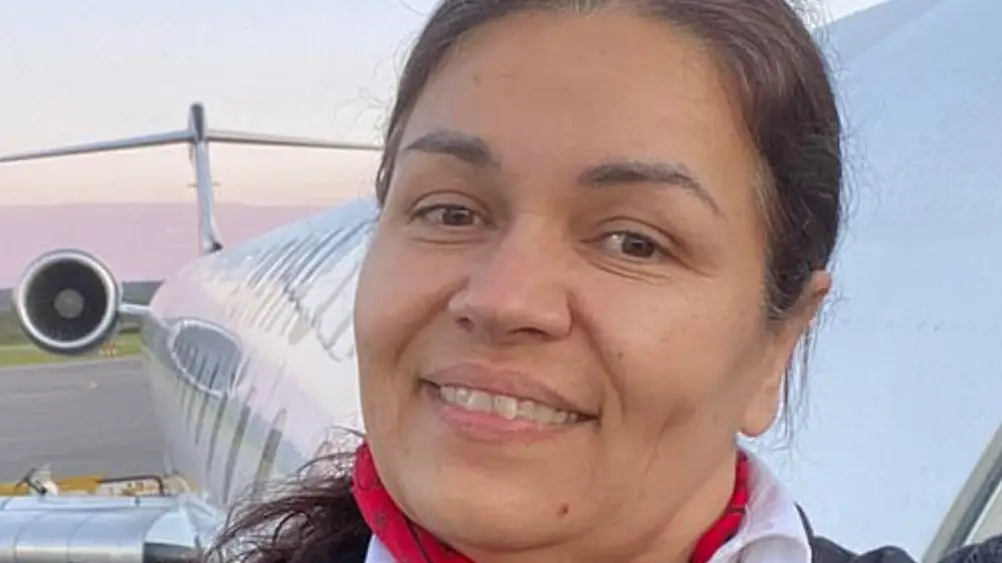
The daughter of a flight attendant who survived being flung from an Air Canada regional jet after it crashed into a fire truck at New York’s LaGuardia Airport has described her mother’s survival as a miracle, as investigators continue to examine how a landing aircraft and an emergency vehicle ended up on the same runway at the same time. The woman, Solange Tremblay, was found still strapped into her jump seat after the late-night collision on Sunday, one of the most startling survivals to emerge from a crash that killed both pilots and injured dozens of other people.
The aircraft, a CRJ-900 operated by Jazz Aviation for Air Canada Express as Flight 8646 from Montreal, was carrying 72 passengers and four crew members when it struck a Port Authority fire truck as it landed on Runway 4 at LaGuardia shortly before midnight. Reuters and other outlets reported that the impact killed the pilot and first officer, crushed the nose of the plane and sent large numbers of passengers and crew to hospital, while two officers in the fire truck were also injured. LaGuardia was closed after the crash and hundreds of flights were cancelled before operations partially resumed.
Tremblay’s case quickly became the human focus of the aftermath. Her daughter, Sarah Lépine, told Quebec broadcaster TVA Nouvelles that her mother had survived despite being thrown clear of the aircraft while still fastened into the crew jump seat. Speaking through accounts carried by AP and other reports, Lépine said her mother had suffered multiple fractures to one leg and would require surgery, but had escaped the kind of catastrophic injuries many would have expected given the destruction to the front of the aircraft. “I’m still trying to understand how all this happened,” she said. “But she definitely has a guardian angel watching over her.” In another remark carried by Canadian and international coverage, she called it a “complete miracle.”
According to the reporting that has emerged since the crash, Tremblay had been seated behind the cockpit in a crew jump seat when the aircraft came in to land. That location helps explain why her survival has drawn such attention. The front section of the aircraft absorbed the worst of the impact, and the cockpit area was left shattered. AP cited aviation safety expert Jeff Guzzetti as saying the four-point restraint used in crew seats was likely crucial in keeping her alive. He described her survival as extraordinary given the force of the collision and the visible destruction to the aircraft’s nose.
The crash itself unfolded during a separate airport emergency. Reuters reported that the fire truck was responding to a United Airlines aircraft that had declared an emergency because of a bad odour in the cabin, an incident that had apparently sickened flight attendants. While controllers were dealing with that situation, the truck was cleared to cross Runway 4. At nearly the same time, the arriving Air Canada flight was landing on that same runway. Audio reviewed by Reuters captured the frantic final seconds. “Stop, truck one, stop,” a controller said after approving the crossing, but the warning came too late. The arriving jet struck the vehicle moments later.
That audio has become central to the early understanding of the disaster. Reuters reported that a separate recording appeared to capture the same controller, shaken after the collision, telling another pilot: “I messed up.” That brief admission has intensified scrutiny of tower operations, although investigators have stressed that the inquiry remains open and that no single cause has been formally established. National Transportation Safety Board chair Jennifer Homendy said nothing was being ruled out, and investigators recovered both the cockpit voice recorder and the flight data recorder as part of the inquiry.

The people killed in the crash have also begun to come into sharper focus. Coverage cited by Reuters and the Guardian identified the dead pilots as Antoine Forest and Mackenzie Gunther, two Canadian aviators at the beginning of their professional careers. The Guardian reported that Forest was 30 and had joined Jazz Aviation in 2022. In a statement carried by ALPA, the Air Line Pilots Association president Jason Ambrosi said: “The loss of our two fellow crewmembers onboard Flight 8646 is a profound tragedy.” He added: “These pilots dedicated their careers to the safe transport of passengers, and we are all thinking of their families, loved ones, and colleagues at Jazz Aviation during this devastating time.”
For passengers and surviving crew, the accounts that have emerged are of confusion, violence and then escape. People reported that the plane landed hard, hit the vehicle and then filled with screams as those on board tried to understand what had happened. Hospitals initially treated scores of people from the aircraft and the emergency vehicle, although many were later discharged. Port Authority executive director Kathryn Garcia said the truck had been responding to another aircraft that had reported an odour issue, while officials said dozens were taken to hospital in the immediate aftermath. By Monday night, the number still in hospital had fallen significantly, but the human and operational consequences remained severe.
Tremblay’s own background has only deepened the emotional impact of her survival. The Guardian reported that she had worked for Jazz for 26 years, making her a long-serving member of the airline’s cabin crew rather than a newcomer. That detail, coupled with her daughter’s description of the injuries she sustained and the fact she remained strapped into her seat after being thrown from the aircraft, has made her story one of endurance as much as luck. In aviation disasters, cabin crew are often remembered for the help they give passengers in the worst moments. Here, one of them has become one of the most improbable survivors.
The crash has also landed in a wider moment of anxiety around air safety and airport operations in the United States, though investigators have been careful not to leap ahead of the evidence. Reuters reported that attention has fallen on air traffic control procedures, communications and the handling of simultaneous emergencies. Transportation Secretary Sean Duffy said staffing was not the issue at LaGuardia, but the recordings have raised obvious questions about decision-making in the tower in the seconds before impact. For now, the investigation is centred on what was cleared, what was heard, and why the warning to stop came too late.
In Canada, the loss of the pilots and the survival of Tremblay prompted a wave of reaction. Canadian Prime Minister Mark Carney described the collision as “deeply saddening”, while labour representatives and colleagues in aviation expressed sympathy for the crew and their families. But for one family, the story now turns on recovery rather than only grief. Tremblay survived a collision that destroyed the front of her aircraft, killed the two pilots ahead of her and left investigators trying to reconstruct a sequence of decisions measured in seconds. Her daughter’s account has not tried to make sense of every technical detail. Instead, it has fixed on the one fact that, amid the wreckage and the deaths, has seemed hardest to explain: she is still alive.