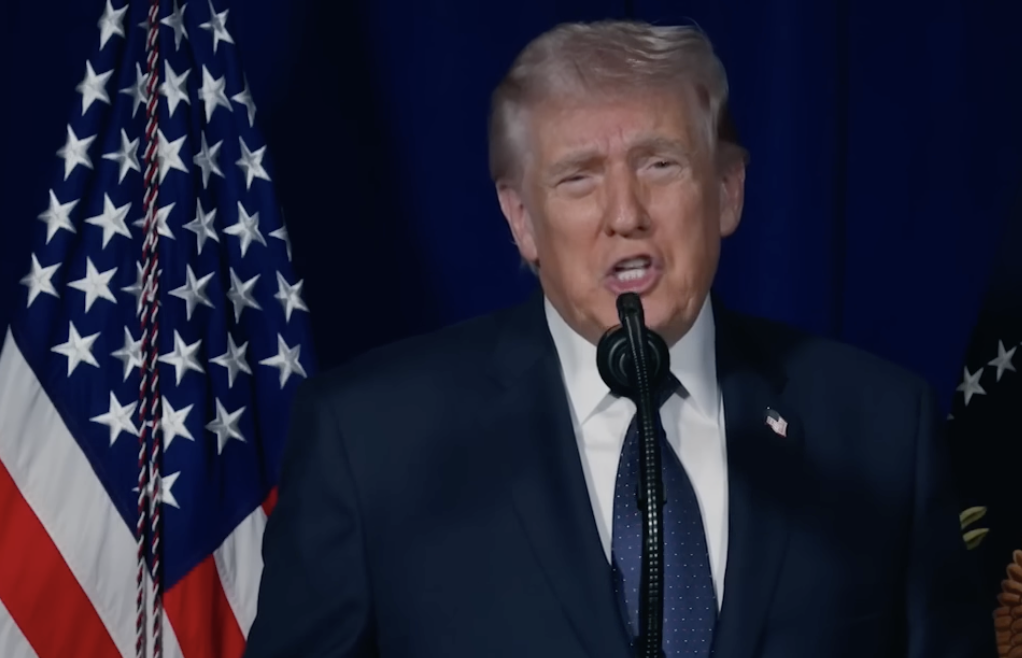
Donald Trump said on Sunday that he believed the war in Iran could be brought to a negotiated end, while also arguing that the conflict had already produced what he described as “regime change” inside the country, a claim that immediately sharpened attention on the state of Iran’s leadership and on the fragile diplomatic efforts now under way to stop a war that has entered its second month. According to reports from the weekend, Trump told reporters he was “pretty sure” a deal could be made and said the United States was now dealing with “a whole different group of people” in Tehran after a wave of killings among Iran’s leadership during the conflict.
The phrase at the centre of his remarks was “regime change”, words that carry a heavy history in U.S. foreign policy and which, in this case, appear to have been used by Trump to describe the upheaval at the top of the Iranian state rather than the formal collapse of the Islamic Republic. In the same comments, he suggested that the people now running Iran were not the same figures international negotiators had dealt with before. That assessment followed the killing of Iran’s Supreme Leader Ayatollah Ali Khamenei in the conflict, after which his son Mojtaba Khamenei took his place, a succession now reflected in international reporting on the war and its political fallout. (The Guardian)
What Trump appeared to be arguing was that the removal of senior figures had already transformed the structure and character of decision-making in Tehran, even though the institutions of the Iranian state remained in place. There has been no public indication that Iran’s constitutional order has been dismantled, nor that its chain of authority has disappeared entirely. Instead, reporting in recent days has pointed to a state under severe strain but still functioning, with Mojtaba Khamenei identified as the country’s supreme leader even as questions persist about his health, whereabouts and capacity to appear in public. Russia’s ambassador to Tehran was quoted on Tuesday as saying Mojtaba Khamenei remained in Iran but was avoiding public appearances for “understandable reasons”. (Reuters)
That gap between Trump’s rhetoric and the observable continuity of the Iranian state is central to the current story. On one side, Trump has sought to present the military campaign as having already achieved a major strategic shift by decapitating parts of Iran’s leadership. On the other, diplomats and foreign governments are still dealing with Iran as a state actor capable of negotiating, responding and continuing the war. Trump’s own remarks reflected that tension. Even while using the language of regime change, he also said a deal with Iran remained likely and indicated that indirect contacts were progressing. Reports from the weekend said Pakistani intermediaries were involved in those efforts, underscoring how military escalation and diplomacy are now unfolding at the same time. (The Guardian)
Pakistan has since moved more visibly into a mediating role. Reuters reported on Tuesday that China and Pakistan jointly called for an immediate ceasefire in the Gulf and the wider Middle East, urging the swift launch of peace talks and restoration of normal navigation in the Strait of Hormuz. Pakistan, which shares a long border with Iran, has said it is ready to facilitate talks between Washington and Tehran, while China publicly backed diplomacy as the only workable path out of the conflict. Reuters also reported that Pakistan had already hosted talks involving Turkey, Egypt and Saudi Arabia, showing that regional powers are now trying to create a framework for de-escalation before the war spreads still further. (Reuters)
Those diplomatic efforts matter not only because of the scale of the fighting, but because the war has become entangled with wider fears about global energy supplies, shipping routes and the stability of the wider Middle East. The Strait of Hormuz remains one of the most sensitive flashpoints in the crisis, and any prolonged disruption there has immediate consequences for oil markets and for governments far beyond the region. That economic pressure has added urgency to international calls for clarity about Washington’s war aims and for a settlement that prevents a broader regional collapse. (Reuters)
Among the leaders voicing concern is Australian Prime Minister Anthony Albanese, who said on Monday that he wanted greater certainty from Trump about the objectives of the war and that he wanted to see de-escalation. His comments were notable because they captured a concern shared by other governments watching the conflict from outside the immediate theatre: even allies of the United States are seeking a clearer explanation of what victory would actually mean. If Trump’s use of “regime change” was intended to suggest that one major objective had already been achieved, it did little to reduce those questions. Rather, it raised new ones about whether Washington sees the killing of leaders as sufficient, whether it wants a formal political restructuring in Iran, or whether it simply wants a negotiated settlement from a weakened adversary. (Reuters)
Trump’s own public style has long relied on bold, compressed phrases that dominate headlines and frame events in stark terms. Throughout his political career, he has preferred language that is direct, provocative and easily repeated, particularly in moments of international crisis. In this case, the words “regime change” immediately transformed a more complicated military and diplomatic picture into a blunt political claim. Yet the detail behind the claim remains messy. Iran’s leadership has clearly been hit hard. Senior figures have been killed. A succession at the top has taken place under wartime conditions. Public visibility from the new supreme leader has been minimal. But the state has not vanished, and regional diplomacy is proceeding on the assumption that Tehran remains a coherent negotiating party. (Reuters)
The new central figure in that equation is Mojtaba Khamenei, whose rise has given the conflict a dynastic edge that would once have seemed improbable in a republic built on revolutionary ideology. Until recently, he had often been discussed in outside analysis as an influential but shadowy clerical figure, not a public national leader. Now he has inherited power in the middle of war, under conditions so insecure that even his public appearances have reportedly been suspended. That alone points to the instability Trump was trying to capture in his remarks, even if his terminology overstated the extent of formal political change inside Iran. (Reuters)
The war’s political meaning is therefore being contested in real time. For Trump, the argument is that the removal of top Iranian figures has fundamentally changed the regime and made a deal more attainable. For Iran’s adversaries and mediators alike, the more immediate reality is that the conflict has left a battered but still operative power structure in Tehran, one that may be under pressure but has not ceased to exist. For countries like Pakistan and China, the priority is to stop the fighting before it deepens the threat to energy routes and drags more actors into open confrontation. (Reuters)
What happens next may depend less on the headline-grabbing phrase Trump used than on whether back-channel diplomacy can produce terms both sides are willing to accept. His comments showed confidence that an agreement could come soon. But they also highlighted the ambiguity surrounding U.S. strategy, especially when paired with language suggesting that a political transformation has already taken place in Iran. For now, the most accurate picture is of a war that has killed senior Iranian leaders, elevated Mojtaba Khamenei, intensified international mediation and left the world trying to work out whether Trump’s “regime change” claim was a declaration of victory, a negotiating tactic, or simply another attempt to impose a dramatic label on a conflict whose end is still not in sight. (The Guardian)