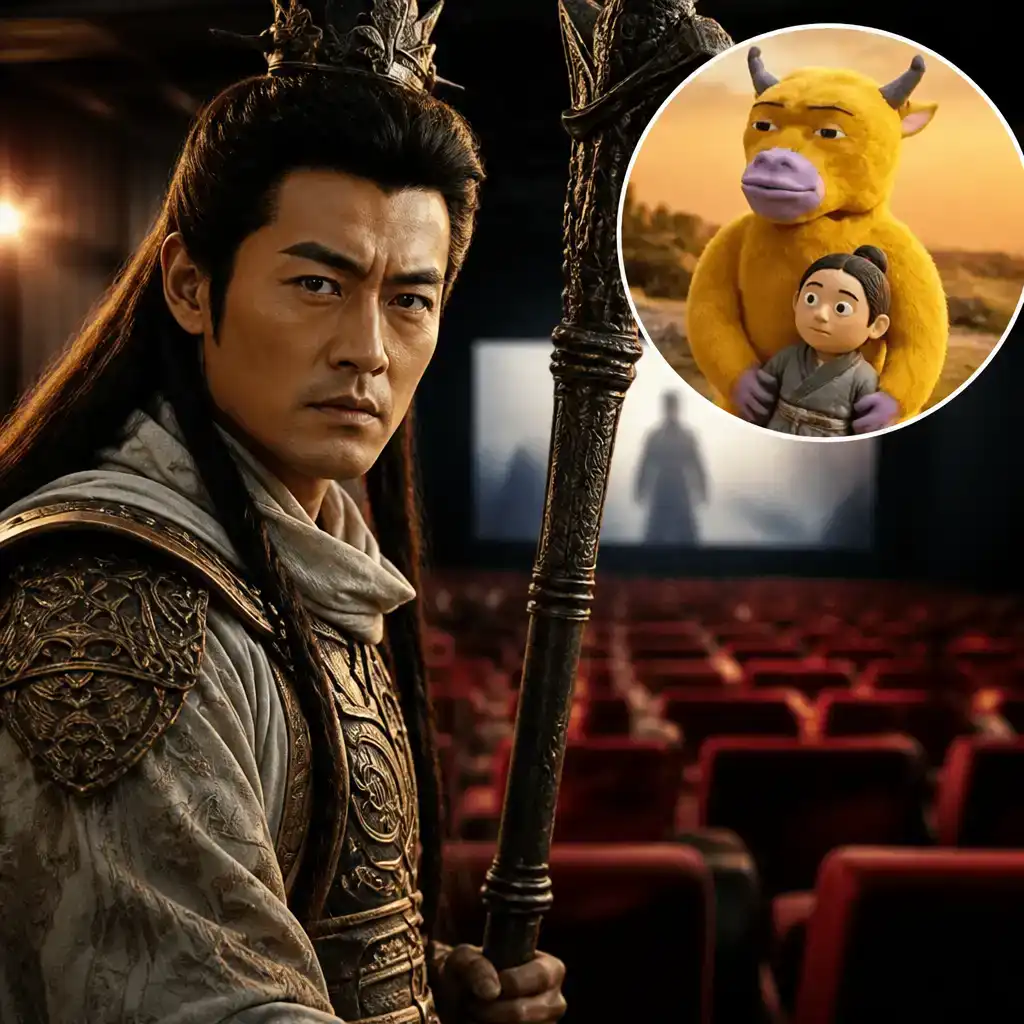
China’s first AI-generated feature film arrived with advanced technology, a major production company and thousands of screenings. Audiences responded by largely staying home. Sanxingdui: Future Past opened on October 23 and had earned just 1.30 million yuan by 5 p.m. on October 27, according to Maoyan data reported by 10jqka.
Bona Film Group said the 100-minute science-fiction production cost more than 10 million yuan, or over $1.5 million. Lighthouse projected a final theatrical gross of roughly 2.61 million yuan, with about 800,000 yuan expected to reach the distributor. That would recover less than one-tenth of the production budget. The machines may have generated the pictures, but they have yet to improve cinema accounting.
How empty were the screenings?
The film opened with more than 10,000 screenings scheduled for its debut, but attendance quickly collapsed. Through late October 26, it had sold around 41,000 tickets.
Caixin-affiliated financial reporting said the movie had earned 1.229 million yuan by that point. On October 26, it received 8,331 screenings, recorded an occupancy rate of 0.2% and averaged 0.3 viewers per showing. Separate reporting from National Business Daily found that screenings on October 24 and 25 averaged only about two viewers each.
One woman who attended a free preview told Agence France-Presse that the technology alone did not justify buying a ticket.
“If AI generation can match the theatrical experience of Avatar, I think I would be willing to pay for it,” she said.
Independent AI filmmaker Zhang Jun made the commercial problem even clearer: “The audience won’t automatically pay for the tickets just because it’s an AI-generated film.”
Was the entire film really made by AI?
The “fully AI-generated” label requires some qualification. National Business Daily reported that all the images were generated using artificial intelligence, while humans retained final creative control. The Paper said Vidu supplied the AI technology, but Bona’s team developed the ideas and made the creative decisions.
Chinese regulators classified the release as an animated film rather than placing it in a separate AI category. Production still involved:
- Nearly 100 human workers
- More than two years of development
- Over 1.2 million underlying images
- More than 100 complete-film iterations
So while AI handled much of the visible output, this was not a case of typing a prompt and returning after lunch. It remained a large, expensive production with extensive human supervision.
Bona executive producer Jiang Defu told Dongxi Entertainment that box-office revenue was not the project’s main objective. He said the company wanted to test whether AI could provide the film industry with “a new solution.” On that narrower measure, the experiment may still offer useful production data. As a theatrical product, however, the early numbers were severe.
Investors also lost some enthusiasm
The market reaction added another layer to the disappointment. The film’s announcement was followed by three consecutive days in which Bona shares reached their daily upward trading limit. After the release struggled, the company’s stock hit the 10% daily loss limit on October 26. Several other AI-content stocks also declined.
Investor excitement had therefore moved much faster than ticket sales. Bona was still looking beyond China, saying at the time that a Malaysian release was scheduled for November 12 and that launches in 14 other markets were under discussion.
A $200 animation found the audience AI could not
The comparison with Niu Lai is particularly uncomfortable. Director Xin Yumeng and his mother, screenwriter Sun Lifang, reportedly spent about $200 and five years making the 86-minute animated feature. They handled most of the production work themselves, without generative AI.
Its crude visuals and awkward character movements initially attracted only around 200 viewers. Online mockery then turned the film into a curiosity, and audiences began visiting cinemas to see the strange result for themselves. By early September, Cartoon Brew reported that it had earned more than 60 million yuan.
That total was more than 46 times the amount earned by Sanxingdui: Future Past through October 27. One film had sophisticated AI tools, a major studio and a seven-figure budget. The other had two determined filmmakers and animation widely described as looking worse than AI.
The contrast does not show that audiences will reject every AI-assisted movie. It does show that production technology is not a substitute for a film people want to watch, a finding the cinema business had technically discovered before artificial intelligence existed.