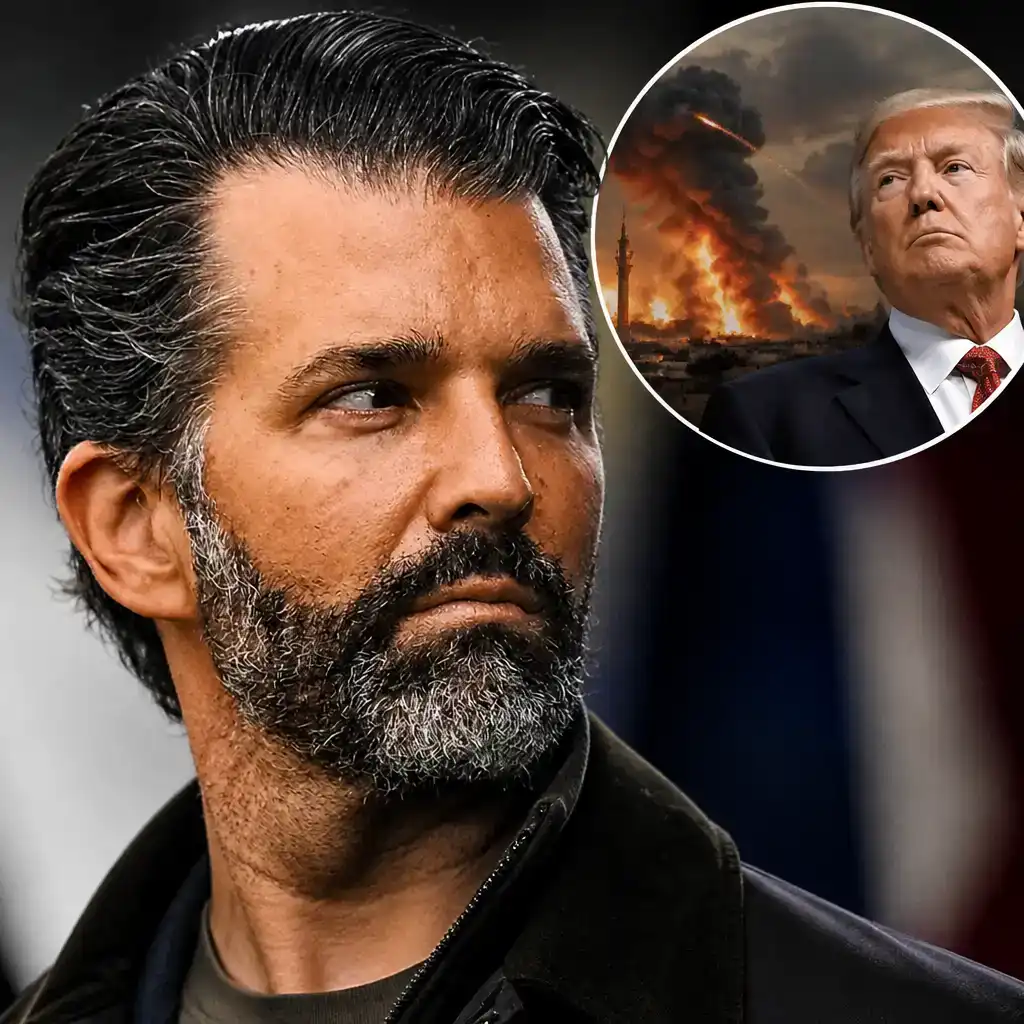
Donald Trump Jr’s Iran war opposition has reportedly been clear in private, even if he has shown no appetite for discussing it where microphones are present. Two people who spoke directly with him told The Atlantic that he opposed the conflict from the outset and raised his concerns with his father, President Donald Trump.
The account presents a rare split between Trump Jr and the president on a major policy decision. It is not, however, a public rebellion. One person close to Trump Jr said he “would never publicly break with his dad on an issue like this,” adding that his private position would not surprise people who know him.
Trump Jr’s spokesperson declined to comment. The White House also avoided answering questions about his reported position, choosing instead to declare that “Iran has been decimated” and predict that the conflict would end “very soon.” Seven months into the war, certainty remains easier to produce than an ending.
The report has not been independently confirmed
No outlet has independently verified Trump Jr’s private conversations since The Atlantic published its account. Subsequent reports from The Independent and The Daily Beast relied on the same original sourcing, rather than separate interviews with people who heard him express those views.
Neither Trump Jr nor President Trump has publicly addressed the claim. No conflicting account has emerged, but the central allegation still rests on two unnamed people who said they discussed the war directly with the president’s son.
According to those sources, Trump Jr wanted to avoid another American war in the Middle East. They also pointed to his relationship with conservative activist Charlie Kirk, who opposed the conflict before his death.
Kirk’s spokesman, Andrew Kolvet, previously told The Washington Post that Kirk understood Iran would be “a tough pill to swallow for Gen Z.” Polling cited by the newspaper found that only 16 percent of adults under 30 supported the decision to go to war.
Private doubts reach beyond Trump Jr
Trump Jr’s reported resistance fits a broader divide among figures associated with Trump’s “America First” coalition. The Independent reported that Vice President JD Vance, Central Intelligence Agency Director John Ratcliffe and Secretary of State Marco Rubio had also expressed skepticism or reservations early in the conflict.
That does not make them a unified anti-war bloc. Their roles, objections and public positions differ. But the reported concerns show the administration’s policy was not greeted with universal enthusiasm inside Trump’s political orbit, despite the White House’s confident public language.
The disagreement also carries implications for the movement’s future. Trump Jr, Vance and Kirk all cultivated younger conservative voters who were drawn to promises of limiting overseas military commitments. Their reported unease suggests the Iran war is testing whether that position remains a governing principle or simply useful campaign material.
The political costs are becoming harder to ignore
Public opinion has moved sharply against the conflict. Pew Research Center found that 65 percent of Americans disapproved of Trump’s handling of the war, while only 34 percent believed the initial use of force was the correct decision. Another 77 percent expected military action to continue for at least six more months.
Support has weakened even among Republicans. Approval of Trump’s handling of Iran fell from 69 percent in March to 63 percent in October. An Associated Press-NORC poll found that roughly two-thirds of registered voters considered the war a leading issue ahead of the November 3 midterm elections.
The military and diplomatic picture remains unsettled. The Associated Press reported that Trump ruled out renewed strikes before the midterms but left open the possibility of escalation afterward. Indirect negotiations have continued following a failed ceasefire in June, with the dispute over the Strait of Hormuz remaining central to the deadlock.
Trump has described the negotiations as productive while also saying, “I think the deal isn’t really something that I want to do.” That leaves the administration promising a rapid conclusion, keeping military options available and expressing limited interest in the agreement under discussion.
For Trump Jr, staying silent avoids a public confrontation with his father. It also leaves voters to learn about his apparent opposition through unnamed sources while the war’s political and economic costs continue to accumulate. Private dissent may preserve family unity, but it offers little guidance about what he would actually do with influence of his own.