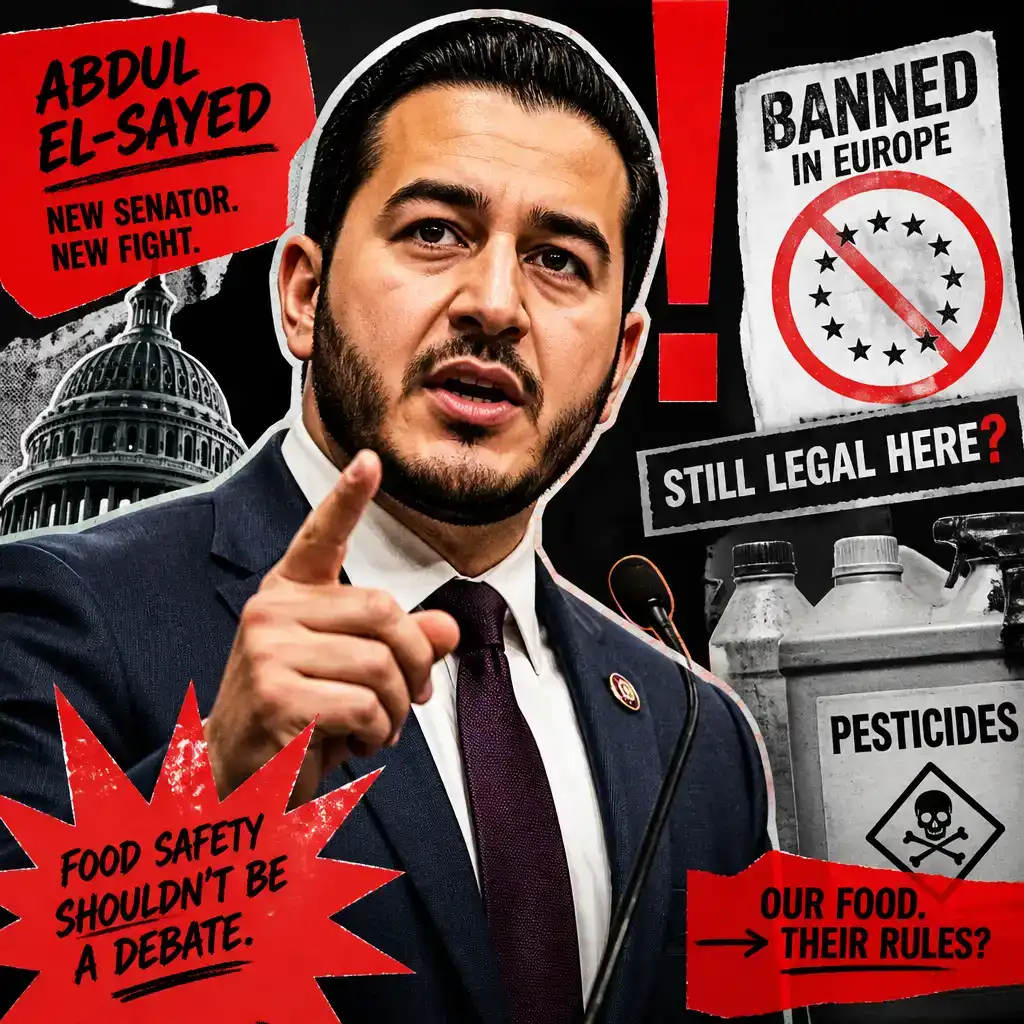
Michigan's newly elected US senator, Abdul El-Sayed, wants America to stop using agricultural pesticides that have already been banned in Europe. His proposal could reopen a long-running dispute over food safety, chemical regulation and the protections available to American farmers.
El-Sayed, a physician and former Detroit health director, defeated Republican Mike Rogers in Michigan's Senate election on November 3, 2026. His victory gives new relevance to a public health agenda he unveiled during the campaign, including a commitment to pursue federal restrictions on pesticides prohibited by European regulators.
The proposal appears in his Building a Healthier America policy agenda, published on September 29. But while the pledge is genuine, the details are less settled than some descriptions of it suggest.
What Abdul El-Sayed actually wants to ban
El-Sayed's campaign committed to introducing legislation targeting pesticides already prohibited in Europe. It also proposed measures to help farmers reduce their dependence on agricultural chemicals, including better technical assistance and changes to agricultural subsidies.
However, the published proposal does not identify a definitive list of pesticides that would be banned, specify when restrictions would take effect or explain how farmers would transition away from particular products.
That distinction matters. Organophosphates and neonicotinoids, two important classes of agricultural insecticides, have faced restrictions in Europe, but their regulatory status varies significantly between individual chemicals.
There is also an important difference between proposing legislation and enacting it. El-Sayed is currently senator-elect and will not take office until January 2027. His campaign commitment is not an enacted federal pesticide ban.
The pesticide Europe banned in 2020 but America still restricts differently
One particularly revealing example is chlorpyrifos, an organophosphate insecticide historically used on numerous agricultural crops.
The European Commission ended its approval in January 2020 following assessments that identified concerns about possible genetic damage and developmental neurotoxicity. European regulators concluded that the available evidence did not establish a safe level of exposure.
The United States took a different and more complicated route.
In 2021, the Environmental Protection Agency revoked the food residue tolerances for chlorpyrifos, effectively preventing its use on food crops. But a federal appeals court overturned that decision in November 2023, and the tolerances were subsequently reinstated.
Since then, US regulators have narrowed the insecticide's permitted agricultural applications. According to the EPA's published guidance, authorised food uses are now limited to 11 crops, subject to geographical and application restrictions.
Those crops include apples, citrus fruits, peaches, strawberries, soybeans and wheat.
The result is a genuine regulatory difference: chlorpyrifos is no longer approved for agricultural pesticide use in the European Union, while certain restricted uses remain permitted in the United States.
Why Europe's pesticide rules are more complicated than a blanket ban
The European Union has also imposed substantial restrictions on neonicotinoid insecticides, particularly because of risks to bees and other pollinators.
In 2018, EU regulators prohibited outdoor uses of three substances: imidacloprid, clothianidin and thiamethoxam. The restrictions initially retained the possibility of use in permanent greenhouses, and the substances have subsequently faced further regulatory changes.
These decisions are documented by the European Commission.
But it would be misleading to suggest that Europe banned every pesticide in these chemical families decades ago. The major restrictions discussed here were introduced in 2018 and 2020, and different substances have different approval histories.
Nor does banning an agricultural chemical automatically mean that every food product containing a detectable pesticide residue is illegal. The EU separately regulates maximum residue levels in food, including imported products.
This distinction is central to understanding what adopting Europe's approach would actually mean for American agriculture.
Another pesticide proposal is already before Congress
El-Sayed's programme also supports the Pesticide Injury Accountability Act, an existing legislative proposal addressing the legal rights of people who claim to have been harmed by pesticides.
The bill, S. 2324, was introduced by Democratic Senator Cory Booker in July 2025 and referred to the Senate Agriculture, Nutrition, and Forestry Committee.
Its purpose is different from a chemical ban. The legislation seeks to establish a private right of action for pesticide-related injuries, giving affected individuals a potential legal avenue to pursue claims against manufacturers.
Supporting that bill and proposing European-style pesticide restrictions are therefore two separate elements of El-Sayed's agenda.
What happens next for US pesticide regulations?
El-Sayed's election gives him an opportunity to pursue the food safety proposals he promoted during his campaign. But implementing them would require much more than a general commitment to follow European standards.
Any proposed legislation would need to identify the relevant chemicals, define the restrictions, account for existing EPA regulations and address the practical consequences for agricultural producers.
His campaign has also promised to strengthen USDA technical assistance, encourage crop diversification and support farming practices designed to reduce chemical dependency. Those commitments could become particularly important if new restrictions require growers to find alternative pest-control methods.
For consumers, the central question is whether a future law would materially change the pesticides permitted in American food production. For farmers, it is which chemicals might be restricted and what alternatives would be available.
Until El-Sayed publishes a detailed legislative proposal, those questions remain unanswered. What is now confirmed is that a campaign promise to bring American pesticide rules closer to European standards will follow him into the US Senate.