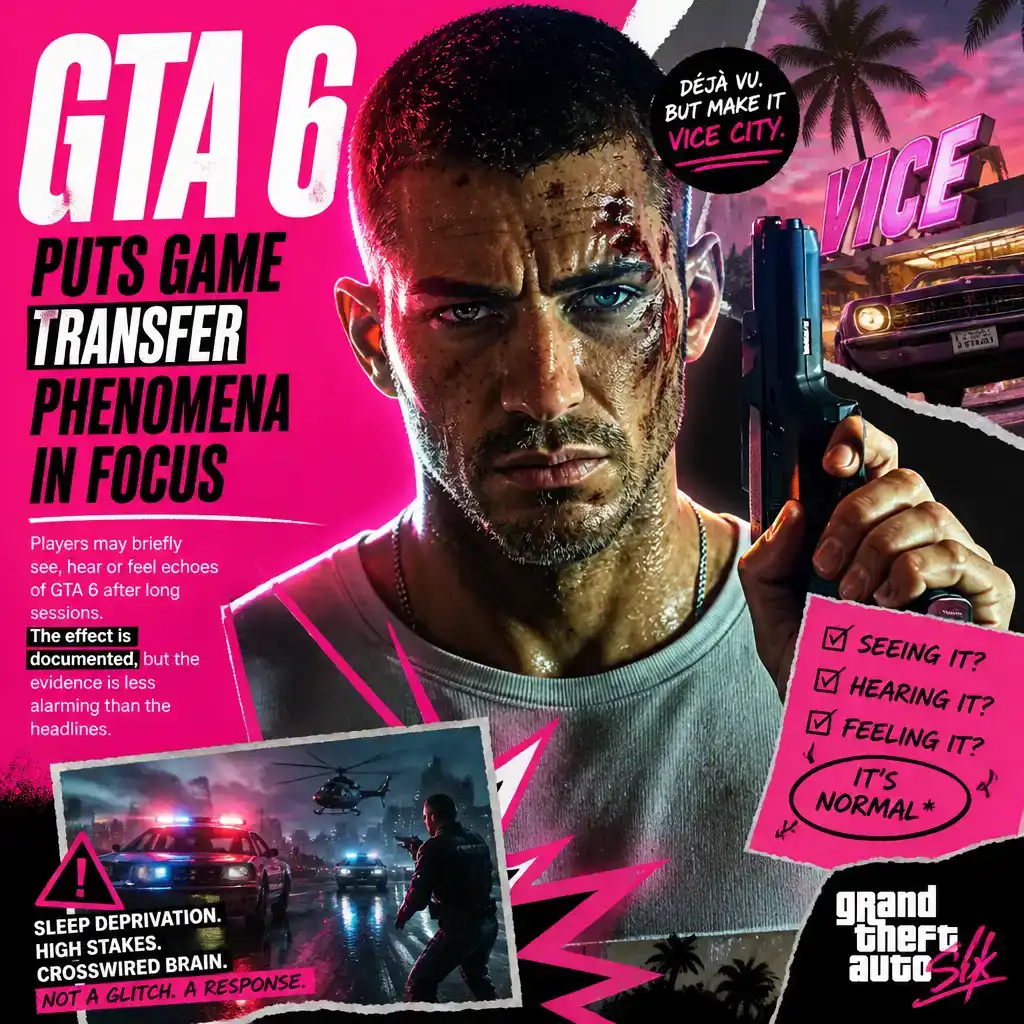
Rockstar Games’ Grand Theft Auto VI, commonly called GTA 6, has renewed interest in Game Transfer Phenomena, the brief moments when sights, sounds or habits from a game intrude on ordinary life. The effect is real and well documented. What has not been documented is a GTA 6-specific outbreak caused by realistic graphics, despite the much tidier story that such a claim would provide.
No clinical study, survey or recorded increase linked specifically to the game had emerged by November 27, eight days after its November 19 release. Rockstar Games and parent company Take-Two Interactive had also made no statement about related mental-health effects.
What does the phenomenon actually involve?
Linda Kaye, professor of cyberpsychology at Edge Hill University, described it as transferring some in-game sensory experiences into the real world. She compared it to an augmented-reality layer, with game features briefly appearing to overlap everyday surroundings.
That does not necessarily mean players believe they are still inside the game. The term covers a broad range of involuntary experiences, including:
- Seeing game-related images or visual patterns
- Hearing music, voices or sound effects
- Feeling movement or bodily sensations associated with play
- Having game-related thoughts appear automatically
- Briefly copying an action or response learned in a game
Repetition, distinctive sounds, familiar controls and frequent play can all contribute. Realistic locations may also make associations easier because something on a street or in a car resembles what the player has just spent hours seeing on screen.
Kaye cautioned that realism is not always the main factor. More convincing environments may strengthen immersion, but researchers also point to repetition, embodiment, individual characteristics and playing habits. In other words, highly polished palm trees are not acting alone.
How common is it among gamers?
A 2016 study in the International Journal of Human-Computer Interaction surveyed 2,362 players and found that 96.6 percent reported at least one lifetime episode. Most occurred during routine activities and lasted only briefly. Around one in five respondents reported some distress or disruption.
A related analysis published in Computers in Human Behavior classified the reported cases as:
- 57.8 percent mild
- 35.6 percent moderate
- 6.6 percent severe
Those numbers require context. The participants formed a self-selected convenience sample rather than a representative cross-section of the public. About 86 percent were male, while most were young, students and dedicated or “hard-core” players. They were also not GTA 6 players recruited after the new game’s release.
Later research has highlighted self-selection and social-desirability bias, both familiar complications when people volunteer to describe unusual experiences. The Oxford Handbook of Cyberpsychology says studies involving more than 6,000 gamers have documented temporary manifestations, but that does not support claims that millions of GTA 6 users are currently experiencing them.
Why marathon sessions matter more than graphics
Dimitrios Paschos of King’s College London said a brief game-related experience that a person recognises is usually little cause for concern. Some research has found associations with stress and sleep problems, although much of the evidence relies on players reporting their own symptoms.
More severe cases have been associated with sessions exceeding six hours a day, sleep or mental-health disorders, escapist play and dysfunctional gaming. Paschos said previous psychotic episodes, severe sleep deprivation and cannabis use also matter when assessing more serious concerns.
The clearer warning signs are therefore less cinematic: losing sleep, being unable to stop playing when intended, or allowing work and relationships to deteriorate. Those behaviours provide more useful information than whether a virtual city has convincing reflections on its car doors.
Streamer Darren Watkins Jr., known as IShowSpeed, reportedly played for more than 50 hours and told viewers, “My reality is GTA 6 right now.” The remark neatly demonstrated the publicity value of an extreme gaming marathon. It also highlighted sleep loss, a concrete concern, rather than proving that the graphics themselves had altered anyone’s grip on reality.
GTA 6’s scale could make rare effects look widespread
The game’s enormous launch means even uncommon reactions may appear frequently online. Take-Two reported $3.79 billion in first-day retail sales. Sensor Tower separately estimated $2.36 billion from roughly 24.6 million units, using a different methodology. Rockstar president Sam Houser said the company was “incredibly humbled” by the response.
That commercial scale helps explain why social media can quickly fill with anecdotes. It does not turn those anecdotes into a controlled study. A large player base produces more clips, posts and dramatic declarations, including from people who have barely slept because a major release apparently requires abandoning normal scheduling.
Kaye said there was no compelling evidence that these temporary sensory effects cause long-term psychological harm. Paschos similarly found little evidence that realistic graphics alone pose a mental-health risk.
Briefly thinking of GTA 6 after hearing a familiar siren or seeing a similar road is generally an association, not a loss of reality. Persistent distress, serious sleep disruption or difficulty functioning deserves attention, but the person’s wider circumstances matter more than the game’s visual fidelity. For now, the research supports sensible concern about marathon play, not panic over realistic pixels.