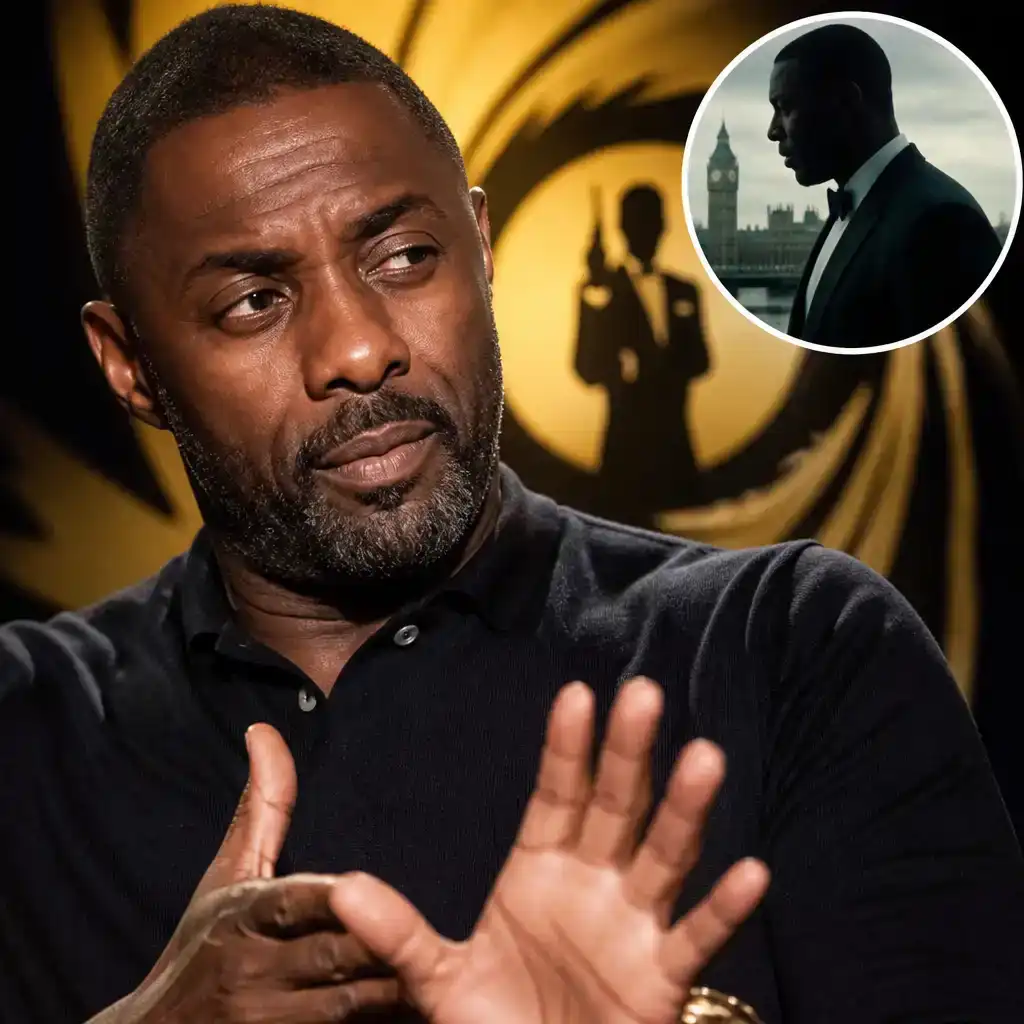
Sir Idris Elba has weighed in on the future of James Bond, warning against attempts to make the iconic British spy "woke" while offering a candid explanation of why he believes a Black actor could face resistance from international audiences.
The British star, whose name has circulated in Bond casting discussions for years, addressed the franchise's future in an interview with GQ. His argument was straightforward: James Bond is a global entertainment property, and filmmakers should be careful about changing a character whose appeal crosses national and cultural boundaries.
Elba's comments arrive as the search continues for Daniel Craig's successor, with director Denis Villeneuve and screenwriter Steven Knight attached to the next installment.
Idris Elba explains why a Black James Bond could face resistance
For years, Elba has been one of the most frequently discussed potential replacements for Craig. His performances in Luther and numerous Hollywood productions have made him a popular choice among fans who believe he could bring a different presence to the role.
But Elba appears considerably less convinced that the casting decision would be universally welcomed.
"Bond is big all over the world. And audiences won't all go for a Black male, an African male, playing Bond. That's not what they like in their culture. Period," he told GQ.
The statement reflects Elba's assessment of international audience preferences rather than evidence that a Black Bond would necessarily struggle commercially.
His argument also introduces an uncomfortable question for a franchise with worldwide ambitions: how much should filmmakers consider cultural expectations when deciding who gets to portray one of cinema's most recognizable characters?
Elba's position is particularly notable because he has personally been at the center of that debate. While many fans have supported the idea of him becoming 007, the actor has repeatedly found himself discussed as a potential Bond rather than simply being allowed to move beyond the speculation.
Why Elba believes James Bond should remain escapist entertainment
Elba's remarks went beyond the question of race. He also challenged the idea that the franchise should deliberately reshape its central character to reflect contemporary political or social expectations.
"Bond is so unrealistic, so a hint of reality is good, but let's not try and make it woke. I think you've got to be pure to what it is: escapism. Don't try to answer the world's taste. Just be Bond."
For Elba, the essential attraction of James Bond appears to lie in its unapologetically fantastical nature. The franchise has always depended on extraordinary missions, improbable escapes, extravagant villains and a leading character who rarely behaves like an ordinary human being.
His comments suggest that he sees a distinction between allowing the films to evolve and consciously redesigning them to satisfy competing cultural demands.
That distinction matters because Bond has never been entirely static. Different actors have brought different personalities to the role, from the comparatively playful interpretations of earlier decades to Craig's more physically vulnerable and emotionally troubled version.
The challenge for the next film is therefore not necessarily whether Bond should change. It is deciding which elements of the character are essential and which can be reinvented without losing the appeal that made the series successful.
Elba sees more flexibility in Masters of the Universe
Interestingly, Elba does not appear to believe that every established fictional character should be restricted by traditional casting expectations.
Discussing his involvement in Masters of the Universe, the actor joked about playing Man-At-Arms, a character traditionally associated with a distinctive ginger moustache and an appearance that hardly resembles everyday reality.
"Man-At-Arms could be any colour! He's got green legs, for God's sake!" Elba said.
The joke highlights an important difference in how he approaches the two properties.
While Elba views Bond as a character whose established identity carries particular expectations across international markets, he appears much more relaxed about reinterpreting a fantastical figure from the Masters of the Universe franchise.
There is an obvious irony in treating the appearance of a fictional secret agent as more culturally sensitive than that of a warrior from a fantasy universe populated by extraordinary characters.
Yet Elba's distinction is less about realism than about what he believes audiences expect from each franchise.
Does protecting Bond's identity mean limiting who can play him?
Elba's argument raises a broader question about the relationship between creative decisions and commercial expectations.
Film studios naturally consider how their productions will perform internationally. A franchise as recognizable as James Bond comes with established audience expectations, and changing its central character is unlikely to escape scrutiny.
However, predicting audience reactions is not the same as knowing how audiences will respond to a finished film.
In my view, Elba makes a reasonable point about protecting Bond's escapist identity, but his argument about race is less convincing. A character's appeal can depend on personality, performance and storytelling as much as physical appearance. International audiences may have different expectations, but those differences alone do not establish that a Black actor could not successfully portray 007. Preserving what makes Bond recognizable should not automatically mean treating every traditional characteristic as untouchable.
There is also a meaningful difference between casting an actor because of their talent and casting someone primarily to communicate a political message. Elba's remarks appear to caution against the latter, although the two motivations are not necessarily mutually exclusive.
Ultimately, the strongest argument for any future Bond actor would be the quality of the performance and the film built around it.
Denis Villeneuve and Steven Knight face the next Bond challenge
With Denis Villeneuve attached to direct and Peaky Blinders creator Steven Knight involved as screenwriter, the next James Bond film is already attracting considerable attention.
Villeneuve's work on visually ambitious productions such as Dune has established him as a filmmaker comfortable handling large-scale spectacle, while Knight brings experience creating morally complicated characters and tense dramatic narratives.
The combination suggests considerable creative potential, although neither filmmaker's involvement answers the biggest casting question: who will inherit the role from Daniel Craig?
Elba's latest comments do not settle that debate, nor do they establish what the filmmakers themselves intend to do with the character.
They do, however, illustrate the competing pressures surrounding the next installment. Bond must remain recognizable enough to satisfy established fans while offering audiences something that does not feel like another exercise in repeating the past.
For a franchise built around a man who routinely survives impossible situations, finding an actor capable of satisfying everyone may be its least realistic mission yet.