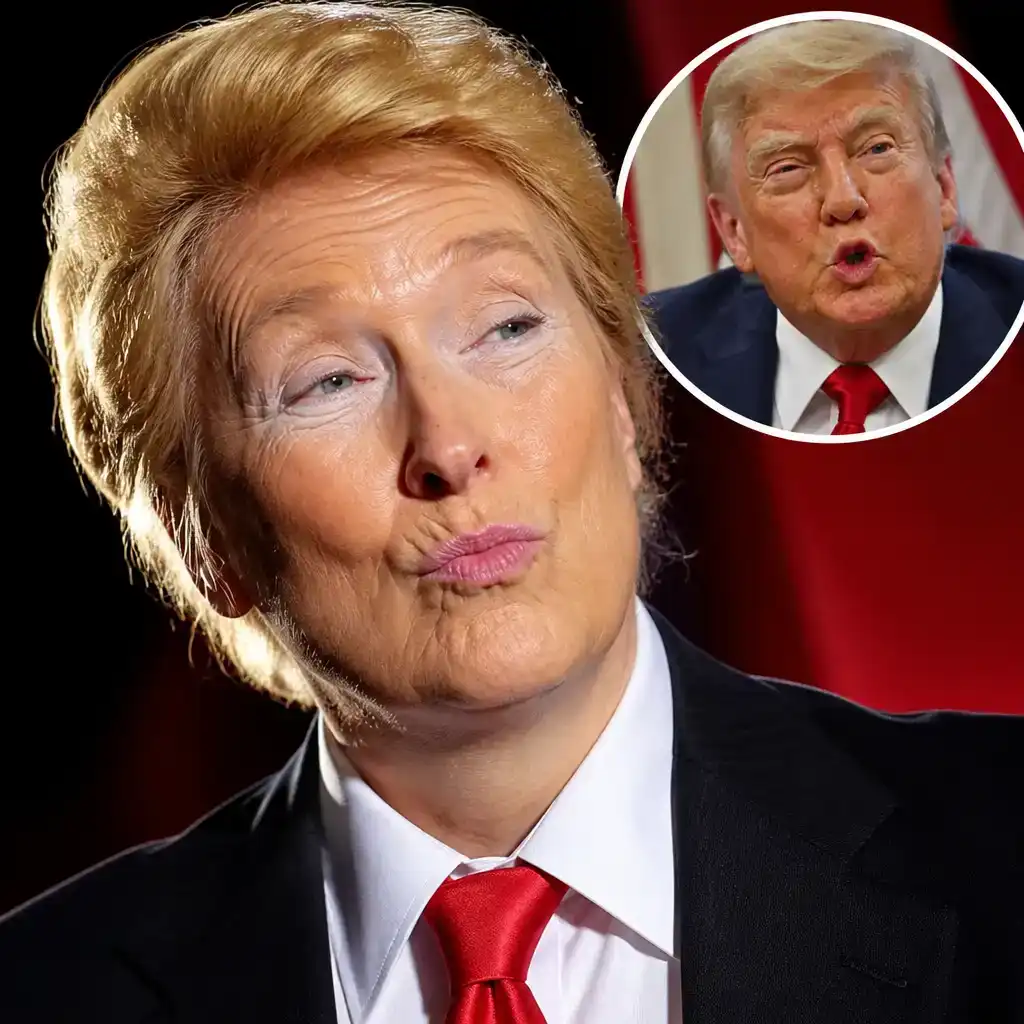
Before Meryl Streep and Donald Trump became involved in a very public war of words, the Oscar-winning actress had already found a rather unconventional way to make fun of the future US president: she played him on stage.
On June 6, 2016, Streep appeared at New York's Delacorte Theater in Central Park wearing a blond wig, orange makeup, an oversized suit and Trump's unmistakable red tie. The transformation was part of The Public Theater's annual gala, but this was no ordinary celebrity impersonation.
Joining her was Christine Baranski, dressed as Trump's Democratic rival Hillary Clinton. Together, the actresses performed a politically charged adaptation of "Brush Up Your Shakespeare", a song from Cole Porter's Broadway musical Kiss Me, Kate.
The performance took place five months before Trump won the presidential election, making it an early example of Streep using her theatrical talents to deliver political satire.
Why Meryl Streep's Donald Trump impression was more than a costume
The evening's production, The United States of Shakespeare, celebrated the playwright's influence on American culture. The gala was also part of a theatrical season featuring an all-female production of The Taming of the Shrew, making the decision to have two women impersonate presidential candidates particularly fitting.
The musical choice carried its own joke. "Brush Up Your Shakespeare" is traditionally performed by two male characters offering advice about impressing women through Shakespearean quotations. Streep and Baranski transformed the number into an election-themed exchange, with Streep's Trump wondering why women kept rejecting him.
According to contemporaneous reporting by CBS News and the Associated Press, Public Theater artistic director Oskar Eustis revealed that the impersonation had been Streep's own idea.
Photographs and footage of the performance circulated online, with BroadwayWorld documenting the theatrical parody shortly after the event.
Months later, the joke gave way to a real confrontation
What makes the performance particularly interesting in hindsight is its place in the chronology of Streep's increasingly public criticism of Trump.
On January 8, 2017, seven months after the theatrical parody and shortly before Trump's first presidential inauguration, Streep delivered a much more serious political message while accepting the Cecil B. DeMille Award at the Golden Globes.
Without mentioning Trump by name, she criticised his apparent mockery of a disabled journalist during the presidential campaign and spoke about the responsibility of powerful public figures to avoid humiliating others.
Trump responded the following day, describing Streep as one of Hollywood's most "over-rated" actresses and accusing her of supporting Hillary Clinton. His comments were widely reported at the time.
The distinction matters: Streep's Shakespeare in the Park impersonation was not a response to that Golden Globes dispute. It happened months earlier, when Trump was still campaigning for the White House.
And while the Golden Globes speech became a serious political confrontation, the 2016 appearance had a rather different purpose: turning a Broadway classic into a satirical portrait of an extraordinary American election.