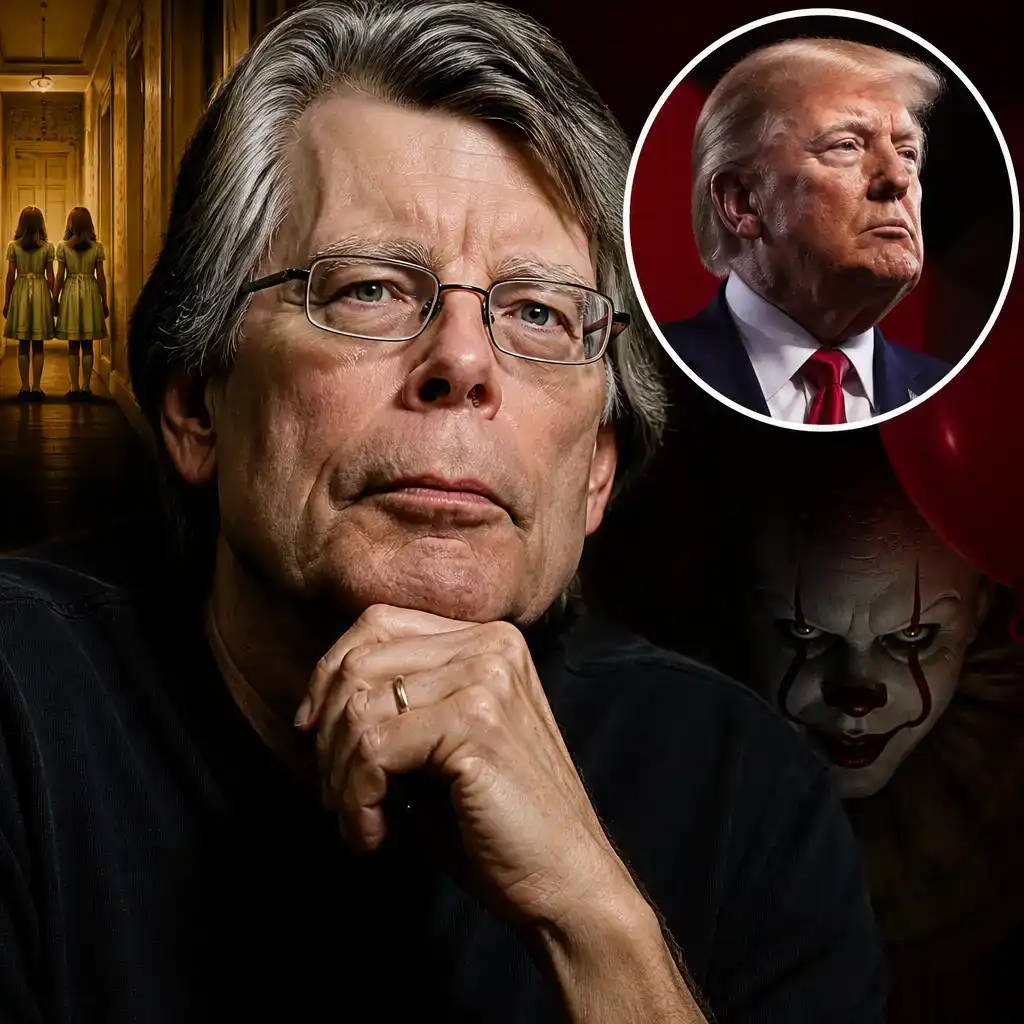
Stephen King has spent decades terrifying readers with murderous clowns, haunted hotels and supernatural nightmares. But when it comes to Donald Trump, the legendary horror writer believes reality has managed to produce something even more frightening.
The author of IT, The Shining and Misery has repeatedly compared Trump's political career to the horrors of his own imagination, making it clear that his concerns go far beyond a simple disagreement over politics.
In an August 2025 interview with The Guardian, King was asked how he would end the story of Trump's America if he were writing it himself.
His preferred ending involved impeachment and Trump's departure from political life. The outcome he feared most was Trump securing a third presidential term and consolidating his power.
King summed up his feelings with a characteristically blunt observation: "Trump is a horror story, isn't he?"
Stephen King has been comparing Trump to horror for years
King's criticism is nothing new. In May 2017, during Trump's first months in the White House, the novelist used Twitter to express his concerns about the president's access to nuclear weapons.
As The Independent reported at the time, King considered the prospect more frightening than anything he had created in fiction.
That comparison became even more pointed in July 2019, when King appeared in a video interview with NowThis News and was asked whether Trump's presidency was scarier than one of his novels.
His answer was unequivocal: "I do think it's scarier."
The interesting part wasn't simply that a famous horror writer disliked the president. King had already explored a remarkably similar political nightmare decades earlier.
The Stephen King villain who reminds him of Trump
In his 1979 novel The Dead Zone, King introduced Greg Stillson, an ambitious and deeply troubling politician whose rise to power becomes a central threat in the story.
Stillson begins as an outsider who attracts attention through unconventional behaviour and provocative political performances. His apparent absurdity makes him easy to dismiss, even as his influence grows.
The novel's protagonist, Johnny Smith, eventually discovers a terrifying possibility involving Stillson's political future and a catastrophic nuclear conflict.
During his 2019 interview with NowThis, King discussed the similarities he saw between Stillson and Trump's rise, particularly their ability to captivate voters despite operating outside conventional political expectations.
Crucially, King did not claim to have literally predicted Trump's presidency. Instead, he explained that he had imagined the possibility of an unconventional political figure gaining extraordinary influence by appealing to voters frustrated with the establishment.
That distinction matters. The Dead Zone was published nearly four decades before Trump first entered the White House, but King's comparison reflects his interpretation of political behaviour rather than evidence of a supernatural prediction.
Why Trump's political career remains a horror story for King
The comparison has evolved alongside Trump's political career.
In 2017, King's concerns focused heavily on nuclear weapons and presidential responsibility. By 2019, he was drawing connections between Trump's public persona and the fictional rise of Greg Stillson.
His August 2025 comments went further, focusing on the possibility of Trump remaining in power beyond the normal constitutional limit of two elected presidential terms.
Those remarks were King's personal political assessment, not a claim that a third term had been authorised or was inevitable. The US Constitution's 22nd Amendment prohibits anyone from being elected president more than twice.
For King, however, the recurring theme is recognisable: the prospect of a powerful political figure becoming a threat precisely because people underestimate what he might do.
And while Pennywise, Jack Torrance and King's other fictional creations remain confined to the pages of his books and their screen adaptations, the author has made clear that his fears about Trump belong firmly in the real world.