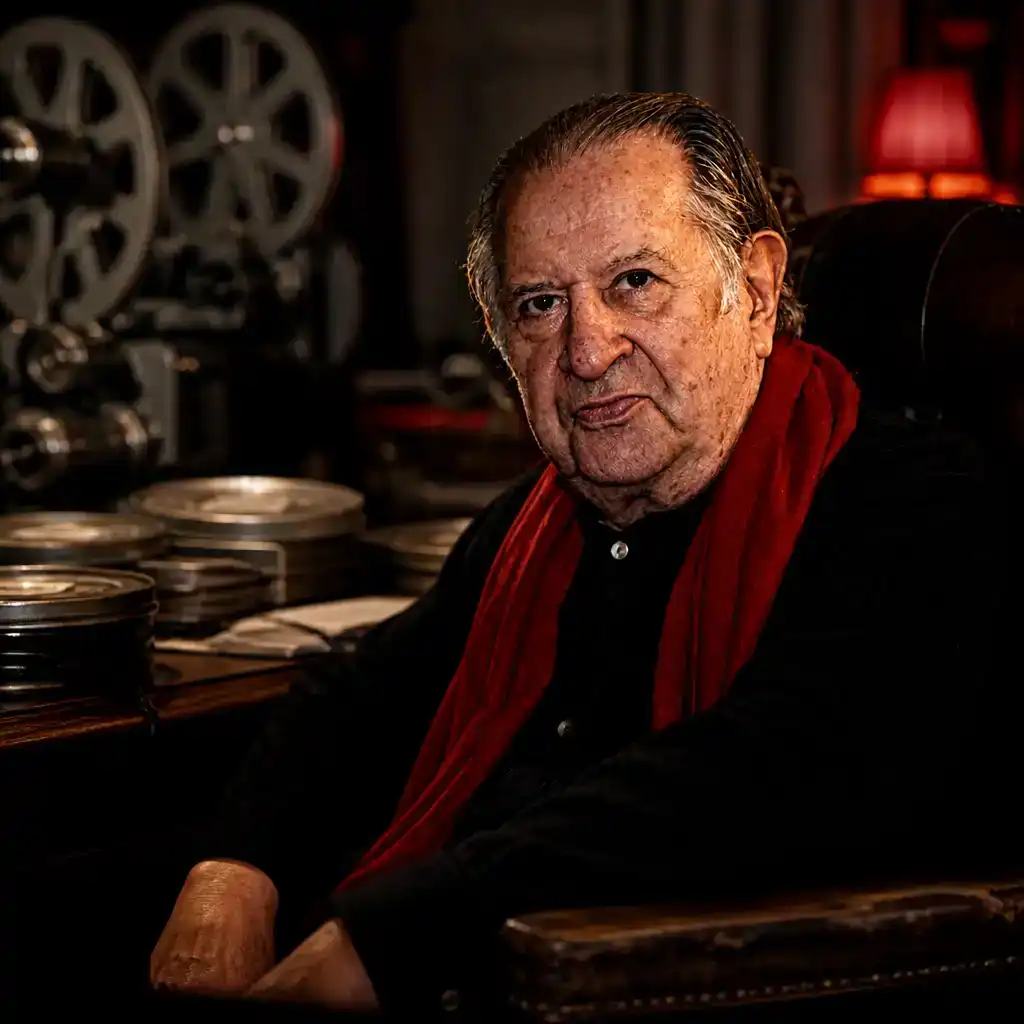
Italian filmmaker Tinto Brass, best known internationally for Salon Kitty and the fiercely disputed Caligula, died on Wednesday, November 4, 2026. He was 93.
His wife, Caterina Varzi, and children, Bonifacio and Beatrice Brass, announced his death through the Italian press agency ANSA. Later reports said he died at about 10:30 a.m. at his home in Rome. No cause was disclosed, although Rolling Stone Italia reported that his health had been critical for several months. The family plans to hold a strictly private funeral.
“It is a difficult moment, of deep sadness and regret,” Varzi told Adnkronos.
Brass directed roughly 30 films across more than four decades. Erotic cinema eventually defined his public image, but a recent wave of restorations and awards had begun recovering the experimental filmmaker who existed before notoriety became the easier label.
How did Tinto Brass begin making films?
Born Giovanni Brass in Milan on March 26, 1933, he came from a Venetian family of artists. He initially studied law before turning to cinema in the late 1950s, a decision that proved considerably more consequential for film censors.
In Paris, Brass worked as an archivist at the Cinémathèque Française. He met Roberto Rossellini there and later served as an assistant on Rossellini’s wartime drama General della Rovere.
Brass made his feature directing debut in 1963 with the Venice-set In capo al mondo, subsequently retitled Chi lavora è perduto. The film follows an unemployed young man with pronounced antisocial tendencies and received an enthusiastic response at the Venice Film Festival. Italian censors were less delighted, beginning a long and remarkably consistent relationship between Brass and official disapproval.
During the late 1960s and early 1970s, he spent extended periods in London making English-language films. The 1967 erotic pop thriller Deadly Sweet, also known by its Italian title Col cuore in gola, starred Jean-Louis Trintignant and Ewa Aulin. Trintignant plays a man who finds a business contact murdered, protects the young woman discovered at the scene and pursues the killers rather than calling the police. This naturally brings him into conflict with London’s criminal underworld.
The film screened out of competition at Venice in 1967. Brass followed it with Attraction in 1969 and Dropout in 1970.
Why did Venice revisit his early work?
The 83rd Venice Film Festival returned to Deadly Sweet in 2026, presenting a new 4K restoration supported by Netflix on September 1. The screening served as a tribute to Brass and highlighted the visual experimentation of his early career, work often overshadowed by the more marketable subject of who removed what in his later films.
Italian film journalists also awarded him the Pietro Bianchi Award for his contribution to cinema. He was too ill to attend the ceremony.
In a message prepared for Venice, Brass wrote: “There is no starting point and no end point, there is only the point where I am.” He also suggested there would be no further opportunity for official recognition. The prediction proved sadly accurate, although the recognition itself arrived before his death.
The restoration offered a broader view of a director frequently reduced to his erotic output. His 1960s films drew on pop art, political alienation, fragmented editing and European avant-garde cinema. Sex was already present, but it had not yet become the entire public conversation.
Why does Caligula remain so controversial?
Brass achieved wider international attention with Salon Kitty in 1976. Starring Helmut Berger, the historical erotic drama takes place in an elite Berlin brothel used by Nazi intelligence to monitor clients. Its combination of fascism, surveillance and sexual spectacle established the territory most audiences would later associate with him.
His most famous film outside Italy, however, was Caligula. Penthouse founder Bob Guccione financed and produced the project, which featured Malcolm McDowell, Helen Mirren, John Gielgud and Peter O’Toole, with a screenplay credited to Gore Vidal.
The production became a prolonged battle over creative control. After clashing with Brass and Vidal, Guccione took control of the material and abandoned much of the intended screenplay. He also filmed additional explicit footage in January 1977, after the principal actors had completed their work. Brass and Vidal subsequently sought to have their names removed.
Release dates have often been confused because the film circulated in several versions and territories. Minerva Pictures dates it to 1979, while restoration materials record an Italian opening in November of that year. What audiences eventually saw was not the cut Brass had intended.
The argument did not end with the original release. A completely reconstructed Ultimate Cut, assembled from surviving material after decades of competing edits, premiered at Cannes Classics in 2023. It renewed debate over whether Caligula could ever have a definitive version when its director, producer and writer had disagreed so fundamentally about what the film was supposed to be. Few productions manage to turn editing history into a multigenerational dispute, but Caligula was never committed to moderation.
What did Brass make after Caligula?
In 1983, Brass directed The Key, adapted from a novel by Japanese author Jun'ichirō Tanizaki and starring Stefania Sandrelli. The film moved toward a more literary form of erotic drama and found substantial international success.
His later work repeatedly examined female sexual liberation, though critics remained divided over whether the films represented freedom, fantasy or both. Notable titles included Black Angel in 2002 and Fallo! in 2003.
Brass’s final feature was Monamour in 2006. He followed it with the short film Hotel Courbet in 2009, closing a directing career that had moved from politically charged experimentation to lavish historical provocation and increasingly explicit studies of desire.
That range was not always acknowledged during his lifetime. The late restoration of Deadly Sweet, the Pietro Bianchi Award and the renewed scrutiny of Caligula began correcting the simplified image of Brass as merely Italy’s best-known erotic filmmaker. He was certainly that, but he was also an editor, formal experimenter and persistent opponent of censorship, even when the commercial machinery around his films created censorship battles of its own.
He is survived by Varzi and his children, Bonifacio and Beatrice.