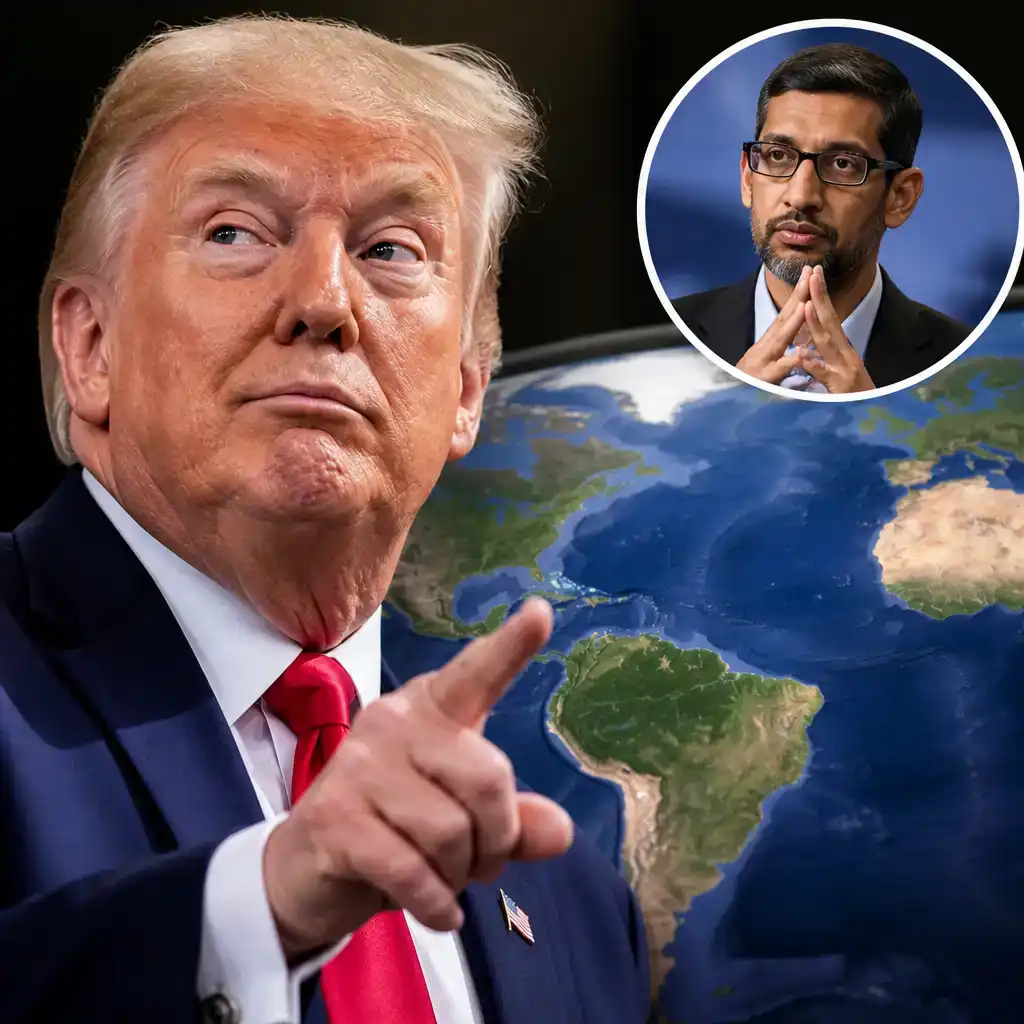
Donald Trump says he asked Google chief executive Sundar Pichai whether Google Maps would rename the Atlantic Ocean, only to receive a polite refusal. Google has not confirmed that the call happened or that Pichai said what Trump claims he said.
Speaking at a campaign rally near Clemson, South Carolina, on Wednesday, October 21, Trump told the crowd that his geographic rebranding project still lacked a river and an ocean.
“So we have a lake. And we have a gulf. Now we need a river, and we need an ocean,” he said. Trump added that only the Atlantic and Pacific were candidates for an American or Trump-branded name.
According to Trump, he called Pichai after “seriously” considering a new name for the Atlantic. He quoted the Google boss as replying: “No, no, no, this time I’m not doing it. Oceans are different, sir. They cover really a lot of countries. Please don’t ask us to do that.”
Trump said he would “probably pass” on the proposal. Google had not publicly verified his account as of Thursday.
Why renaming an ocean is not so simple
Trump had already tested the idea publicly. The Washington Post reported that he floated “Trump Ocean” and “Ocean of the Americas” during an October 10 rally in Clarksville, Tennessee.
His administration has had more success changing names used by the US government. Trump previously declared the Gulf of Mexico the “Gulf of America.” On August 27, Executive Order 14422 directed federal agencies and the US Board on Geographic Names to replace “Lake Ontario” with “Lake America” in federal usage.
That does not give Washington authority over what other countries call shared waters. The United Nations says a name adopted by one country does not automatically become the international standard. Oceans, inconveniently for anyone seeking exclusive branding rights, touch rather a lot of jurisdictions.
Lake Ontario provides a smaller example of the same problem. The lake covers about 7,340 square miles and straddles New York and the Canadian province of Ontario. Ontario Premier Doug Ford responded to the US order with a large “Lake Ontario” shoreline sign, saying Canada was “standing up for ourselves” and that the established name would outlast Trump.
Google Maps can show different names by country
Google says its maps generally follow official government geographic databases and locally recognised names. That policy allows the company to display different labels depending on where a user is located.
After Trump’s Lake Ontario order, Google Maps reportedly showed:
- “Lake America” to users in the United States
- “Lake Ontario” to users in Canada
- Both names to users elsewhere
US search results have also displayed Trump’s preferred names for the gulf and lake while retaining the familiar labels in parentheses.
The arrangement lets Google follow domestic naming decisions without pretending those decisions settle international usage. It is functional, if not especially elegant. Applying the same approach to the Atlantic would be considerably more conspicuous, which may explain why Trump’s reported request met resistance where his earlier changes did not.