The Bulletin of the Atomic Scientists has set its symbolic “Doomsday Clock” to 85 seconds to midnight, the closest the clock has ever been to the point the group uses to represent global catastrophe, citing what it described as worsening nuclear risk, accelerating climate impacts, emerging biological threats and the rapid adoption of artificial intelligence without sufficient safeguards.
The update follows last year’s setting of 89 seconds to midnight, a figure referenced widely online in recent days, including in a social media post shared by TMZ which said the clock had been pushed “closest to midnight in history” at 89 seconds in 2025. The Bulletin’s latest decision moves the clock four seconds closer still.
The Doomsday Clock, created in 1947 by the Bulletin, is not a literal countdown but a communications tool designed to convey how the organisation’s Science and Security Board assesses the world’s proximity to existential danger. Midnight is used as a metaphorical endpoint. In recent years, the group has shifted from measuring the clock in minutes to measuring it in seconds, arguing that risks are intensifying and moving faster.
In announcing the new setting, the Bulletin said deteriorating international relationships among major powers were eroding the kind of cooperation it considers essential to reducing risk. Its statement said “hard-won global understandings are collapsing” and argued that leaders in multiple countries were adopting approaches that increased danger rather than reducing it.
Nuclear tensions remained central to the board’s assessment. The group pointed to continuing wars and flashpoints involving nuclear-armed states, and to what it characterised as pressure on arms control and confidence-building frameworks. Reuters reported that the board cited Russia’s war in Ukraine, conflict in the Middle East and growing anxiety over nuclear stability as factors in its decision.
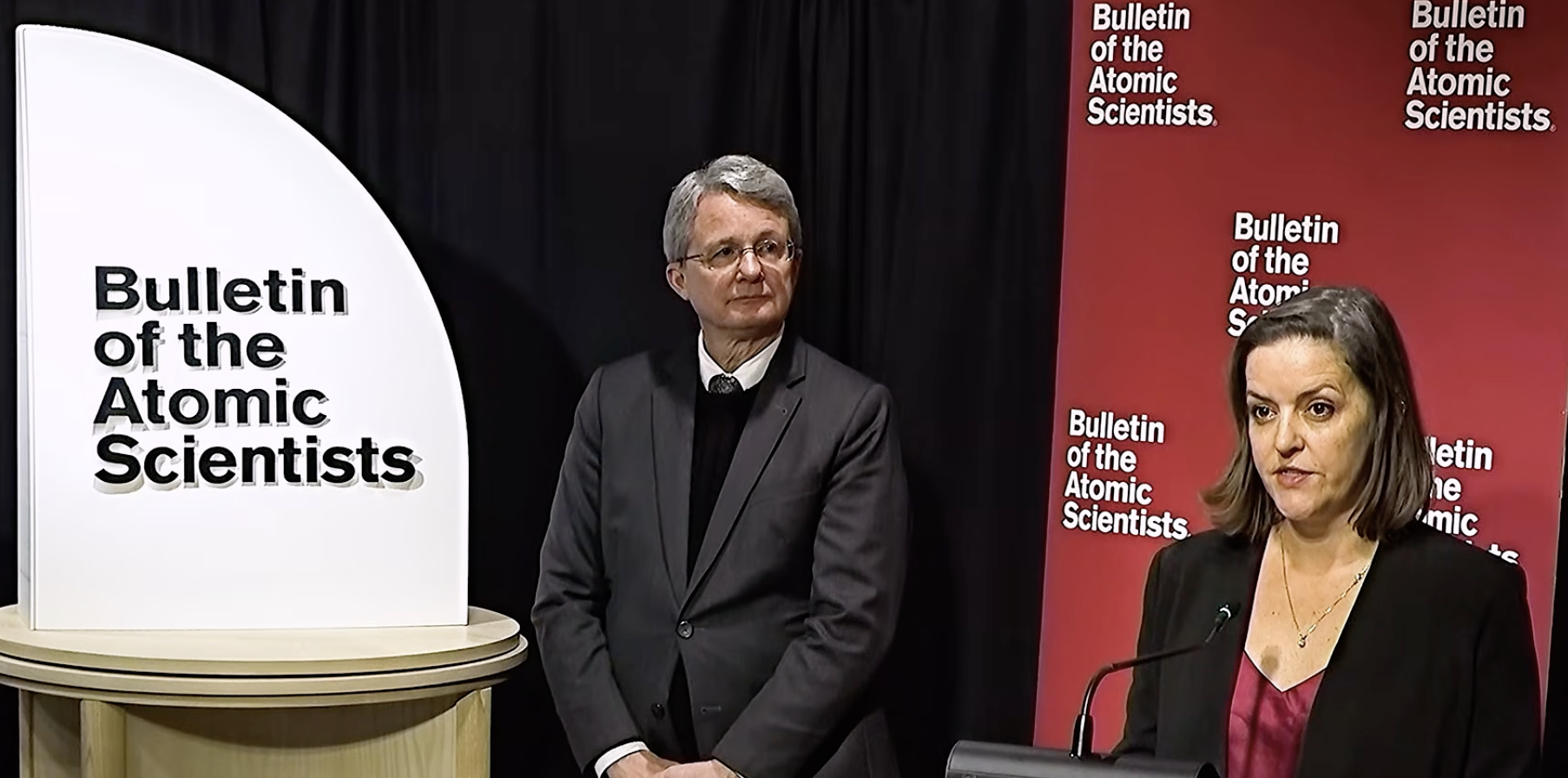
Alexandra Bell, the Bulletin’s president and chief executive, told Reuters the clock reflected what she described as a broad erosion of responsible leadership and a turn towards increasingly aggressive governance. “Of course, the Doomsday Clock is about global risks, and what we have seen is a global failure in leadership,” Bell said.
Bell also warned, in comments to Reuters, that growing geopolitical rivalry and the weakening of diplomatic guardrails were raising the likelihood of miscalculation. “In terms of nuclear risks, nothing in 2025 trended in the right direction,” she said, describing proliferation concerns and heightened military activity under what she called the shadow of nuclear escalation.
The Associated Press reported that the Bulletin also emphasised the role of global trust and cooperation as a risk reducer, quoting Daniel Holz, chair of the group’s science and security board, who said: “If the world splinters into an us-versus-them, zero-sum approach, it increases the likelihood that we all lose.”
Beyond nuclear risk, the Bulletin cited climate change as a persistent and compounding threat, arguing that rising temperatures, extreme weather and slow progress on emissions reductions were adding pressure to global stability and humanitarian systems. The AP reported that the group again highlighted climate alongside nuclear and emerging technology risks as it made the annual announcement.
The board also raised concerns about biotechnology and the potential for misuse, a theme that has become increasingly prominent in recent years as advances in life sciences become more accessible. Reuters reported that the scientists voiced worry about the potential misuse of artificial intelligence in assisting the creation of biological threats, and the broader dangers of insufficiently regulated technology being integrated into sensitive domains.
Artificial intelligence featured as both a direct and indirect risk in the Bulletin’s reasoning. The Reuters report said the group warned about the “unregulated integration” of AI into military systems and its capacity to accelerate decision-making in ways that could reduce human oversight at moments of crisis. The Bulletin also pointed to disinformation as a destabilising force, with AI tools capable of amplifying false narratives quickly and at scale.
The Doomsday Clock has moved both closer to and farther from midnight over its history, reflecting shifts in global tensions and perceived progress in reducing risk. After the end of the Cold War, it was set as far as 17 minutes to midnight, a distance the Bulletin has described as its safest point. In more recent years, the clock has hovered close to midnight, reflecting the organisation’s view that multiple categories of existential risk are interacting at once.
The TMZ item circulating on social media this week framed the clock’s earlier setting of 89 seconds to midnight as a sign of a world “edging” toward disaster, and it referenced the clock’s movement in recent years. The Bulletin’s latest statement goes further, arguing that even small movements reflect major shifts in its assessment because the world is already near what it describes as a precipice.
While the clock is often discussed as a novelty online, the Bulletin presents it as an attempt to communicate urgency and to encourage steps it believes could reduce risk. The AP reported that the group said the clock could be turned back if leaders and nations work together to address the dangers it has identified.
The Bulletin’s announcement typically comes alongside public remarks and the release of a formal statement explaining its assessment. This year’s update, reported by Reuters and the AP, again placed the emphasis on compounding and interconnected threats, arguing that geopolitical conflict, climate instability and rapid technological change are combining in ways that raise the likelihood of severe global disruption.
For the Bulletin, the move to 85 seconds is meant to be a warning rather than a prediction, but it is also a marker of how bleak the organisation’s board believes the international environment has become. As Holz put it in remarks reported by the AP, the drift toward a rigid, zero-sum worldview is, in the group’s assessment, one of the clearest paths to higher risk.