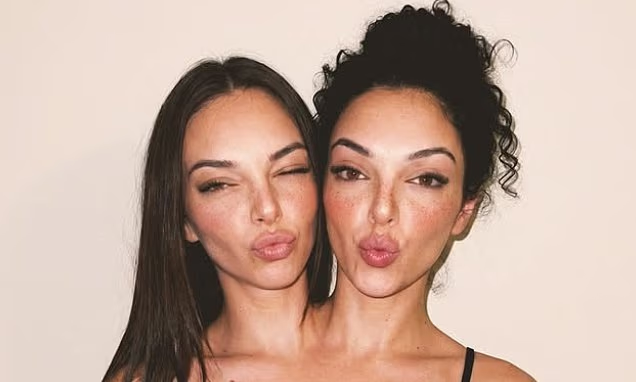
A social media account presenting itself as belonging to a pair of young conjoined twins has drawn intense attention online, but experts and digital analysts say the figures behind the posts are not real people but artificial intelligence–generated creations designed to attract followers and engagement.
The Instagram account in question, using the handle itsvaleriaandcamila, portrays two women who appear to be conjoined at the torso and share one body while having separate heads, a rare form of conjoined birth known medically as dicephalic parapagus. In posts dating back to December 2025, the account’s subjects identified themselves as Valeria and Camila, 25-year-old twins from Florida who describe their condition as “born this way” and assert that they have undergone multiple surgeries due to their fused spines. Their biography on the profile reads, in part, “two heads, one vibe,” and they have amassed hundreds of thousands of followers in a matter of weeks while sharing lifestyle images, fashion content and responses to follower questions about their lives. Followers have commented with admiration, curiosity and fascination, and the account’s visibility has grown rapidly across several social platforms.
Despite their apparent popularity, a growing number of observers and specialists in artificial intelligence content have questioned the authenticity of the pair. Comments on posts and independent analysis from digital practitioners point out inconsistencies in the images, including hyper-stylised body proportions, symmetrical features that do not align with known examples of human conjoined anatomy, and other artifacts common in AI-generated visuals. Such characteristics have led AI researchers to conclude that the figures and scenes depicted are not photographs of real individuals but rather the product of algorithm-generated imagery.
In attempts to counter these claims, Valeria and Camila have addressed scepticism directly in their Instagram Stories, answering questions from followers and insisting that they are not artificial constructs. In one video interaction, they responded to direct queries about their nature by saying “We move, we talk, we’re obviously not AI,” a statement designed to reassure viewers of their purported reality. Despite these reassurances, many social media users have persisted in questioning the account’s legitimacy, asking for live appearances or other evidence that would substantiate the twins’ existence.
Industry experts who study synthetic media have weighed in on the situation. AI prompt engineers and digital content analysts say the narrative presented on the account is structured to maximise engagement rather than to present verifiable human experiences. One AI specialist described the story and imagery as a constructed narrative engineered for social interaction, with the heightened plausibility of everyday life scenes and personal anecdotes helping to draw in viewers. According to those analysts, such narratives are increasingly common in AI-driven digital marketing and influencer schemes, where compelling backstories and striking visuals can rapidly generate large followings even when the subjects are not real people.
Critics of these accounts have also highlighted broader concerns about how AI-generated influencers may blur the lines between genuine human personalities and artificial creations. They argue that when accounts present fictional life histories, medical conditions or personal struggles without clear disclosure of their synthetic origins, they can mislead audiences into believing that they are following real people. The use of medical narratives, such as the described surgeries and daily lives of conjoined individuals, also raises ethical questions about the specification and portrayal of rare conditions for entertainment or attention purposes.
Independent reviews of the images tied to the Valeria and Camila account have noted specific markers that suggest synthetic origin, including perfect symmetry in facial features, identical skin textures across different posts, and subtle artifacts around body contours that are inconsistent with real anatomy. Observers familiar with AI image generation tools say these patterns are typical of current generation systems that prioritise aesthetic appeal over biological accuracy. In contrast to verified photographs of conjoined twins documented in medical and anthropological literature, the images associated with this account lack clear evidence of naturally occurring physical traits that would be expected in living individuals with such a condition.
The rapid growth of the account also reflects broader trends in social media where visually striking content, regardless of its authenticity, can attract significant attention and follower engagement. Analysts say that in the competitive world of digital influence, accounts that stand out for their novelty or uniqueness can achieve widespread visibility, particularly when they tap into curiosity about unusual human experiences or exotic lifestyles. Even when users suspect that content may be fabricated, engagement can remain high simply because the subject matter provokes strong reactions or discussions.
As of this week, there has been no independent verification from journalists, medical professionals or on-the-ground reporting confirming the existence of real individuals matching the identities presented on the itsvaleriaandcamila account. Neither the purported twins nor their representatives have provided evidence such as undistorted live video, third-party documentation, or verifiable personal histories that would satisfy standard criteria for confirming real human identity. Meanwhile, AI researchers and digital ethics observers continue to highlight the case as an example of how synthetic media can create convincing yet ultimately fabricated personality profiles that challenge assumptions about authenticity on social platforms.
The phenomenon underscores ongoing tensions in online culture about the distinction between human and machine-generated presence, particularly as artificial intelligence tools become increasingly sophisticated in creating life-like images and narratives. Users, experts say, should exercise caution and critical judgment when encountering viral social media figures whose origins cannot be independently verified, especially in cases where extraordinary claims are presented without accompanying evidence.