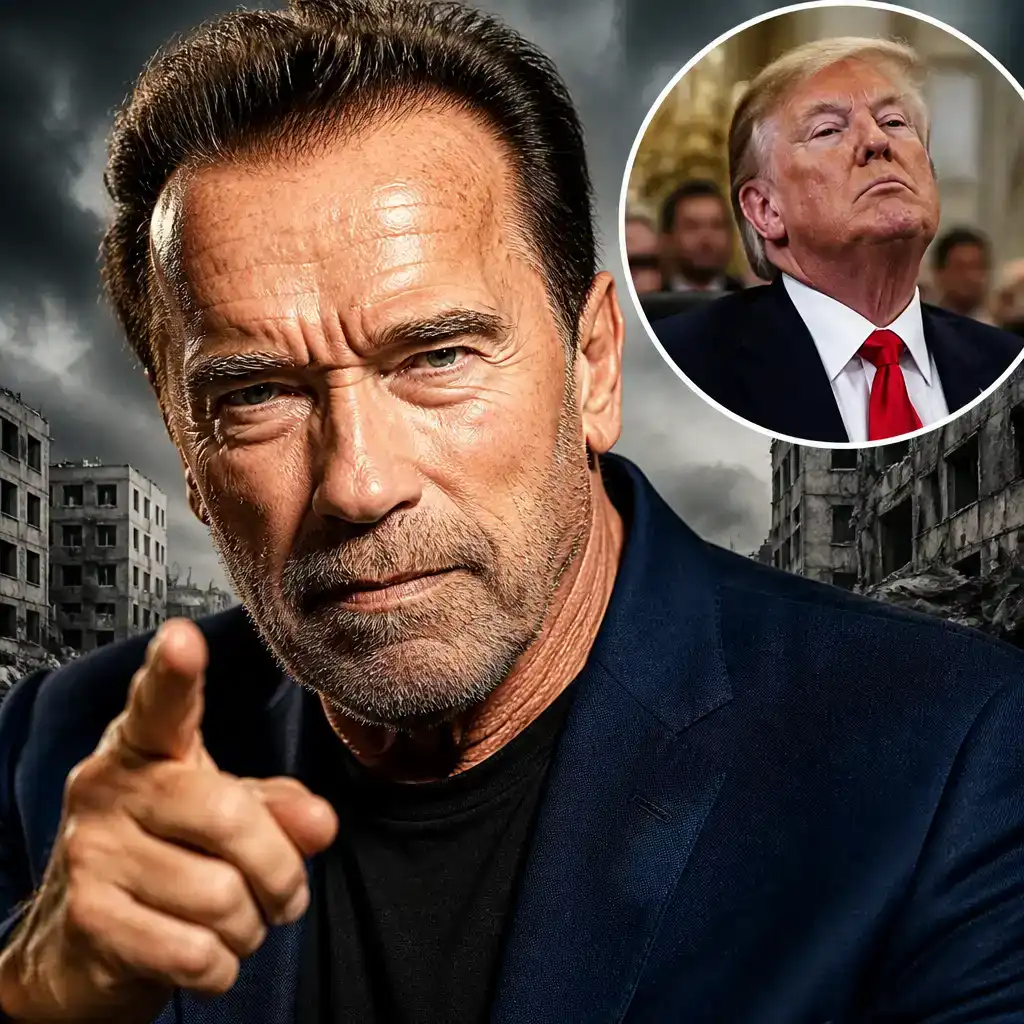
Arnold Schwarzenegger has never been particularly subtle when it comes to Donald Trump, but one of his most scathing attacks on the president went far beyond their long-running political rivalry.
The former Republican governor of California branded Trump the "worst president ever" in a video message released following the January 6, 2021 attack on the US Capitol, accusing him of misleading Americans and attempting to overturn the result of a democratic election.
What made the intervention particularly striking was Schwarzenegger's decision to connect the violence in Washington with the political extremism he witnessed growing up in Austria after the Second World War.
Schwarzenegger's devastating verdict on Trump
In the video, Schwarzenegger condemned Trump's role in the events surrounding the Capitol attack, describing him as a failed leader whose efforts to remain in power had undermined American democracy.
"He will go down in history as the worst president ever," Schwarzenegger declared. "The good thing is he will soon be as irrelevant as an old tweet."
The remark was delivered in January 2021, during the final days of Trump's first presidency. His prediction about Trump's political irrelevance has since proved inaccurate: Trump returned to the White House in January 2025 after winning the 2024 presidential election.
That distinction matters because the video continues to circulate online. Although Schwarzenegger's criticism remains unmistakable, his remarks were made in response to a specific moment in American history, rather than Trump's current administration.
Why Schwarzenegger compared January 6 to his childhood in Austria
Schwarzenegger's message was not simply another celebrity condemnation of a politician. He used his family history to explain why he considered the events of January 6 so dangerous.
Born in Austria in 1947, Schwarzenegger grew up in a country still confronting the consequences of Nazi rule and the Second World War. In his address, he recalled the destructive effects of political lies, extremism and the willingness of ordinary people to accept dangerous ideologies.
He also drew a comparison between the Capitol attack and Kristallnacht, the violent antisemitic pogrom carried out by the Nazis in November 1938.
The comparison was intended to highlight the danger of political violence fuelled by falsehoods, rather than suggest that the two historical events were identical.
For Schwarzenegger, the central concern was the erosion of trust in democratic institutions and the consequences of political leaders encouraging their supporters to reject an election result.
A Republican criticising a Republican president
Schwarzenegger's political background gave the message an additional dimension. He served as California's Republican governor from 2003 to 2011, making him one of the most internationally recognisable figures associated with the party.
His condemnation therefore came from someone who shared Trump's party affiliation, even if the two men represented very different strands of Republican politics.
Schwarzenegger also had a personal connection to Trump through The Celebrity Apprentice. He took over as host of the television franchise after Trump left to pursue the presidency, and the pair subsequently exchanged public criticism.
However, the January 2021 address focused on something considerably more consequential than their entertainment-industry feud: the peaceful transfer of presidential power.
Trump had repeatedly made false claims that the 2020 election had been stolen from him. Those allegations were rejected by election officials, and legal challenges failed to establish widespread fraud capable of changing the result.
On January 6, a mob of Trump supporters stormed the Capitol while Congress was meeting to certify Joe Biden's electoral victory, disrupting the proceedings and forcing lawmakers to evacuate or shelter.
Why the remarks still resonate
Schwarzenegger's prediction that Trump would fade into political obscurity is particularly notable in hindsight. Rather than disappearing from American politics, Trump remained the dominant figure in the Republican Party and ultimately secured another presidential term.
That subsequent comeback does not change the historical context of Schwarzenegger's original remarks, but it does give them a different significance when viewed years later.
The former governor's warning was ultimately about more than one president's reputation. He argued that democratic institutions depend on political leaders respecting election outcomes and refusing to legitimise violence or misinformation.
His video message, shared on Facebook, captures an unusually forceful intervention from a former Republican governor at one of the most turbulent moments in recent American political history.