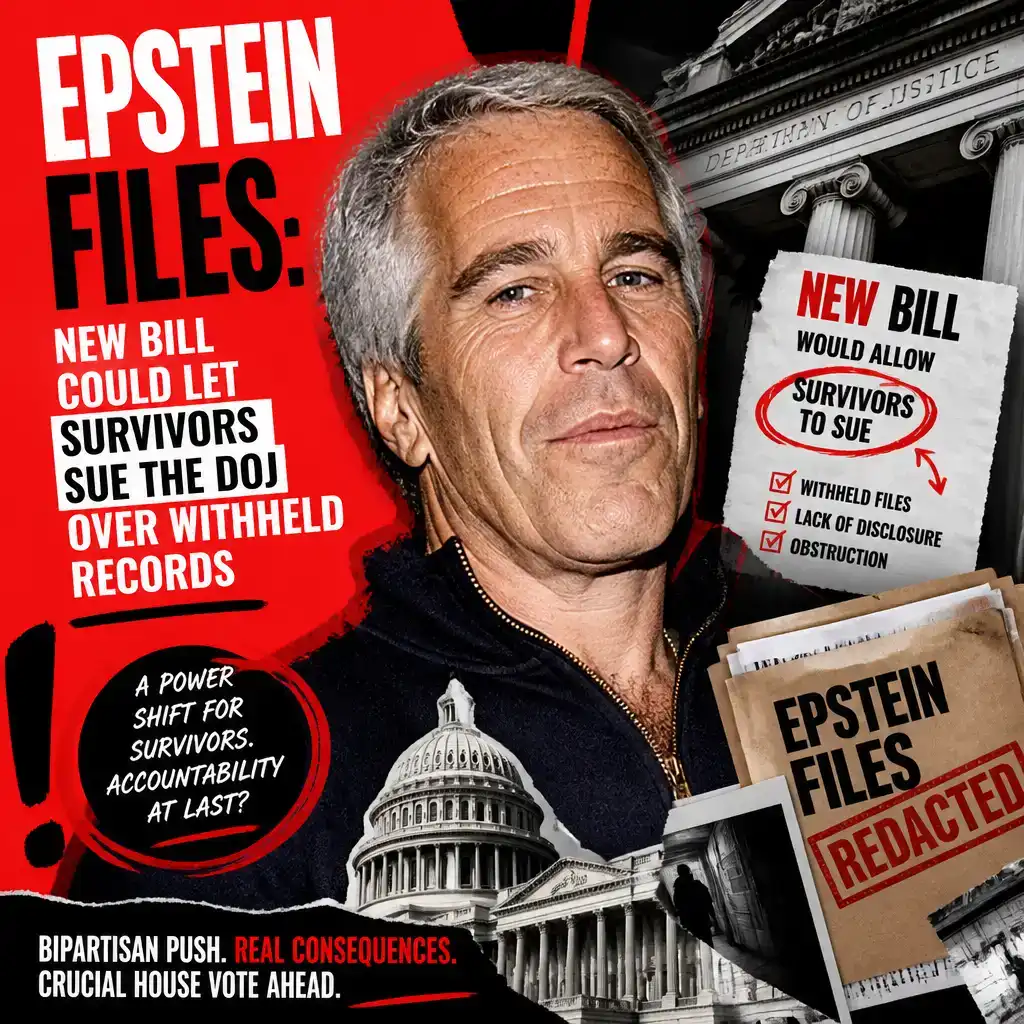
Republican Congressman Thomas Massie says he expects to secure enough support next week to force a House vote on legislation that would allow survivors of Jeffrey Epstein's abuse to challenge the Justice Department over withheld investigative records.
But there is an important distinction between what Massie has announced and what has actually happened: the 218 signatures needed to trigger the next stage of the congressional process have not yet been formally secured.
In a November 5 statement, the Kentucky representative said he anticipated reaching the threshold when lawmakers return to Washington following the midterm elections.
The official House Clerk's register currently records 216 signatures on Massie's discharge petition, leaving the effort two short of the required number.
The distinction matters because the legislation, known as the Epstein Files Transparency Act II, would create new legal mechanisms for survivors and state authorities to challenge the federal government's handling of records connected to Epstein.
What the Epstein Files Transparency Act II would actually change
Introduced on July 15, 2026, by Massie alongside Democratic Representatives Ro Khanna and Teresa Leger Fernández, H.R. 9694 is designed to strengthen enforcement of the original Epstein Files Transparency Act, signed into law by President Donald Trump on November 19, 2025.
Rather than simply ordering another release of documents, the proposal would give survivors, state attorneys general, district attorneys and certain other officials an explicit legal route to challenge alleged failures to disclose records.
Survivors would be able to request unredacted investigative materials relating to themselves, including relevant FBI interview reports, while retaining protections for the personal information of other victims.
The bill would also allow qualifying individuals and officials to bring civil actions against the US Attorney General over allegedly unlawful withholding, excessive redactions, delays or concealment of records. Courts would be directed to expedite those proceedings where practicable.
For state prosecutors, the proposal addresses another obstacle: access to federal evidence that could be relevant to investigations or prosecutions within their jurisdictions.
Under its provisions, authorised state and local prosecutors could obtain relevant unredacted records for investigative and judicial purposes, with additional safeguards governing sensitive or classified information.
The bill would not automatically prosecute Epstein's alleged associates or establish anyone's criminal liability. Its purpose is to improve access to potential evidence and strengthen the mechanisms available to enforce existing disclosure requirements.
Why lawmakers are challenging the Justice Department
The dispute centres on whether the Department of Justice has fully complied with the first Epstein Files Transparency Act.
In January 2026, the Justice Department announced that it had published nearly 3.5 million pages of Epstein-related material, including millions of pages released that month.
The department maintained that its disclosures complied with the legislation, explaining that material not produced included duplicate records, documents covered by legal privileges and information falling within statutory exceptions.
Massie and other critics dispute that assessment, arguing that substantial amounts of material have been improperly withheld or redacted.
The disagreement has also drawn intervention from state law enforcement officials. On October 15, New York Attorney General Letitia James joined a coalition of 16 other attorneys general urging Congress to pass the second transparency bill.
The coalition argued that access to federal investigative records is important not only for public accountability but also for state authorities seeking to investigate potential offences and for survivors attempting to obtain information about their own cases.
The central disagreement is therefore no longer simply how many Epstein-related documents have been published. It is whether the government has met its legal obligations and what remedies should be available when that compliance is challenged.
Does reaching 218 signatures guarantee a vote?
Massie's strategy relies on a congressional procedure known as a discharge petition, which enables lawmakers to pursue consideration of legislation without the cooperation of House leadership or the relevant committee.
His current petition, filed on August 31, targets a procedural resolution, H.Res. 1430.
Reaching 218 signatures would represent a major procedural breakthrough, but it would not automatically produce an immediate vote on the Epstein Files Transparency Act II.
Under House discharge rules, additional legislative days and procedural steps are generally required before a discharge motion can be considered. The House would then have to approve the relevant measures before the underlying legislation could advance.
Even successful passage through the House would not make the proposal law. Senate approval and presidential action would still be required.
For now, the next verifiable milestone is straightforward: whether Massie can obtain the two additional signatures needed to reach the threshold when Congress returns.
Until then, the proposed legal rights for Epstein survivors and additional disclosure mechanisms for state prosecutors remain legislative proposals, not enforceable provisions of federal law.