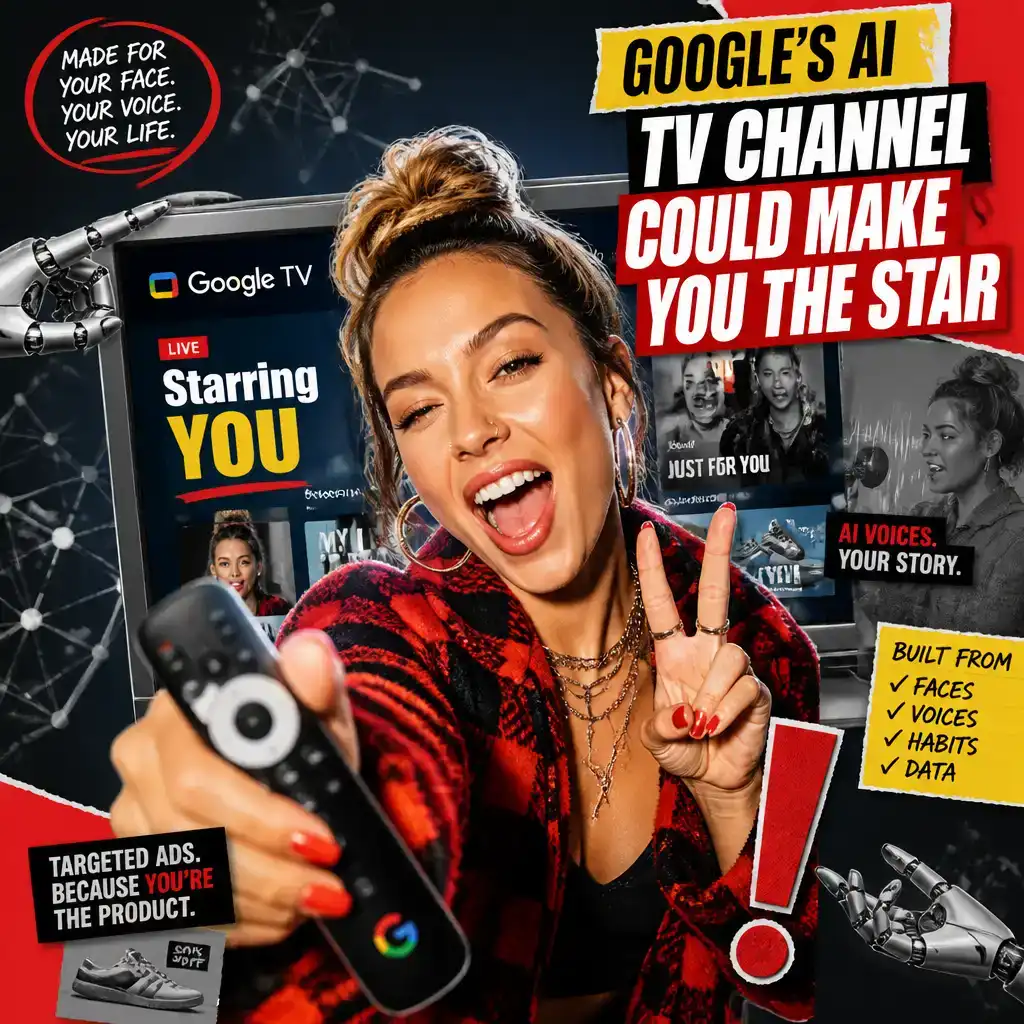
A Google AI TV channel could generate shows specifically for each viewer, then place that person’s face and voice at the center of the action. The idea appears in a patent application for “My Channel,” a proposed feed that would use viewing habits, location, language and demographic information to decide what entertainment to create. Apparently, merely watching television was not personal enough.
The application, titled “Creating a Channel of Video Experiences Tailored to a User,” was filed on May 13, 2025, and published by the United States Patent and Trademark Office on November 19, 2026. Google has not announced a product, confirmed testing or said that the feature will ever reach viewers.
How would Google’s My Channel work?
The filing describes My Channel as a feature inside a television app. Instead of recommending an existing film or series, as Netflix and YouTube already do, the system could generate original videos around an individual viewer.
Possible inputs include:
- Viewing history
- Location
- Language preferences
- Demographic information
- Photographs and voice data
- Current news, sports results and social-media trends
Those details could shape the genre, setting, characters and storyline. Images supplied to the service could help create a digital version of the viewer, while voice technology could make that avatar sound like them.
One example concerns a person who recently watched cricket highlights. The system might place that viewer in the stands at the Cricket World Cup or generate an interaction with a favorite player. Other examples suggest romantic comedies, science-fiction stories and different forms of personalized entertainment.
The content would not always require a fresh request. Google’s proposal includes scheduling options that could create videos weekly, monthly or yearly. It could therefore behave like a television channel, except every program would be made for one person and assembled from their data.
Advertising is part of the proposal
The filing is not just about making viewers the protagonist. It also explains how advertisements could be inserted into generated programming, because even an artificial fantasy apparently requires a commercial break.
The 28-page application is identified as US 2026/0370899 A1, application 19/206,873. It lists inventors Aravind Reddy Ayuluri and Prameela Kavya Thummuru and contains 20 claims. According to PPC Land, three of those claims specifically address advertising.
Tailored commercials could sit alongside videos already shaped by a person’s location, interests and identity. That combination raises questions beyond ordinary recommendation algorithms. A platform would not merely decide what someone might watch. It could build a synthetic version of that person, place it in a fictional setting and surround it with individually selected marketing.
The patent says users could restrict how much information the system collects. Sharing less data would produce more generic content. That offers some control, although it also creates a familiar bargain: provide more personal information for a more customized experience.
No named Google service appears in the filing. It does not say My Channel would belong to Google TV, YouTube, Gemini or the Veo video-generation platform. There is also no evidence in the document that Google has built or tested the proposed system.
Has Google received the patent?
No patent has been granted. Patentlyze, CNET and The Next Web reported that an examiner issued a final rejection of the application. PPC Land described it as pending, but those accounts are not necessarily contradictory. Google can still amend its claims or appeal the decision after a final rejection.
As of November 27, 2026, no later filing, appeal or related product announcement had surfaced. Google also had not publicly responded to questions reported by CNET, Gizmodo and The Next Web.
That distinction matters. Technology companies routinely patent broad ideas without releasing them as products. The application shows what Google sought to protect, not what it has committed to launch. Reports claiming the company plans to introduce My Channel go further than the available evidence supports.
The proposal does, however, show how far personalized video could move beyond conventional recommendations. A system drawing on live news, sports scores and online trends could rapidly turn real events into fictional programming designed for one viewer. That may sound convenient until the personalized story gets the facts wrong, copies a real person or turns a developing news event into entertainment.
Synthetic faces and voices bring familiar problems
Using a viewer’s own likeness may be straightforward when that person knowingly provides photographs and recordings. The harder questions concern other people who could appear in generated scenes, including athletes, performers and public figures. Consent, compensation and impersonation rules have not kept pace with systems capable of producing convincing video and audio at scale.
A separate dispute involving Google illustrates the sensitivity around synthetic voices. Former National Public Radio host David Greene is suing the company over the male voice used by NotebookLM. Greene told The Washington Post he was “completely freaked out” by the resemblance and described hearing it as “this eerie moment where you feel like you’re listening to yourself.” Google denies that the voice is based on him.
My Channel remains a patent concept, but its ingredients already exist: generated video, cloned voices, digital avatars, behavioral profiling and targeted advertising. Combining them would make television more personal in the most literal possible way.
Roku has already launched Fairground AI Creator TV, a round-the-clock channel featuring AI-made shorts from multiple creators. It is materially different from Google’s proposal because it curates programming for a general audience rather than generating a private stream around each viewer.
For now, Google’s version is paperwork rather than programming. If it ever becomes a product, viewers may need to decide whether starring in their own endless television channel is a novelty, a privacy problem or simply a highly elaborate method of serving them another advertisement.