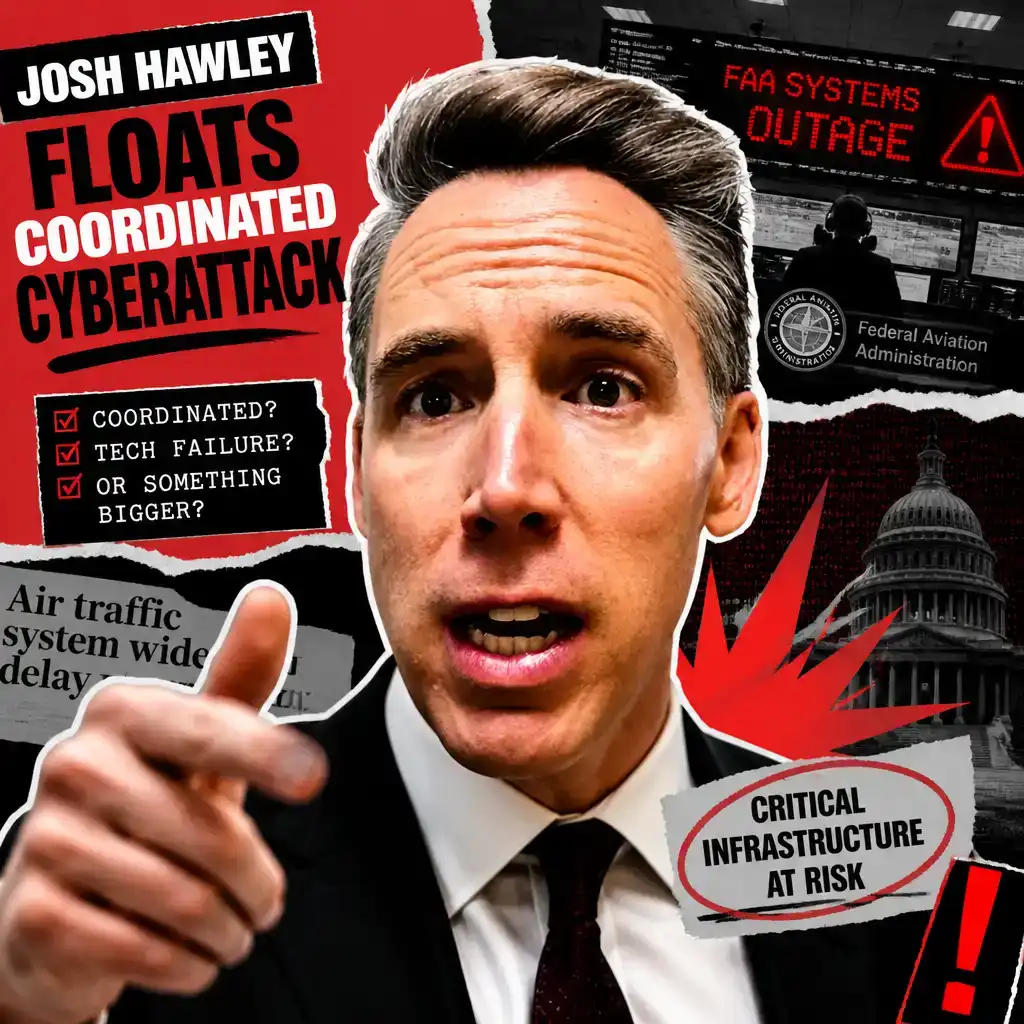
Senator Josh Hawley suspects a coordinated cyberattack may be behind a run of outages affecting US aviation, banking, email and airline systems. So far, however, every available official account says the incidents were unrelated technical failures. The suspicion is dramatic. The evidence has been considerably less cooperative.
Speaking in Washington on Tuesday, November 17, the Missouri Republican said the timing of the disruptions was difficult to dismiss.
“You can’t tell me it’s a coincidence,” Hawley said, explaining that his first thought was that the United States was under attack. “Maybe I’m wrong. I hope I’m wrong.”
What happened during the FAA ground stop?
The most disruptive incident began Friday, November 13, when unstable data affected 17 of the Federal Aviation Administration’s 22 regional air traffic control centers. The agency imposed a nationwide ground stop lasting more than four hours while about 3,500 aircraft already in the air landed safely.
Hawley questioned how one router in Arkansas could disrupt flights across the country. The answer remains incomplete, but the failure appears more complicated than one device simply deciding it had done enough work for the week.
According to the Associated Press, technicians working for contractor L3Harris had installed a new Juniper router while replacing older copper infrastructure in El Dorado, Arkansas. Investigators also identified instability involving a facility in Amarillo, Texas.
The FAA said it found no evidence that an outside actor caused the disruption. Still, identifying failed equipment does not fully explain why the breakdown spread so widely, why backup systems failed to contain it or whether testing during the network conversion was adequate.
Were the other outages connected?
The incidents arrived close together, but officials have offered separate explanations for each one.
- JPMorgan Chase blamed its online banking disruption on a software bug affecting on-premises hardware. The failure delayed some transactions involving other banks and Zelle, showing how one company’s technical problem can quickly become everyone else’s inconvenience.
- United Airlines said it found no indication of a cybersecurity incident after its separate outage, which lasted about 100 minutes. Roughly 600 flights were delayed during the same period, although the Associated Press could not determine how many delays resulted directly from the failure.
- Microsoft attributed its Outlook disruption to a latent code defect, overloaded servers and reduced capacity.
- The FAA has maintained that its nationwide shutdown was not caused by a cyberattack.
Homeland Security Secretary Markwayne Mullin told Fox News that federal cybersecurity officials had examined the events individually and considered them unrelated. He said he was “98% certain” there had been no cyberattack.
No corroborating report has produced evidence linking the failures.
What happened to the NSA’s classified network?
After Hawley’s comments, CNN reported another unsettling outage: NSA Net, the National Security Agency’s classified internal communications network, had gone offline.
Six sources told CNN there was no evidence of a cyberattack. Officials also said urgent intelligence could still reach President Donald Trump despite the interruption. That distinction matters, even if “the classified NSA network is down, but do not worry” is not an especially soothing sentence.
The NSA incident added to the public sense that critical systems were failing in rapid succession. It did not, based on the information released so far, establish a common cause.
Hawley said lawmakers had not received a sufficient briefing and were left with little more information than members of the public reading reports as they appeared. He called for a full investigation and said Trump should press cabinet secretaries for answers.
Why Congress still wants a technical briefing
Senator Maria Cantwell and other Democrats on the Senate Committee on Commerce, Science, and Transportation have demanded a technical briefing from the FAA, L3Harris and Juniper by November 23.
Their letter argued that finding a failed device does not establish why it failed. The lawmakers also pointed to apparently conflicting explanations. The Department of Transportation emphasized aging equipment, while newer Juniper routers appeared to play a central role in the disruption.
Congress wants answers on several points:
- Why instability at a limited number of locations affected most regional control centers
- Whether the replacement work received adequate testing and oversight
- Why redundant systems failed to prevent a nationwide ground stop
- What role L3Harris and Juniper equipment played in the failure
- Whether similar vulnerabilities remain elsewhere in the aviation network
Transportation Secretary Sean Duffy raised his requested funding for air traffic control modernization from $30 billion to $50 billion after the shutdown. New spending may be necessary, but the investigation will also need to determine whether the problem involved old equipment, new equipment, contractor procedures or an especially expensive mixture of all three.
The larger risk is fragile infrastructure
Even without a coordinated attack, the outages exposed a serious national vulnerability. Essential services increasingly depend on tightly connected systems where a single software defect, router failure or capacity problem can spread far beyond its starting point.
The Chase outage affected transactions involving other financial institutions. The FAA disruption reached 17 regional centers. United’s failure disrupted airport operations while Microsoft users dealt with a separate service breakdown. None needs to be connected by an attacker to create widespread confusion.
Hawley warned that uncertainty could discourage people from flying or trigger a run on banks if customers feared losing access to their money. He also urged Americans not to panic, stockpile supplies or otherwise treat the outages as proof of an imminent national emergency.
That leaves two separate questions. Investigators must establish exactly why each system failed, while officials must explain why critical infrastructure appears so vulnerable to isolated faults. The available evidence does not support Hawley’s theory, but the demand for clearer answers is harder to dismiss.