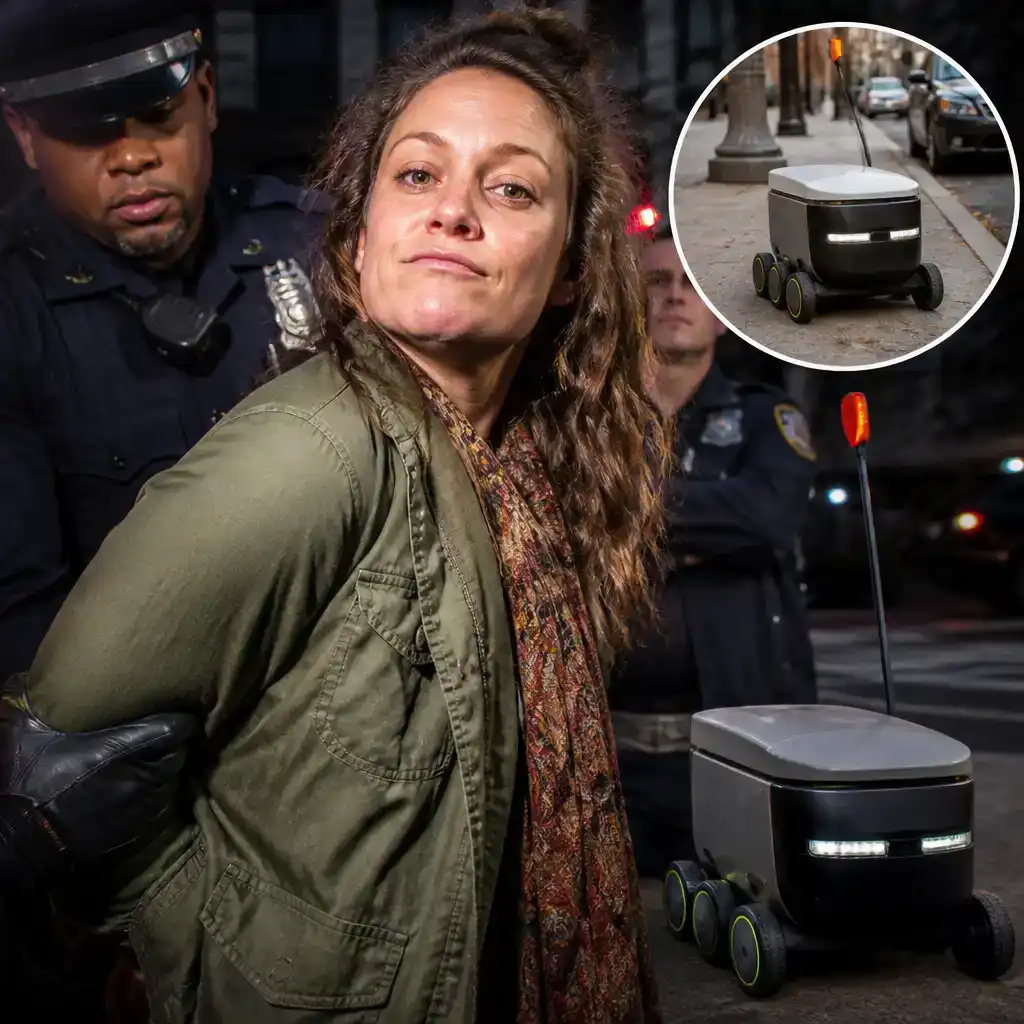
A woman in Philadelphia has been arrested after repeatedly blocking an Uber Eats delivery robot, arguing that the machines are taking jobs away from human workers. But her confrontation with police has also raised an unusual question: what rights do delivery robots actually have on public sidewalks?
Carolyn Marvin was charged with disorderly conduct following an incident near Reading Terminal Market in Center City, where officers said she repeatedly stepped into a robot's path and ignored instructions to move.
According to 6abc Action News, the encounter was captured on video. Marvin subsequently explained that she had been deliberately obstructing delivery robots because she believes they threaten jobs traditionally performed by people.
It was not her first confrontation with the technology. Marvin said she had protested against robots on previous occasions, including an incident on Broad Street in September.
She believes blocking delivery robots is her constitutional right
Despite her arrest, Marvin told Action News that she intends to continue protesting, maintaining that her actions are protected by the First Amendment.
"I think it's my First Amendment right to publicly demonstrate on a sidewalk to protest against delivery robots," she said.
Her position introduces an important distinction. Marvin argues that she is exercising her right to protest, while police say she repeatedly obstructed the robot and disregarded officers' instructions.
The disorderly conduct charge does not, by itself, establish whether her particular form of protest was constitutionally protected. That question would require consideration of the circumstances and applicable law.
Philadelphia's delivery robots have a surprising legal status
There is another complication: under Pennsylvania law, authorised delivery robots are actually classified as pedestrians.
According to the Pennsylvania Department of Transportation, these machines are generally permitted to travel on sidewalks and other pedestrian areas, subject to operating requirements.
However, the rules contain a significant qualification. Delivery robots must yield the right of way to human pedestrians and cyclists in pedestrian areas.
That requirement does not automatically establish a right to deliberately obstruct a robot indefinitely, nor does a robot's legal pedestrian status settle the circumstances of Marvin's arrest.
PennDOT's official register also confirms that Avride, Uber Eats' autonomous delivery partner, received authorisation for Phase 2 operations in Philadelphia on September 23, 2026. This phase permits remotely monitored operation, with human operators able to intervene when necessary.
Are Uber Eats robots really replacing human delivery workers?
Marvin's central concern is employment, and Philadelphia's rollout provides some context for that debate.
Uber Eats launched robot deliveries in the city in March 2026 through its partnership with Avride. By May, the programme had expanded considerably.
An investigation by The Philadelphia Inquirer found that restaurants within the designated operating zone were receiving robot pickups even when some owners did not recall joining the programme.
The newspaper also reported that customers could opt out of autonomous delivery and that Uber had previously maintained the robots were not intended to replace human couriers.
However, the available reporting does not establish how many delivery jobs, if any, have been eliminated as a direct result of Philadelphia's robot rollout. Marvin's concern about displacement is therefore distinct from a verified finding that workers have already lost their jobs.
What is established is that automated deliveries have expanded beyond the initial pilot, bringing robots into everyday interactions with restaurant staff, customers and pedestrians.
For Marvin, the arrest has apparently done little to change her position. She told Action News that she plans to keep protesting, leaving open the possibility of further confrontations as the machines continue operating across Center City.