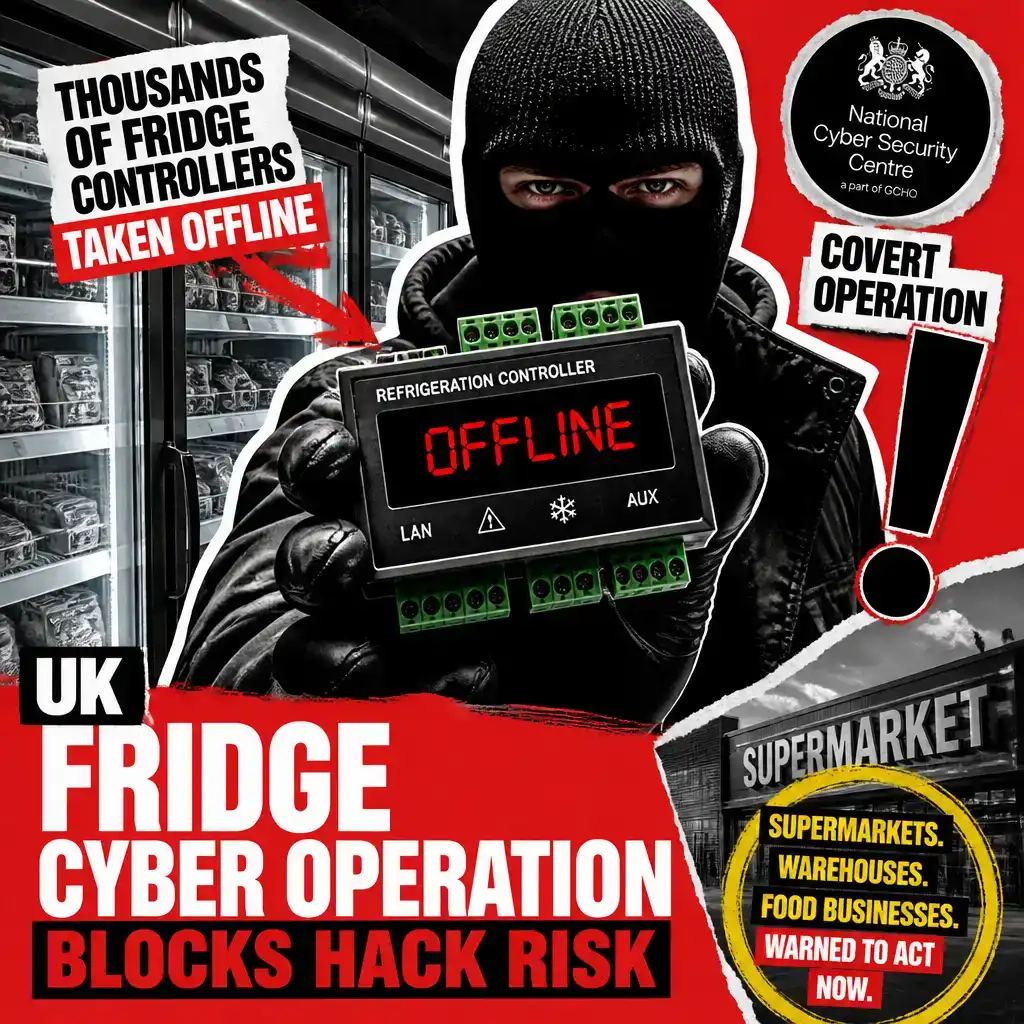
A UK fridge cyber operation quietly secured tens of thousands of refrigerators and freezers after researchers found a weakness that hackers could potentially exploit. The equipment was spread across supermarkets, warehouses, restaurants, petrol stations, hotels and stadiums, giving the issue rather more consequence than the average malfunctioning kitchen appliance.
The operation began after ethical hackers identified the flaw in late October. Security specialists, government agencies and company IT teams then spent weeks warning businesses and removing exposed controllers from the public internet. Reporting on the effort was delayed to avoid giving attackers a useful technical prompt while the work continued.
Why refrigeration systems became a target
Cyberattacks against refrigeration temperature controllers have already caused serious disruption elsewhere. Recent incidents in Europe spoiled tonnes of food across hundreds of stores and produced losses running into millions of pounds.
France blamed Iran for one wave of attacks affecting French supermarkets. Tehran denied responsibility.
Britain initially appeared to have avoided the damage because much of its refrigeration industry uses different control equipment. That reassurance did not last. Researchers examining systems widely used in the UK found a potential vulnerability that could have allowed attackers to interfere with temperatures and cause extensive food losses.
Three major waves of refrigeration attacks had raised concern during the year:
- In August, refrigerators at a small number of United States military bases were affected.
- On 11 and 12 October, hundreds of supermarkets and food-processing sites in France were hit through Danfoss temperature control systems.
- On 1 and 2 November, dozens of supermarkets in seven European countries were targeted. Belgium and Luxembourg suffered the greatest impact, while a small number of French blood bank sites were also affected.
Those incidents prompted an expert at cybersecurity firm Omega Solutions to inspect controllers commonly used in Britain.
How investigators found the UK weakness
Omega Solutions discovered the initial security problem in equipment made by British company Resource Data Management, known as RDM. Specialists at Pen Test Partners then verified the findings, expanded the research and helped alert the authorities.
The National Cyber Security Centre, the Department for Environment, Food and Rural Affairs and the Food Standards Agency joined the response. Officials arranged industry conference calls and assigned teams to contact businesses believed to be at risk.
Ken Munro of Pen Test Partners said the controllers had a weak-password issue similar to weaknesses found in Danfoss and other systems attacked abroad.
“These popular controllers had a similar weak password problem to the Danfoss and other controllers that were attacked so successfully in previous hacks, so we had to get the message out as soon as possible and keep it secret,” Munro said.
He warned that heightened interest in refrigeration systems meant criminals or state-backed hackers could have discovered the same route within days.
What supermarkets and other businesses had to do
Thousands of internet-connected controllers, responsible for tens of thousands of refrigeration units, were removed from the open internet. Some could be secured remotely. Others required staff to physically unplug network cables and monitor temperatures manually, a technological solution with the timeless elegance of disconnecting the machine.
Most major UK supermarkets reportedly redirected IT staff to handle the threat. An employee at one large chain said teams took hundreds of devices offline each day for roughly a week.
“It did feel like a race against time as we were expecting another wave of these fridge hacks to come,” said the worker, who asked not to be identified.
The employee said an attack could have caused severe business interruption and supply chain problems. Warehouses held food worth millions of pounds, all of which could have been spoiled if attackers had found and exploited the weakness.
Warnings extended well beyond large supermarkets. Businesses and sites advised to take precautions included:
- Convenience stores and petrol stations
- Restaurants and fast-food chains
- Sports arenas and hotels
- Food-processing plants
- Cold-storage facilities
The potential impact was therefore not limited to warm ice cream and disappointed shoppers. A successful attack could have affected national food distribution, commercial storage and, depending on the site, temperature-sensitive medical supplies.
RDM disputes how serious the flaw was
Resource Data Management challenged the description of the vulnerabilities as critical. The company argued that comparisons with controllers attacked in mainland Europe were unfair because compromising its systems would have required access to a specific piece of hardware.
The researchers said that obstacle was manageable because the required equipment could be bought cheaply through online marketplaces such as eBay.
RDM chief executive Ged Evans said the vulnerability was identified in a test environment. He added that the researchers went beyond a conventional assessment by dismantling the company’s hardware.
“In any event we have acted at pace to address this issue and have already deployed first patch releases and have been in proactive contact with our customers to flag any issues and recommend mitigatory steps,” Evans said.
Despite disputing the severity, RDM was praised for responding professionally and quickly. The company issued initial software patches, contacted customers and continued working with the National Cyber Security Centre and other authorities.
RDM said it had found no evidence that attackers had compromised its controllers. The operation was preventive, rather than a response to confirmed damage in Britain. That distinction matters: tens of thousands of cooling units were secured before anyone had the opportunity to discover how expensive a few altered temperature settings could become.