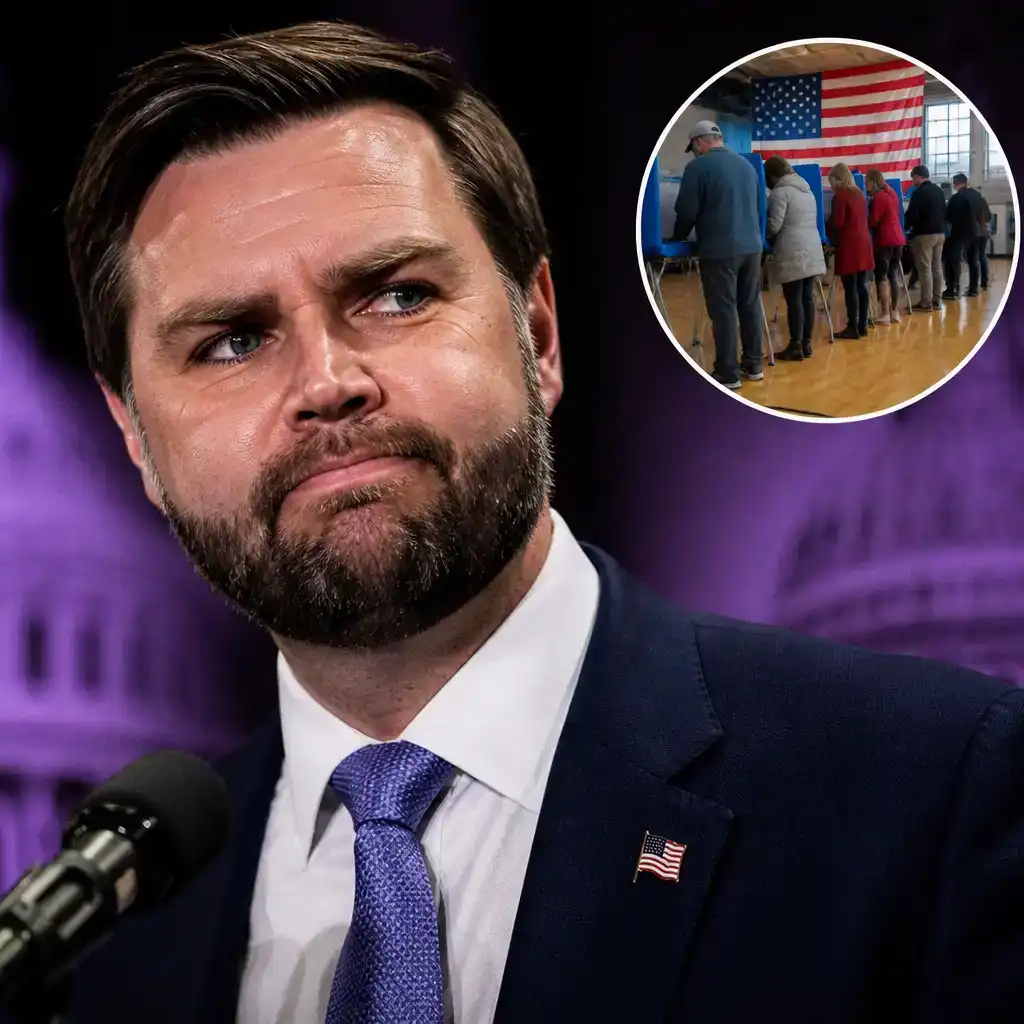
Vice President JD Vance asked Americans to give Republicans "another chance" ahead of the 2026 midterm elections. Less than two months later, voters have delivered an answer that could reshape the remainder of Donald Trump's presidency.
Democrats won control of both the House of Representatives and the Senate in the November 3 elections, according to projections reported by the Associated Press and Reuters. The result ends Republican control of Congress and leaves the Trump administration facing a significantly more difficult political landscape.
It also gives new significance to a remark Vance made during a September 15 appearance on the All-In Podcast, when he was asked to explain why voters should keep Republicans in power.
"Give us another chance," Vance said, before immediately adjusting his appeal to ask for another couple of years to continue the administration's work.
The wording attracted criticism at the time because Republicans already controlled the White House and both chambers of Congress. But the full exchange reveals a more specific argument than the isolated clip suggested.
What JD Vance Actually Said Before the Election
Speaking with podcast co-host Chamath Palihapitiya, Vance defended the administration's record on immigration enforcement, tax policy and its proposed changes to the H-1B visa programme.
He acknowledged that significant work remained unfinished and argued that handing Congress to Democrats would undermine Republican efforts to address problems the administration claimed to have inherited.
His appeal was therefore less a concession of failure than an argument for additional time. Vance wanted voters to judge Republicans on what he described as progress rather than demand that every campaign promise had already been fulfilled.
He also attacked Democrats, portraying the opposition as politically extreme and arguing that Republicans represented a more sensible alternative.
That distinction matters. Although the phrase "another chance" sounded unusually defensive for a sitting administration, the recording does not establish that Vance intended to admit Republican policies had failed.
The Midterm Results Have Changed the Political Equation
The November election has now placed Vance's September argument in a different context.
According to Associated Press reporting, Democrats captured at least seven Republican-held Senate seats, including victories in Texas, Iowa, Kansas and South Carolina. They also gained more than two dozen House seats, securing control of both chambers.
The results indicate that the administration's argument for continuity failed to persuade enough voters to preserve Republican congressional majorities.
Economic concerns were particularly significant. Reuters reported that dissatisfaction with living costs, the war with Iran and concerns about government corruption contributed to Democratic victories across traditionally Republican territory.
Voter polling also pointed to demand for greater congressional oversight of the president. Reuters reported that approximately 70% of surveyed voters wanted Congress to provide stronger checks on presidential power.
The findings do not establish that voters rejected Vance's specific comments. They do, however, demonstrate the broader political pressures facing an administration that had asked for more time to deliver its agenda.
What Happens to Trump's Agenda Now?
The consequences extend beyond an embarrassing comparison between a campaign statement and an election result.
When the newly elected Congress convenes in January 2027, Democratic majorities will be positioned to block Republican legislation, scrutinise administration decisions and exercise oversight powers that were considerably less confrontational under unified Republican government.
Democratic control of the Senate will also complicate the confirmation of presidential nominees, potentially limiting Trump's ability to advance important appointments during the final two years of his presidency.
Trump has acknowledged Democratic victories while rejecting the suggestion that the results represent a personal repudiation of his leadership.
For Vance, the contrast is especially striking. His September appeal was built around the argument that Republicans needed another two years to complete their work. The voters have instead chosen a Congress with the power to challenge how that work proceeds.
The original remark was not a prediction of defeat or an admission that the administration had failed. But with Republicans now facing divided government, the political question behind Vance's request has received an unmistakable electoral answer.