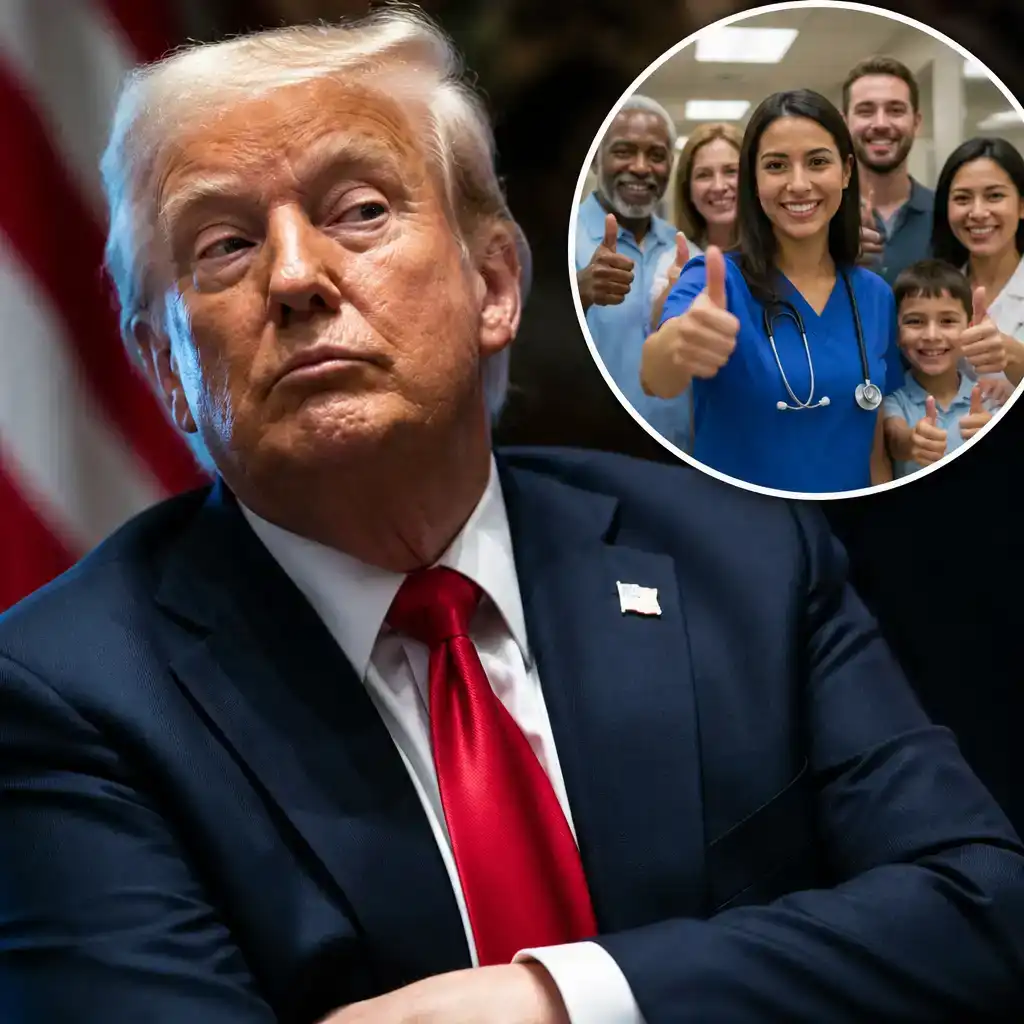
Donald Trump's warning about a healthcare system "where everybody gets health care" is making the rounds again. But a new poll has revealed something rather more complicated about what Americans actually want from their health insurance.
According to research published by KFF in October 2026, 66% of US adults now support Medicare-for-all, a proposal that would replace most existing health insurance with a single government-run plan. Yet a majority of privately insured Americans also believe they would be able to keep their current coverage under such a system.
That contradiction adds a new dimension to remarks Trump made more than two years ago, during his 2024 presidential campaign against Kamala Harris.
What Trump actually said about universal healthcare
Speaking at his Bedminster golf club in New Jersey on August 15, 2024, Trump warned that a Harris presidency would eliminate private health insurance and force Americans into a government-controlled system.
"You're all going to be thrown into a communist system," he told reporters, before describing a system "where everybody gets health care."
According to the full transcript of his press conference, Trump also claimed that patients could face waits of up to a year to see a doctor and would lose the freedom to purchase more comprehensive private insurance.
The surrounding comments are important. Trump was not simply objecting to everyone receiving medical care. He was attacking what he claimed would be the consequences of Harris's healthcare policies.
However, his description did not accurately reflect the position her campaign had adopted by August 2024.
Harris had previously supported Medicare-for-all, including legislation associated with Senator Bernie Sanders. But her position had evolved. Her own 2019 healthcare proposal retained a role for private insurers, and her 2024 campaign subsequently confirmed that she would not pursue a single-payer system as president, as CNN reported at the time.
Most Americans now support Medicare-for-all, but there is a catch
The political landscape looks different in 2026.
A KFF Health Tracking Poll, conducted between September 16 and 21, found that 66% of Americans favor a national health plan under which everyone receives insurance from a single government programme.
That represents an increase from 53% in October 2020 and the highest level of support KFF has recorded for the proposal.
Support includes 84% of Democrats and 72% of independents, although 66% of Republicans oppose the idea.
Yet the findings become considerably less straightforward when people are asked about the possible consequences.
When respondents were presented with the possibility of longer waits for medical treatment, opposition to Medicare-for-all rose to 76%. When told it could increase taxes, 64% opposed it.
Conversely, 75% supported the proposal when presented with the possibility of eliminating insurance premiums and out-of-pocket costs.
These figures measure reactions to potential consequences, not evidence that any particular healthcare proposal would necessarily deliver those outcomes.
Perhaps the most revealing finding concerns private insurance. KFF discovered that 57% of Americans who currently have private coverage believe they would probably be allowed to keep their existing plans under Medicare-for-all.
In reality, most conventional single-payer proposals would replace much of the current private insurance system with government coverage. Universal healthcare more broadly, however, does not necessarily require eliminating private insurers.
This distinction matters because protecting private insurance was central to Trump's original warning, while many Americans supporting Medicare-for-all appear to have different expectations about how such a transition would work.
Healthcare costs are becoming a major election issue
The renewed interest comes ahead of the November 3, 2026 midterm elections, with healthcare affordability emerging as a significant concern for voters.
In the same KFF survey, 60% of registered voters said they were worried about affording healthcare for themselves and their families.
The survey also found that 42% trusted Democrats more to address healthcare costs, compared with 22% who trusted Republicans.
Democrats have made reversing Medicaid cuts and addressing insurance costs part of their midterm agenda, although support for those policies should not be confused with support for replacing the entire insurance system.
Trump's 2024 remarks were a warning about what he believed a rival administration would do. The 2026 polling highlights a separate problem: Americans increasingly support changing their healthcare system, but their expectations about costs, waiting times and private insurance remain sharply divided.