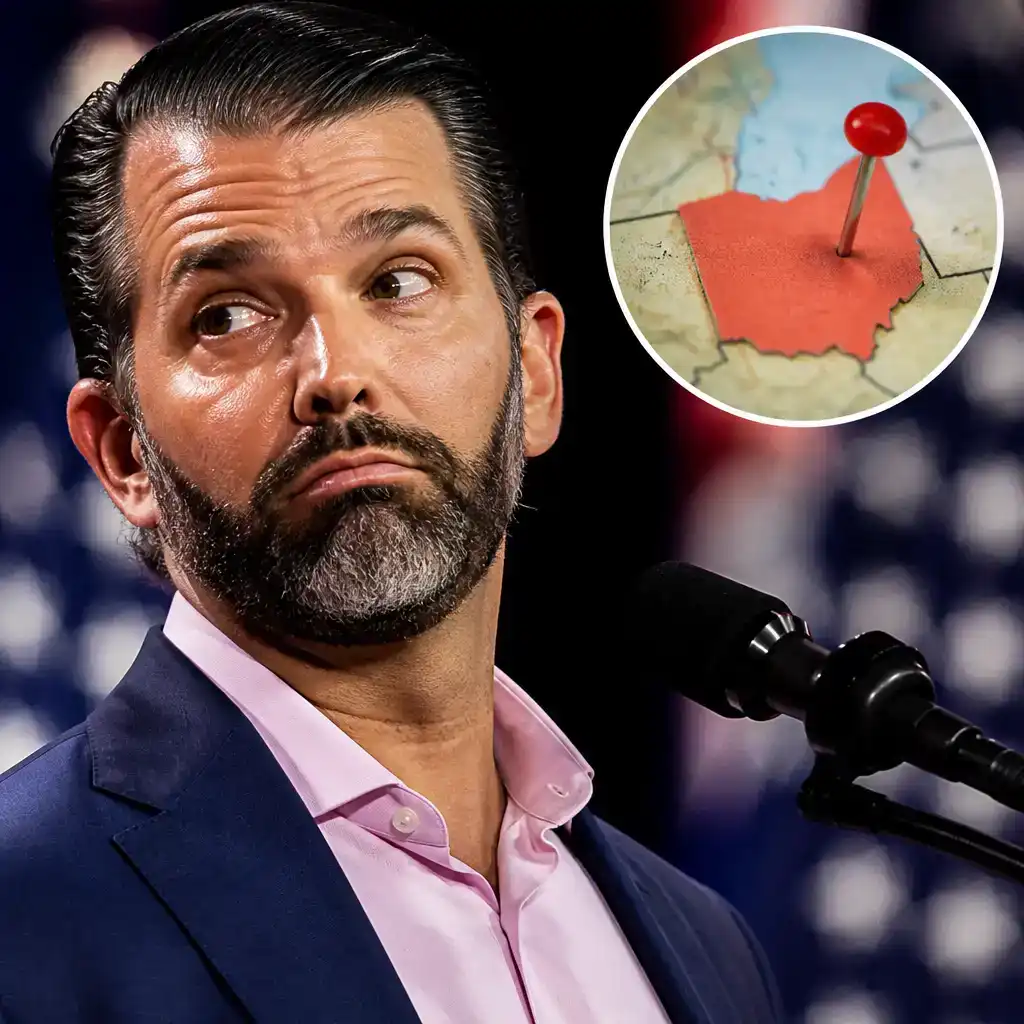
Donald Trump Jr. made an awkward geographical slip during a campaign rally in Ohio on Monday, November 2, warning voters that Democrats wanted to turn their state into something it has already been for more than two centuries.
Speaking at Eugene F. Kranz Toledo Express Airport in Swanton, alongside Vice President JD Vance, the president's eldest son was outlining what he portrayed as the Democratic Party's political ambitions ahead of the November 3 midterm elections.
"They want to pack the Supreme Court. They want to make Ohio a state, make D.C. a state," Trump Jr. told the crowd, before continuing his criticism of Democrats and their supposed pursuit of permanent political control.
There was one fairly significant problem with that warning: Ohio became the 17th state to join the United States in 1803.
The remark quickly attracted attention online, with critics highlighting the geographical mistake. But the fuller statement provides an important distinction: Trump Jr. immediately mentioned Washington, D.C., suggesting the reference to Ohio was a verbal slip rather than a serious claim about the state's constitutional status.
Ohio's statehood has been settled for more than 220 years
According to the U.S. National Archives, Congress recognised Ohio as a state on February 19, 1803, although March 1 is celebrated as its official statehood date.
That distinction has its own unusual history. In 1953, Congress formally established March 1, 1803, as Ohio's admission date, recognising when the state's first legislature convened.
In other words, Ohio's place in the Union was settled long before the modern Democratic and Republican parties began competing over its electoral votes.
What Donald Trump Jr. was apparently trying to say
The reference to Washington, D.C., offers the clearest explanation for the mistake.
Unlike Ohio, the nation's capital is not a state. Its residents pay federal taxes but do not have voting representation in the House of Representatives or the Senate, a longstanding issue at the centre of the statehood debate.
Democratic lawmakers have repeatedly supported legislation to make Washington, D.C., the 51st state. The proposal remains a genuine political issue, with Democratic delegate Eleanor Holmes Norton continuing to advocate for the Washington, D.C. Admission Act in 2026.
Supporters argue that statehood would give District residents full congressional representation and greater control over local government. Opponents, including many Republicans, have challenged the proposal on constitutional and political grounds.
Trump Jr.'s criticism of Democratic ambitions therefore concerned an actual policy debate, even if he briefly included a state that joined the Union 223 years ago.
The timing made the mistake particularly conspicuous. Trump Jr. was campaigning alongside Vance on the eve of closely watched Ohio elections, including the gubernatorial contest between Republican Vivek Ramaswamy and Democrat Amy Acton.
Rather than revealing a new position on Ohio's status, the remark illustrated how a few misplaced words can overshadow a campaign message. The full rally coverage from local broadcaster 13 Action News provides the broader setting for the speech.