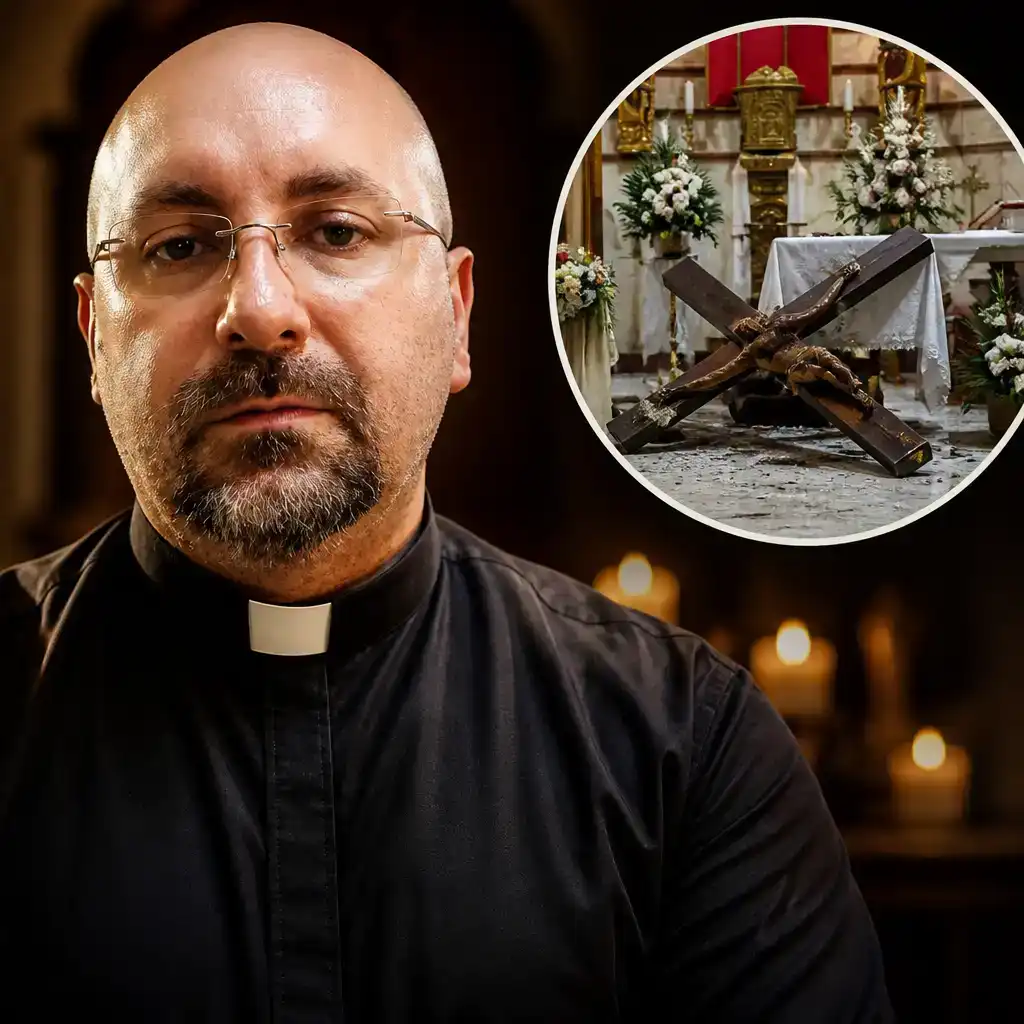
A falling crucifix killed a priest during Mass in Guayaquil, Ecuador, on October 17, turning a weekly service into a fatal incident watched both by the congregation and people following a social media livestream.
Father Patricio Sánchez Molinari, 52, was celebrating Mass at Nuestra Señora del Perpetuo Socorro, also known as Our Lady of Perpetual Help, when the heavy wooden cross detached from the wall behind the altar. It struck him directly on the head and trapped him underneath.
Congregants screamed and called for an ambulance as others tried to help. The livestream was cut shortly after the impact.
What happened inside the Guayaquil church?
The cross fell roughly 30 minutes into the service while Sánchez Molinari stood at the altar. The Associated Press, EFE and several Ecuadorian outlets confirmed that the crucifix detached during the livestream and struck the priest while he was celebrating Mass.
Reports differ on precisely when he died. Early accounts said emergency workers took him to hospital, where he was later pronounced dead. El Comercio reported that he died at the church. A witness quoted by El Universo said the ambulance arrived around 30 minutes after the accident and that Sánchez Molinari was already dead.
The Archdiocese of Guayaquil confirmed his death without settling that timeline.
“We announce that our beloved Father Patricio Alfredo Sánchez Molinari, who served as parish priest of the Perpetual Help church in the Central Vicariate, has departed to the Father’s House to enjoy His presence and His glory,” it said.
Earlier in the service, the priest had reflected on mortality, telling worshippers that “all of us, who are here, are going to die too.” The coincidence is stark, although it offers no explanation for the accident itself.
Why did the crucifix fall from the wall?
As of October 19, neither church officials nor public authorities had issued a formal explanation for the fixture’s failure.
The original description of the cross as being nailed to the wall has not been supported by later reporting. Parishioner Carmen Morán told El Universo that it appeared to have been secured with two bolts and that one had come loose. Her account has not been confirmed by an official inspection or technical report.
That leaves several basic questions unanswered:
- When was the crucifix installed?
- How heavy was it, and what fixings supported it?
- When was the wall fixture last inspected?
- Were other heavy objects inside the church checked after the accident?
A large wooden cross mounted directly above an occupied altar is not a minor decorative detail. The absence of a public explanation also prevents parishioners from knowing whether the failure was isolated or reflected a broader maintenance problem.
No criminal allegation has been reported, and authorities have not publicly assigned responsibility. For now, the central fact is painfully simple: a heavy fixture detached above a place where someone routinely stood, and the safety system meant to keep it there failed.
Who was Father Patricio Sánchez Molinari?
Sánchez Molinari was born in Cuenca in 1973. He had marked 15 years as a priest on October 16, just one day before his death.
He belonged to the Congregation of the Most Holy Redeemer, commonly known as the Redemptorists. The Catholic missionary congregation was founded in 1732 and has operated in Ecuador since 1870.
Before serving in Guayaquil, Sánchez Molinari spent several years at San Lorenzo parish in Vinces. Parishioners remembered him as humble, approachable and particularly close to young people. They also described a priest who visited sick residents and supported local schools.
Alexandra, a member of the congregation, told El Universo that he had helped defend nearby shelters threatened with demolition. That community work formed a large part of the tributes after his death, which focused less on the extraordinary manner of the accident and more on the ordinary assistance he provided over many years.
Auxiliary Bishop John Kwamevi Cudjoe said Sánchez Molinari “lived doing good and died giving everything.”
How did the parish commemorate him?
Two memorial Masses were held at Nuestra Señora del Perpetuo Socorro on October 18, with Sánchez Molinari’s coffin placed before the altar. Clergy, parishioners and residents attended to pay tribute.
His family requested that his body be transferred to Cuenca, his birthplace. A novena was scheduled to begin on October 19, followed by a funeral ceremony at Camposanto Santa Ana at 3 p.m. on October 20 and burial afterward.
The memorials gave the parish a formal way to mourn. They did not answer how the crucifix came loose or whether the accident could have been prevented.
Those questions now sit with church administrators and any authorities examining the building. Grief may explain why answers take time, but it does not make inspection records, mounting hardware or maintenance responsibilities less relevant. A congregation should not need to consider the structural reliability of the objects above the altar while attending Mass.