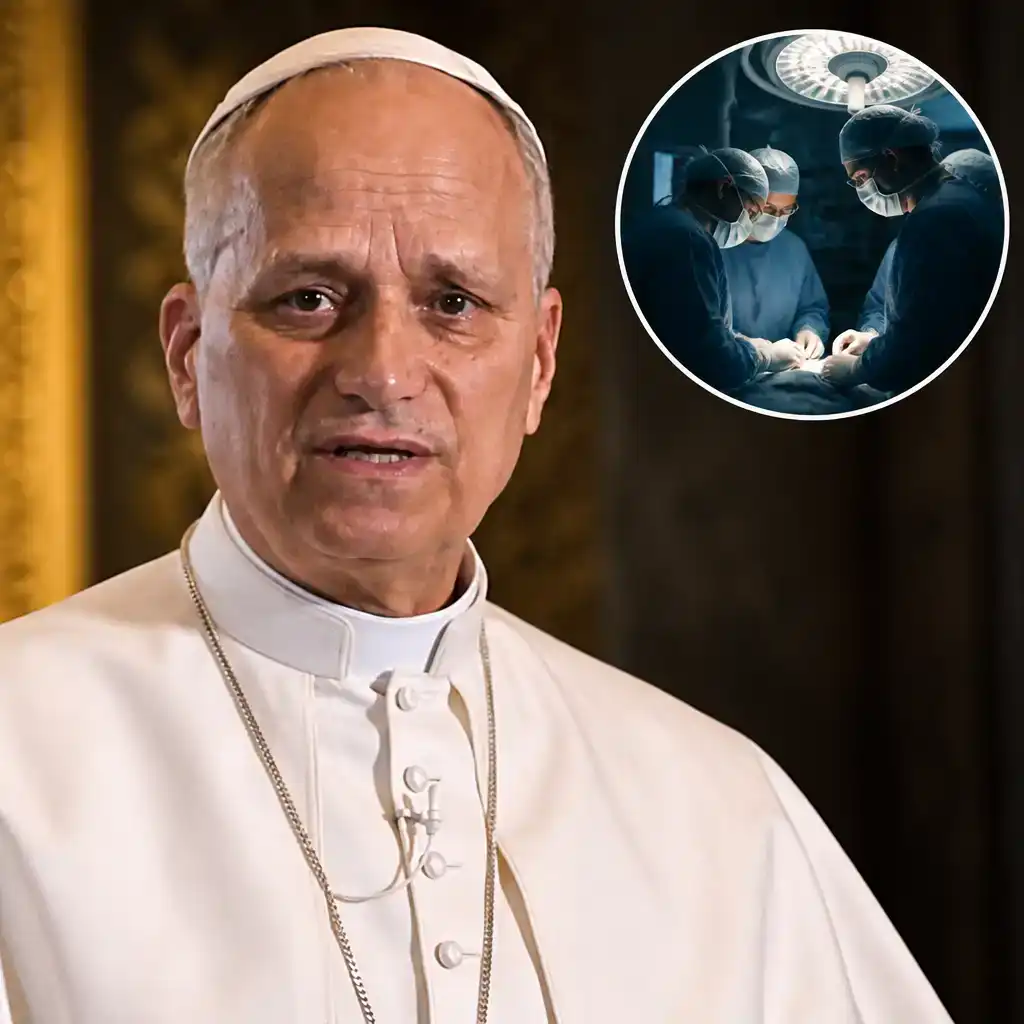
Pope Leo XIV's lung cancer surgery was successful and free of complications, according to the Vatican, but doctors are still waiting for results that will determine the full diagnosis and whether he needs further treatment.
The 71-year-old pontiff underwent the operation at Rome’s Gemelli Hospital on October 13 after routine examinations detected a growth in his right lung. An examination during surgery confirmed pulmonary adenocarcinoma, a type of non-small-cell lung cancer.
Surgeons removed the lower lobe of Leo’s right lung using a video-assisted technique. The right lung has three lobes, so the procedure removed one of them rather than the entire lung.
How is Pope Leo recovering after surgery?
The Holy See Press Office said Leo passed a “calm” first night in hospital. He woke normally after the anaesthetic, requested dinner and spent the evening with aides, Vatican spokesman Matteo Bruni said.
Leo was in the operating room for about three hours, according to the Associated Press. The surgery itself lasted roughly 90 minutes and was led by Professor Stefano Margaritora and Gemelli Hospital’s thoracic surgery team.
“The surgery was successful, and there were no complications,” the Vatican’s medical bulletin said.
The pope is expected to remain in hospital for about a week. His public engagements have been cancelled until October 20, and that timetable had not changed by October 14.
Before entering the hospital, Leo greeted officials and approached patients. He had completed his scheduled audiences the previous morning, maintaining the Vatican preference for keeping the programme moving until medicine makes that impossible.
What do doctors still need to establish?
Although the operation confirmed adenocarcinoma, the Vatican has not disclosed the cancer’s stage, whether lymph nodes were affected or whether it had spread beyond the lung. Further pathology tests on the removed tissue are pending.
Those findings will shape the next steps. The Holy See has not announced whether Leo will need chemotherapy, radiation treatment or additional care after recovering from surgery.
The American Cancer Society describes lobectomy, the removal of one lung lobe, as a standard treatment for operable early-stage non-small-cell lung cancer. Leo had previously said the growth was “well-contained” and detected early, but that description is not a substitute for final pathology.
US population data put five-year relative survival for localized non-small-cell lung cancer at 67 percent. That falls to 40 percent when the disease has spread regionally and 12 percent after distant spread. Such figures describe large groups and cannot predict one patient’s outcome, including the pope’s. The medical terminology is precise; the individual forecast is not.
When did the Vatican reveal the diagnosis?
Leo publicly announced the lung growth during his Sunday Angelus prayer on October 11. Speaking to people gathered in St Peter’s Square, he said doctors had found it during a check-up and advised him to undergo surgery.
Two days later, surgeons removed the affected lobe. The diagnosis was confirmed during the procedure, making this the first major publicly disclosed health issue of Leo’s papacy since his election in May 2025.
Vatican Secretary of State Cardinal Pietro Parolin described the announcement as a shock and said the pope had shown “great serenity.” US Secretary of State Marco Rubio said he and his wife were “united in prayer” for Leo.
The Vatican’s relatively detailed updates have answered the immediate questions about the operation and recovery. They have not answered the larger ones about staging, follow-up treatment or how quickly Leo can resume a full schedule.
Will the pope’s Latin America trip go ahead?
Leo is scheduled to visit Uruguay, Argentina and Peru from November 6 to 17. The Vatican has not definitively reconfirmed the trip following surgery.
The Associated Press reported that doctors commonly advise patients to avoid flying for three weeks after this type of operation. That would leave little room between Leo’s expected discharge and the start of a demanding international journey.
The final decision is likely to depend on his recovery and pathology results. Even without further treatment, a three-country papal tour involves long flights, public ceremonies and tightly packed meetings. Cancer has not shown much interest in diplomatic calendars.
The operation also briefly highlighted an unresolved issue in Catholic Church law. According to the Associated Press, canon law provides no explicit mechanism for temporarily transferring a living pope’s authority while he is under anaesthesia or otherwise incapacitated.
There is no indication that Leo currently cannot govern. Still, the absence of a formal temporary handover process remains a structural gap, one the Vatican may eventually have to address somewhere between medical bulletins and the next health emergency.